
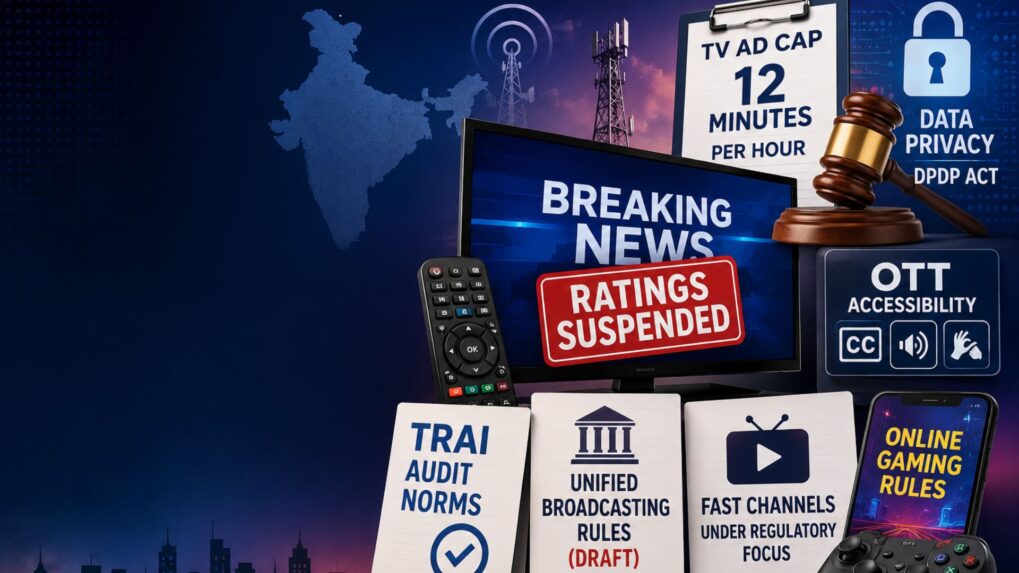
From the unprecedented suspension of television news ratings during the US-Iran conflict to sweeping reforms in audience measurement, accessibility mandates for OTT platforms, tighter audit norms for TV distributors and a proposed overhaul of broadcasting regulations, the first half of 2026 has witnessed one of the busiest policy cycles for India’s media and entertainment industry.
With regulators increasingly focusing on governance, transparency, consumer protection and digital convergence, these developments are expected to influence broadcasters, OTT platforms, distributors, advertisers and gaming companies well beyond this year.
Here’s a comprehensive look at the biggest policy and regulatory updates of 2026 so far:
1. MIB suspends TV news ratings for four weeks amid war coverage concerns
In a first-of-its-kind intervention, the Ministry of Information and Broadcasting (MIB) directed the Broadcast Audience Research Council (BARC) to suspend television ratings for news channels for four weeks initially amid concerns over sensational coverage of the ongoing conflict involving the United States and Iran. The directive has now been extended multiple times.
According to sources, the move was intended to discourage excessive dramatization that could heighten public anxiety and influence editorial priorities. The decision reignited debate over whether television ratings incentivise sensational news coverage and highlighted the government’s willingness to intervene in exceptional circumstances when national interest and responsible broadcasting are at stake.
2. Delhi High Court upholds TRAI’s 12-minute television advertising cap
In a landmark judgment, the Delhi High Court upheld the Telecom Regulatory Authority of India’s (TRAI) long-contested regulation capping television advertising at 12 minutes per clock hour, bringing an end to a legal dispute that had lasted over 13 years. Under the rule, channels can air up to 10 minutes of commercial advertisements and two minutes of self-promotional content every hour. The verdict strengthens TRAI’s regulatory authority and is expected to reshape advertising strategies across television, particularly for news broadcasters and free-to-air channels that remain heavily dependent on advertising revenues.
3. Government strengthens governance norms for television ratings agencies
The MIB amended key provisions of the Television Rating Agencies Policy, 2026, significantly tightening governance standards for television audience measurement agencies. One of the most notable changes mandates that at least 33% of the board of directors must comprise independent directors with no direct or indirect association with broadcasters, advertisers or advertising agencies. The policy also seeks to broaden the scale of television audience measurement across India to improve representation and credibility. The reforms are aimed at strengthening confidence in television ratings by reducing conflicts of interest and reinforcing institutional independence.
4. TV audience measurement aligned with DPDP Act, panel security strengthened
Alongside governance reforms, the government introduced stricter data privacy and panel management requirements for television ratings agencies by aligning the framework with the Digital Personal Data Protection Act, 2023. Rating agencies are now required to maintain strict confidentiality of metered homes and establish privacy mechanisms compliant with India’s data protection framework. The revised policy also mandates deployment of 10% additional metered homes beyond the prescribed sample size and annual replacement of at least 25% of panel homes. These measures are designed to improve data integrity, preserve anonymity and minimise the risk of panel manipulation.
5. MIB proposes unified regulatory framework for broadcasting services
In one of the biggest structural reforms proposed this year, the MIB released the draft Telecommunications (Television, Radio and Associated Services) Rules, 2026, for public consultation. The proposed framework seeks to replace multiple licensing regimes governing television, radio, Direct-to-Home (DTH), Headend-in-the-Sky (HITS), IPTV and community radio with a single regulatory structure under the Telecommunications Act, 2023. If finalised, the rules could simplify licensing, reduce regulatory fragmentation and create a more uniform compliance framework for broadcasting services operating across traditional and digital distribution platforms.
6. TRAI introduces tighter audit framework for TV distributors
TRAI notified amendments to its broadcasting and cable interconnection regulations, introducing a stricter annual audit framework for television channel distributors. The revised rules shift audits from the calendar-year system to a financial-year basis, requiring cable operators, DTH providers, IPTV operators and HITS platforms to complete annual audits of the previous financial year and submit reports to broadcasters by September 30. To standardise compliance, audits must be conducted only by TRAI-empanelled auditors or Broadcast Engineering Consultants India Limited (BECIL). Smaller distributors with up to 30,000 active subscribers have been exempted from the mandatory audit requirement.
7. OTT platforms to roll out accessibility features for persons with disabilities
The MIB introduced detailed accessibility guidelines for OTT platforms to improve content accessibility for audiences with hearing and visual impairments. The framework directs streaming platforms to progressively integrate features such as closed captions, audio descriptions and Indian Sign Language interpretation across their content catalogues. Applicable to OTT publishers as well as their self-regulatory bodies, the guidelines are intended to make digital entertainment more inclusive while encouraging accessibility-by-design in content production and distribution. The move also aligns India’s streaming ecosystem with evolving global accessibility standards.
8. FAST channels and internet-delivered television come under regulatory focus
As Free Ad-Supported Streaming Television (FAST) channels and internet-based linear television continue to gain traction, leading DTH operators, including Tata Play and Dish TV India, urged TRAI to bring Application-based Linear Television Distribution (ALTD) services under the same regulatory framework as traditional television distribution. Industry players have argued that internet-delivered television currently benefits from regulatory arbitrage despite offering similar services. TRAI’s ongoing consultation is expected to play a crucial role in determining how connected TV, FAST channels and app-based television services will be regulated in the future.
9. Draft Online Gaming Rules propose national regulator and registration framework
The Ministry of Electronics and Information Technology (MeitY) released the draft Promotion and Regulation of Online Gaming Rules, 2025, laying the groundwork for a comprehensive regulatory framework under the Online Gaming Act, 2025. The draft proposes the establishment of the Online Gaming Authority of India (OGAI), a public registry for recognised platforms and a structured registration mechanism with five-year validity. It also outlines a split governance model involving MeitY, the Ministry of Youth Affairs and Sports and the MIB, while introducing age-based classification and oversight provisions for different categories of online games.
What’s next?
With half the year still remaining, 2026 has already emerged as one of the most significant years for media regulation in recent memory. Several key developments, including the finalisation of the unified broadcasting rules, TRAI’s recommendations on FAST and application-based television services, implementation of the revised TV Ratings Policy and stakeholder consultations on online gaming, are still underway. As television and digital media continue to converge, the regulatory decisions taken in the coming months are likely to shape the industry’s competitive landscape, compliance obligations and business models for years to come.
First Published on