
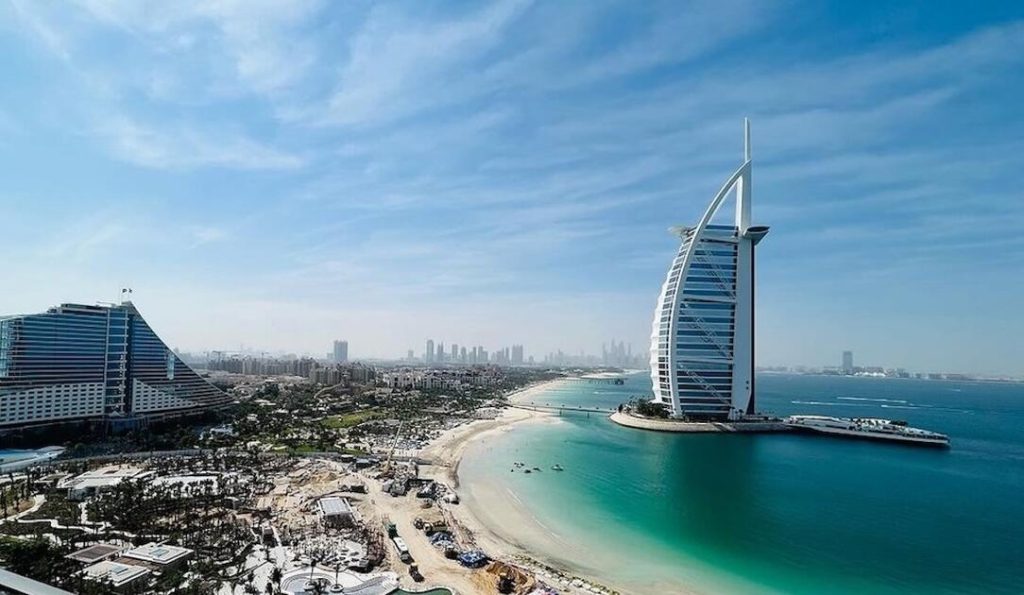
Dubai live — from trading post to mega-city in 50 years
Dubai was founded as a small trading post in 1833 on the coast of the Arabian Gulf. It remained a minor settlement until oil was discovered in 1966 — but Dubai’s oil reserves were limited (unlike Abu Dhabi’s vast reserves). The city’s rulers made a strategic decision: instead of depending solely on oil, transform Dubai into a global trading and tourism hub. The transformation was ruthless and complete. From the 1970s onward, Dubai became a free port, a financial centre, then a real estate and tourism juggernaut. Burj Khalifa (completed 2010, 828m tall, world’s tallest building) represents the culmination of this ambition — a structure built in defiance of the desert’s aridity and Dubai’s youth. Dubai today has 3.6 million inhabitants; 80% are expatriates. It is a city of imported labour, imported workers, imported talent. Everything is air-conditioned. Nothing is old.
3.6MInhabitants
50Years transformation
828mBurj Khalifa
50°CSummer heat peak
What the camera shows
🏗️
Burj Khalifa — 828m, world’s tallest
2010 completion • SOM architects • 2,717 steps
Designed by Skidmore, Owings & Merrill. Tallest building in the world since completion. 163 floors above ground, 6 below. The needle-thin silhouette dominates Dubai’s skyline and defines the city. Visible from 95 km away on clear days. Holds observation decks (At the Top, At the Top Sky).
🌊
Dubai Marina — artificial crescent bay
2003 opening • 40km waterfront • 40,000 residents
Artificial marina dug into the coast. Crescent-shaped waterfront lined with 40+ high-rise apartment towers, luxury hotels, yachts. Home to 40,000 residents and thousands of moored boats. The entire waterfront is built; none of it is natural. One of Dubai’s most recognizable landscapes.
🏝️
Palm Jumeirah — artificial island
2001-2006 built • Palm-tree shape • 95km shoreline
Palm Jumeirah is a man-made island shaped like a palm tree when viewed from above — 95 km of artificial shoreline with luxury villas and hotels. Built by dredging sand from the Gulf and placing it on a concrete and rock foundation. Visible from satellite and the Burj Khalifa observation deck. Represents the apex of Dubai’s engineering ambition.
🏜️
Desert dunes — the vast backdrop
Endless south & east • 50°C summer • Empty
Dubai is surrounded by the Arabian Desert. The dunes extend south and east for hundreds of kilometers — empty, forbidding, unchanged. The city is an island of development in an ocean of sand. This contrast is visible from the webcam: the built environment of Dubai against the emptiness beyond. The desert defines Dubai’s isolation.
⛵
Burj Al Arab — iconic sail hotel
1999 opening • Sail shape • Helipad • 7-star
Built on an artificial peninsula, the white Burj Al Arab is shaped like a billowing sail and is Dubai’s most iconic hotel. Built before Burj Khalifa and still one of the most recognizable structures. Helipad on the roof. The hotel’s branding as “7-star” (no official star rating exists) exemplifies Dubai’s excess and ambition.
🏗️
Downtown Dubai — commercial core
Post-2000 built • Dense towers • Souk + modern
Downtown Dubai clusters mid-rise and high-rise office and retail towers around Burj Khalifa. The area mixes modern malls (Dubai Mall, world’s largest by number of stores) with a recreated traditional souk (marketplace). Everything is air-conditioned, climate-controlled, and built since 2000.
🌍
Arabian Gulf — water, yachts, artificial shoreline
Turquoise • Artificial coastline • Desalinated
The Arabian Gulf water is turquoise and warm (up to 35°C in summer). Entirely artificial shoreline — Marina, Palm Islands, other developments. The water is mostly desalinated. Everything visible is either built or dredged. No natural features remain on Dubai’s coastline.
🌆
Skyline growth — constant, relentless construction
50 years of building • Still expanding • No limits
Dubai’s skyline has changed entirely every 10-15 years since 1970. New towers are always under construction. The city has no zoning constraints, height limits, or growth restrictions. The webcam shows a city where construction is permanent, growth is the default, and ambition is the only boundary.
🛢️
Oil was discovered offshore in 1966, but Dubai’s reserves were modest compared to Abu Dhabi or Saudi Arabia. Rather than depend on oil alone, Dubai’s ruler Sheikh Rashid bin Saeed Al Maktoum made a strategic choice: develop Dubai as a free trade port, financial centre, and tourism destination. The transformation was complete. From 1970s onward, every major decision was driven by growth, ambition, and capital. The Burj Khalifa (2010) is the culmination of this strategy — proof that with enough money and ambition, you can build anything, anywhere, on sand.
Dubai beyond the camera
Dune bashing — 30 minutes outside Dubai, the Arabian Desert becomes drivable. Desert safaris on quad bikes or in 4x4s are a standard tourist activity. The contrast is stark: air-conditioned city to endless sand in 30 minutes.
Humidity and heat — Summer temperatures exceed 50°C (122°F). Humidity in coastal areas is oppressive. October to April (winter) is pleasant (25-30°C). Most construction happens at night in summer. The city is designed around air-conditioning; outdoor life is minimal in summer.
The skylinewebcams.com view captures Dubai’s essential paradox: a mega-city built from nothing in 50 years, gleaming and modern, surrounded by empty desert, entirely dependent on imported water, imported labour, imported electricity. There is no historical continuity. There are no old neighbourhoods. Everything is new, air-conditioned, and expensive. The Burj Khalifa is the apex — a structure that proves you can build anything if you have capital and ambition, regardless of geography or resources.
When to watch
Winter dusk (November–March, around 6pm): Clear skies, comfortable temperatures, Burj Khalifa and Marina towers lit against golden sunset. Tourist season. The city is most pleasant and most crowded.
Summer pre-dawn (May–September, 4–5am): Before the heat hits, the air is clearer. Night construction lights still visible. The city at its quietest.
National Day (2 December): UAE National Day celebrations. Fireworks, flag displays, national pride on display. Also the date Dubai broke free from British protectorate (1971) and joined the Emirates.
Getting there: Dubai International Airport (DXB) is 5 km from the city centre — Metro (Red Line) reaches downtown in 20 minutes (€2.50); taxis €15–20. The Metro (2 lines) is clean, modern, and efficient. Burj Khalifa is in Downtown Dubai; the observation decks are at 124m (At the Top, €15–20) and 144m (At the Top Sky, €30–45). Marina is adjacent. Palm Jumeirah is accessible by monorail or taxi. Dune safaris depart from hotels. By air: Abu Dhabi 1h, Doha 1.5h, Muscat 2h, Mumbai 3h, London 7h.
🌍
Live cameras across France, Europe and beyond — Sports Infos.