45
The South African deputy president did not fly to New Delhi this month merely to exchange toasts and platitudes; his six‑day working visit signalled that India is emerging as one of the key arenas where Africa will negotiate its economic future, strategic autonomy and voice in a fragmenting world order. For South Africa and the continent, the significance lies less in the photo‑ops at Rashtrapati Bhavan than in what this relationship could mean for trade, industrialisation and the balance of power between the Global North and the Global South.
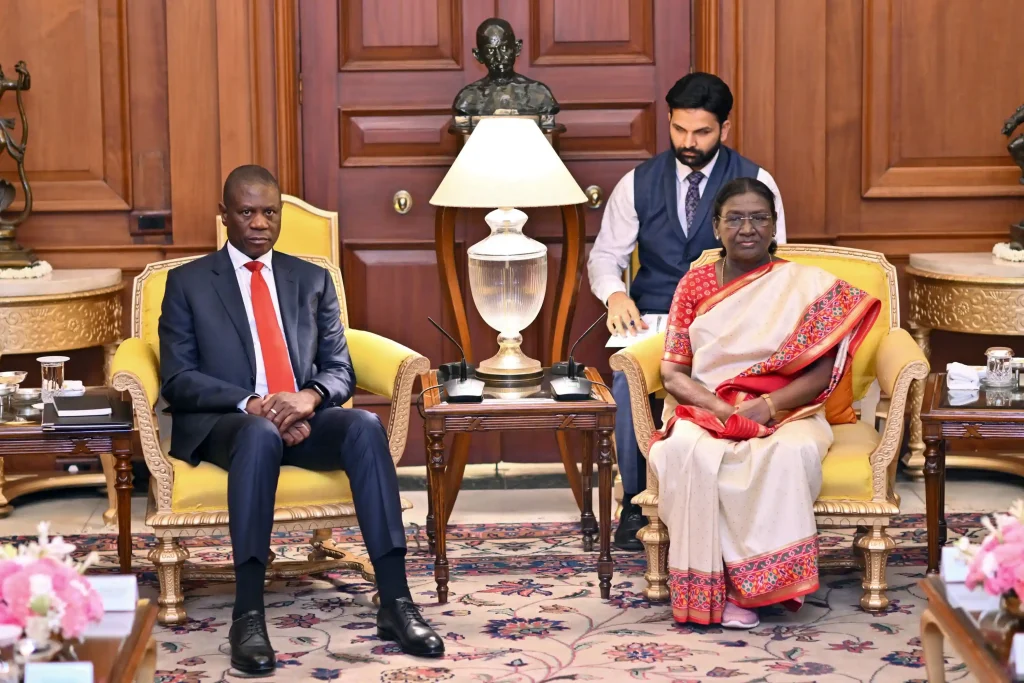
When Deputy President Paul Mashatile arrived in New Delhi on 29 May for a visit stretching to 3 June, officials in both capitals described it as the most substantial high‑level engagement between India and South Africa in years. The trip combined formal meetings with India’s president Droupadi Murmu, vice‑president C.P. Radhakrishnan and foreign minister S. Jaishankar with business roundtables in New Delhi and Hyderabad, India’s technology and pharmaceutical hub.
Pretoria framed the journey as a “working visit” to deepen trade, investment and political coordination, and explicitly linked it to Africa’s Agenda 2063—the African Union’s long‑term blueprint for prosperity and industrialisation. Mashatile himself emphasised that India is already one of the top‑ten investing countries in South Africa, describing the mission as a push to translate goodwill into concrete projects in skills, infrastructure and technology transfer.
That ambition matters because India–South Africa ties had been coasting on historical sentiment—Gandhi, Mandela, non‑alignment—without a commensurate expansion in joint ventures, value‑adding industries or coordinated positions in multilateral forums. This visit was designed to move the relationship, in Mashatile’s words, “from dialogue to action,” a phrase that could just as well describe Africa’s broader impatience with rhetoric that is not matched by investment and industrial jobs.
From solidarity to strategy
India and South Africa like to remind the world that theirs was India’s first formal “strategic partnership,” established in 1997, rooted in a shared history of anti‑colonial struggle and rejection of apartheid. That political solidarity has since been institutionalised through overlapping platforms—BRICS, IBSA, the G20 and the United Nations—where both countries position themselves as “leading voices of the Global South.”
In New Delhi, Mashatile and his counterparts explicitly framed their talks as part of a project to “advance the priorities of the Global South,” from reforming multilateral lending rules to giving developing countries a greater say in global governance. South Africa has already backed India’s efforts to secure full membership for the African Union in the G20, a symbolic but important step that was lauded by President Cyril Ramaphosa when he hosted India’s prime minister last year.
For African states that often experience multilateral forums as places where decisions are made about them rather than with them, this convergence is not trivial. A closer India–South Africa axis within these groupings offers at least the possibility that African priorities—from climate finance to debt restructuring—are tabled by partners who share some of the continent’s history of marginalisation.
The economic stakes for Africa
Yet the heart of this visit was not diplomacy; it was economics. Bilateral trade between India and South Africa has risen from roughly 4 billion US dollars in 2005 to around 15–18 billion dollars in recent financial years, making South Africa India’s single largest trading partner on the African continent. A recent India–Africa business conclave noted that trade between the two countries alone reached about 18.1 billion dollars in 2024–25, dominated by South African exports of minerals and metals and Indian exports of petroleum products, vehicles, pharmaceuticals and machinery.
Zoom out and the picture is even more striking: India–Africa trade overall crossed the 100‑billion‑dollar mark in 2024–25, up sharply from 56 billion dollars just five years earlier, and India has emerged as one of the top‑five investors on the continent. South Africa, with a GDP estimated at just over 400 billion dollars in 2024 and status as the continent’s most diversified industrial economy, is central to that story.
In this context, Mashatile’s meetings with Indian business associations and corporations—delivering a keynote at the Global Trade and Technology Council of India and engaging with technology and pharma firms in Hyderabad—were about more than bilateral deal‑making. They were a pitch to position South Africa as India’s “gateway into Africa” under the African Continental Free Trade Area (AfCFTA), a role Pretoria has begun to highlight more assertively.
If South Africa succeeds in that ambition, the dividends will not be confined to its own borders. Indian manufacturers and service providers that set up in Johannesburg, Durban or Cape Town to serve the continent are likely to integrate supply chains and logistics that span the SADC region and beyond, creating opportunities—if negotiated wisely—for neighbouring economies from Namibia to Mozambique.
Critical minerals and the green race
One of the quiet but telling developments in the India–South Africa relationship this year was the India–South Africa Critical Minerals Symposium held in March 2026 at the Future Africa campus of the University of Pretoria. The meeting brought together policymakers, geologists and industry to explore cooperation over minerals such as manganese, chromium, rare earths and platinum group metals that are indispensable to electric vehicles, batteries and renewable energy technologies.itj.dgciskol.
During Mashatile’s visit, both sides underscored their interest in expanding collaboration in mining, including critical minerals, alongside traditional sectors like coal and gold. India, whose energy transition plans depend on secure supplies of such inputs, sees South Africa not only as a supplier but as a potential partner in processing and value‑addition, and the two governments have floated ideas for joint ventures and technology exchanges in mining and beneficiation.
For Africa, this is where the significance—and the danger—of the visit crystallises. If critical minerals cooperation simply replicates the old extractive model—ores out, finished technologies in—then the partnership will entrench, not dismantle, the structural imbalances that have long trapped African economies at the bottom of the value chain. But if South Africa can use its industrial base, financial system and AfCFTA access to insist on local refining, manufacturing of components and skills transfer, it could anchor a greener industrialisation path not only for itself but for the region.
That will require African negotiators to treat India not as a benevolent “fellow developing country” but as a rising power with its own firms to promote and its own energy security to safeguard. The fact that New Delhi is courting Pretoria at a time of intense competition for African minerals—from China, Europe, the United States and the Gulf—gives South Africa and its neighbours leverage; the question is whether they will use it.
Rebalancing great‑power courtship
The timing of Mashatile’s trip was not accidental. Global economic disruptions, from wars that roil oil supply routes to tariff shifts that upend manufacturing plans, have made South–South partnerships more attractive as a hedge against dependencies on any single bloc. As India’s junior foreign minister recently reminded a business audience, India–Africa trade now rivals its commerce with some advanced economies, and New Delhi is openly staking a claim to be one of the continent’s principal long‑term partners.
This is not altruism. Indian companies see markets for generic medicines, digital payments platforms, automobiles and construction services; they see ports and railways that can be built or upgraded; they see, in South Africa especially, a financial sector and rule‑of‑law environment that can support complex investments. And Indian strategic planners see an Indian Ocean rim—from Maputo to Mombasa to Durban—whose sea lanes and ports will be crucial to their country’s security and prosperity.
South Africa, for its part, is looking to diversify beyond its traditional partners in Europe and North America at a time when its growth has been sluggish and domestic pressures—from unemployment to energy insecurity—are mounting. India already counts among the top investors in the country, and Pretoria’s own statements about the visit stressed the intention to “encourage greater investment flows and economic collaboration” through high‑level business roundtables.
For other African countries watching this courtship, there is a dual lesson. First, that India’s pursuit of South Africa is not a zero‑sum alternative to existing relationships with China, the European Union or the United States, but part of a wider rebalancing that can, if skilfully managed, expand the continent’s room for manoeuvre. Second, that agency lies in setting terms—on local content, technology transfer, environmental safeguards and regional value chains—rather than taking sides in others’ rivalries.
The soft power of cheetahs and code
Among the talking points during Mashatile’s call on President Murmu was an unusual symbol of India–South Africa cooperation: cheetahs. South Africa has already translocated big cats to India as part of New Delhi’s high‑profile cheetah reintroduction programme, and its president has even joked about being willing to “donate more” animals, underscoring the role of conservation in the relationship.
It would be easy to dismiss this as a diplomatic curiosity, but it reflects a broader reality—that twenty‑first‑century partnerships are as much about science, conservation and culture as they are about tariffs and tanks. During the New Delhi leg of his trip, Mashatile also highlighted cooperation in skills development and digital innovation, while India showcased Hyderabad’s status as a global pharmaceutical and technology hub where African students, engineers and entrepreneurs are increasingly present.
For African societies whose young people are as likely to be coding apps as they are to be working in mines, these softer dimensions matter. The challenge is ensuring that scholarships, training programmes and technology pilots are scaled up, and that Indian digital public infrastructure—from payments systems to identity platforms—is adapted with sensitivity to local governance needs rather than imported wholesale.
A test of African agency
When the vice‑president of India highlighted, in his meeting with Mashatile, a proposed India–Southern African Customs Union Preferential Trade Agreement, he was signalling that New Delhi wants not just ad‑hoc deals but institutionalised economic architecture with the region. India’s president, for her part, used their encounter to push for reconvening the India–Africa Forum Summit “at an early date,” positioning India as a convenor of continent‑wide engagement.
For South Africa—and for African governments more broadly—the question is whether they will approach these frameworks with the same assertiveness they have begun to show in engagements with China and the European Union. Preferential trade arrangements can lock in advantages for African exporters, but they can also expose fragile producers to competition if rules of origin and safeguard mechanisms are not carefully crafted.
Mashatile’s delegation, which included ministers responsible for trade, small business development and science and technology, suggests Pretoria understands the stakes. The inclusion of small enterprises and digital innovation in the agenda hints at an awareness that the benefits of any India–South Africa surge must be felt beyond mining houses and conglomerates.
Yet symbolism and communiqués are the easy part. What will determine whether this visit was truly significant is what follows: whether South Africa uses its strategic partnership with India to drive industrial projects that create decent work, to secure better terms for its critical minerals, and to champion a multilateral order where African priorities are not politely acknowledged and then ignored. If it does, this early‑winter trip to New Delhi may be remembered not only as a “productive first leg” of bilateral engagement, as Mashatile called it, but as a moment when Africa began to shape, rather than simply inhabit, the new geography of global power.