

Gulfstream has long been the biggest name in private aviation, producing some of the world’s largest and most opulent business jets. As of now, the manufacturer is building the super-midsize G300 (developed in collaboration with Israel Aerospace Industries), and the larger GVII family (consisting of the G400, G500, and G600). Meanwhile, the company’s flagship is the GVI family, which originally debuted as the famous G650 and is now produced as the G700 and G800.
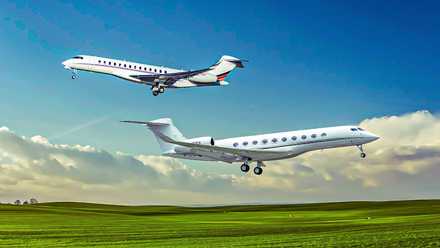
The closest rival to the flagship Gulfstream models is the Bombardier Global family. These planes are about as large as the largest Gulfstream jets and have comparable range, although they lack the brand recognition associated with the Gulfstream name. But the latest Bombardier Global model, the Global 8000, is the largest and most capable business jet Bombardier has produced yet. With this plane, Bombardier might not have just built a plane as good as the Gulfstream; it may have built a better one.
What The Global 8000 Brings To The Table

In 2010, Bombardier set out to develop a new, clean-sheet long-range private jet to serve as the company’s flagship aircraft. The initial Global 7500 model entered service in 2018, with a larger cabin than the older Bombardier Global Express, and offering greater range and a faster cruising speed. With a length of 111 feet (34 meters), a wingspan of 104 feet (32 meters), and a Maximum Takeoff Weight (MTOW) of 52.1 tons, it’s the largest purpose-built business jet ever made, offering a maximum capacity of 19 passengers, four cabin zones, and a range of 7,700 NM (14,300 km).
The Global 8000 was going to be a smaller version of the airframe, enabling even longer flights while offering less cabin space, but Bombardier redesigned the 8000 in 2022 to be an upgraded version of the 7500 instead. It retains the cabin from the 7500but features a range of 8,000 NM (15,000 km) and the same takeoff distance. The Global 8000 also has a faster maximum operating speed of Mach 0.95, making it the fastest civilian aircraft since Concorde, and it even broke the sound barrier during flight testing.
The Global 8000 first entered service in December 2025 and is now the production standard for the line. Bombardier is also offering customers the ability to upgrade existing 7500 models to the 8000 specifications via a service bulletin. It was a fairly cheap development of Bombardier’s Global 7500 program, and the plane’s price premium means higher margins than when the company was just selling the 7500 or the shrunken 8000 design. Today, it is the most capable four-cabin private jet in the world.
The Role Of The Global 8000

Because the Global 8000 retains the same takeoff distance as the 7500, it’s just as flexible for operators. The 7500 has already proven its capabilities on short runways, having flown from London City to Van Nuys, while also operating routes such as Detroit to Sydney. Of course, the 7500 can’t fly this route with a full payload, and it also exceeds the Global 8000’s brochure range. However, it will be able to operate the route in practice with a reasonable payload, while operating routes like Los Angeles to Dubai with little challenge.
The original shrink design for the Global 8000 was a compromise aircraft, with Bombardier essentially making customers choose between the 8000’s added range or the space offered by the 7500. It was believed that most buyers would prefer the larger size of the 7500, and that the 8000 would only make up a small portion of Global 7500/8000 sales. Orders for the 8000 ended up even scarcer than anticipated, and it was starting to look like the 8000 was a plane with no real place in the market.
Bombardier’s customers ultimately wanted one plane that could do everything, rather than choosing between two compromised variants, and the Global 8000 is just that. What’s more, the current 8000 design was likely cheaper to develop than a shrink of the 7500, while production costs are now lower since the company is building one aircraft rather than two. As such, the program is now even more popular, while Bombardier will see better margins.
Top 5: The Private Jets That Can Currently Fly The Furthest
Top 5 private jets that can fly the furthest. From aicraft already certified to jets that are set for 2025
Meeting The Competition

The Gulfstream G700 is the manufacturer’s direct competitor to the latest Bombardier Global variants. While it’s smaller in some dimensions, it’s essentially the same size as the Global 7500/8000 and offers five modular living areas (this is a design philosophy difference rather than an indication of its cabin size compared to the Bombardier Global). Crucially, however, the G700 is a modernized variant of the Gulfstream GVI type, which used to be sold as the venerable G650 and G650ER.
The G700 is a competitor to the Global 7500 and has a slightly greater range of 7,750 NM (13,350 km). While it has ultra-long-range capability, it becomes limited on the longest flights. On routes like Los Angeles to Dubai, the G700 faces payload restrictions, especially if the aircraft cannot overfly Russia (this depends on the country in which the aircraft is registered). What’s more, the Global 7500 is no longer in production, and the G700’s direct competitor is now an aircraft that flies 250 NM (463 km) further at higher cruising speeds.
|
Aircraft |
Cruising Speed |
|---|---|
|
Bombardier Global 7500 |
Mach 0.85 to Mach 0.90, max Mach 0.925 |
|
Bombardier Global 8000 |
Mach 0.85 to Mach 0.92, max Mach 0.95 |
|
Gulfstream G700 |
Mach 0.85 to Mach 0.90, max Mach 0.935 |
|
Gulfstream G800 |
Mach 0.85 to Mach 0.90, max Mach 0.935 |
For customers requiring longer range, Gulfstream offers the G800, which has a range of 8,200 NM (15,200 km), more than the Global 8000. However, this is a shrink of the G700 with a smaller cabin, offering four living zones rather than five. Gulfstream is essentially making its customers choose between having nearly limitless range, whereas Bombardier sells a plane that can do both. Against this portfolio, the Bombardier option looks increasingly appealing, especially considering the faster cruising Mach and the superior performance.
The Importance Of Aircraft Performance

The additional cruising speed of the Global 8000 against competing Gulfstream models doesn’t have a huge impact on flight times, and these types have to fly slower on ultra-long-haul flights anyway to maximize range. The take-off performance is crucial, however, because the Global 8000 can use shorter runways than either the Gulfstream G700 or G800 despite its larger size and range advantage against the G700. This makes the Global 8000 the most versatile of these three planes.
Both the Global 7500 and 8000 have a takeoff distance of 5,760 feet (1,760 meters) when fully loaded in standard conditions. As a point of comparison, the Gulfstream G700 has a takeoff distance of 6,250 feet (1,905 meters) in the same conditions at MTOW. Because of this, the Global 8000 can operate from more airports than the G700, and at airports that can accommodate both types but have short runways, the Global 8000 will take off at higher weights than the G700, allowing more payload, more fuel, or both.
The G800 has a takeoff distance of 5,812 feet (1,771 m) when fully loaded, which is comparable to the Global 8000. While its MTOW is slightly lower than that of the G700, it will still carry more payload out of challenging airfields than the G700. However, the fact remains that it’s a fundamentally smaller plane than the Bombardier Global 8000, and while both planes are certified to carry up to 19 passengers, the Global will be able to accommodate more passengers in a more spacious layout than the G800 in all circumstances.

How Does The Bombardier Challenger 300 Compare To The Gulfstream G280?
Comparing the Bombardier Challenger 300 to the Gulfstream G280, two business planes that are highly esteemed but each have differences.
The Battle Between The Global 8000 And The GVI Family

The Bombardier Global 8000 comes with a sticker price starting at $78 million, with options bringing the price to well over $80 million. The Gulfstream G700 starts at $75 million, while the G800 has a starting price of $72.5 million, and both also have a massive list of options that bring the price well above $80 million. Neither Bombardier nor Gulfstream discloses their exact order counts for their programs, but it’s clear that the aircraft families are competitive with one another.
Netjets ordered four Global 8000s and converted eight 7500 orders to the 8000. In addition, it will be upgrading its current Global 7500 fleet to the 8000 standard, aiming to eventually fly 24 Global 8000s in total. Rival Flexjet ordered 16 Gulfstream G700s, along with an undisclosed follow-up order for more examples. Gulfstream has seen a major surge in demand for the G700 and G800, with the company currently having a roughly two-year backlog, while Bombardier has also seen tremendous success with the Global 7500 and now the 8000.
|
Aircraft |
Entry Into Service |
|---|---|
|
Bombardier Global 7500 |
2018 |
|
Gulfstream G700 |
2024 |
|
Gulfstream G800 |
2025 (August) |
|
Bombardier Global 8000 |
2025 (December) |
The two aircraft families are as evenly matched as ever, and customers are buying from both manufacturers. It is quite notable, however, just how compelling the Bombardier Global 8000 is, as it combines the attributes of the G700 and the G800 into one package, which is extremely appealing to many potential buyers. While Bombardier doesn’t quite have the brand name, the Global 8000 is a truly remarkable aircraft that sets a new standard in private aviation capability.
Catch what other trackers miss
Emergency squawks, holds, NOTAMs — live signals, no signup.
Open tracker
Catch what other trackers miss
Emergency squawks, holds, NOTAMs — live signals, no signup.
Open tracker