
Published on
June 26, 2026

Image generated with Ai
Bangkok is being pushed alongside Singapore, Manila, Kuala Lumpur, and Ho Chi Minh City as Southeast Asia is being turned into a giant travel tech corridor in 2026. Across the five cities, digital transformation is being accelerated, AI is being inserted into tourism operations, MICE capacity is being strengthened, and higher yielding business travelers are being targeted. In Bangkok, a city of exhibitions strategy has been embedded, major global meetings at Queen Sirikit National Convention Center are being counted down, and business appointments are being generated through national trade events. In Singapore, Travel Tech Asia is being staged within a government backed innovation system. In Manila, PHITEX and an ASEAN roadmap are being tied to seamless travel and digital reform. In Kuala Lumpur, buyer seller networks are being built for Visit Malaysia 2026. In Ho Chi Minh City, ITE HCMC 2026 is being promoted with digital and green ambition. A new Southeast Asian travel map is therefore being drawn around technology, commerce, and continuous cross border movement. Industry leaders, investors, suppliers, and destination agencies are being pulled into one arena.
The exact event label used in the assigned title could not be matched to a government hosted page during the official source review completed on June 26, 2026. For that reason, only government verified material has been used, and a broader regional trend has been reconstructed from official records. That trend has been shown clearly enough. Public agencies in the five cities are being seen pushing the same formula: more technology, more structured business events, more seamless journeys, and more value from every traveler movement. The result is not being created by one exhibition alone. It is being built by a chain of state backed conferences, trade marts, digital platforms, destination plans, and tourism policies. Because that chain is being advanced simultaneously, Bangkok can reasonably be read as joining a wider Southeast Asian travel technology surge rather than moving in isolation. The strongest story is therefore not a single stage event. A regional system is being assembled, and the system is being designed to pull global buyers, investors, suppliers, and high spending delegates deeper into Southeast Asia.

Image generated with Ai
Bangkok builds the launchpad
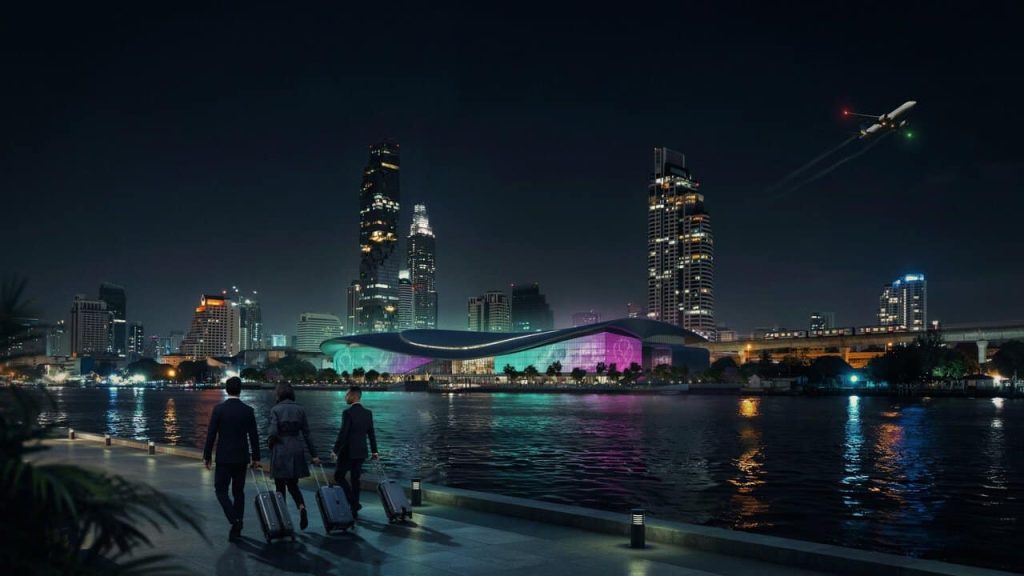
In Bangkok, the strongest official evidence of that push is being supplied by the Bangkok Metropolitan Administration and the Government of Thailand. Metropolitan planning has identified Bangkok as both a world class tourism destination and a city of exhibitions, with meetings, incentives, conventions, and exhibitions readiness being built into the city development framework. That local ambition is being matched at national level. Thailand is preparing to host the 2026 Annual Meetings of the International Monetary Fund and the World Bank Group from October 12 to October 18 at Queen Sirikit National Convention Center, and the capital is being presented as safe, connected, modern, and welcoming for delegates from around the world. The message being sent is unmistakable. Bangkok is not merely being sold as a leisure gateway. It is being framed as a place where global decision makers can land, meet, negotiate, and move efficiently through a polished urban ecosystem that is increasingly dependent on data, connectivity, and event infrastructure.
That Bangkok proposition is being sharpened further by official trade activity. Thailand Travel Mart Plus 2026 has been positioned as a key platform for global buyers, and 800 buyers from around the world were expected by the Public Relations Department at the April announcement. Later government reporting stated that more than 15,000 business appointments were expected to be generated, with more than THB5 billion in tourism revenue projected from the event. Alongside those figures, a recent official countdown for the IMF and World Bank meetings has been used to reaffirm Bangkok as a dynamic regional hub with strong connectivity and proven event hosting capability. Even outside tourism, the capital is being packed with global conferences and trade exhibitions, and that matters because corporate travel is rarely driven by destination branding alone. It is usually pulled by deals, credentials, schedules, and access. In that environment, travel tech becomes indispensable, because a busier events city is forced to depend on smarter booking flows, faster visitor servicing, stronger analytics, and wider digital coordination.

Image generated with Ai
AI policy direction and smart city transformation
A still more direct technology signal is being issued through Thai policy language itself. The Thai government has argued in 2026 that AI can no longer be treated as optional, and tourism policy has separately stated that AI will be used to enhance travel experiences and to spread attention toward more destinations. When those policies are read alongside the Bangkok exhibition agenda, a larger implication is created. The city is being prepared not just to receive delegates, but to operate inside a more intelligent service environment. Such an environment is usually characterized by better recommendations, stronger crowd management, cleaner information flows, improved payments, and more personalized movement across transport, hospitality, and attractions. Bangkok has therefore been placed on the same conceptual map as other Southeast Asian capitals where tourism growth is being linked directly to digital capability. Even where the exact trade show label remains unverified on government pages, the official direction is being left in little doubt. Bangkok is being readied for a future in which tourism competitiveness is being measured as much by technology as by temples, hotels, or headline visitor volumes.

Image generated with Ai
Singapore supplies the benchmark
If Bangkok is being positioned as a rising business travel and travel tech node, Singapore is being used as the regional benchmark that must be answered. The Singapore Tourism Board has built a tourism innovation hub through Tcube, where businesses are being guided under a learn test scale framework. The system is being designed to help tourism firms use data analytics, improve productivity, and augment visitor experience. At the 2026 Tourism Industry Conference, a special exhibition of integrated technology experiences and AI solutions was featured, and the Board also highlighted its AI Playbook for Tourism and the new Tcube Centre of Excellence as mechanisms for faster technology adoption. The architecture being displayed is highly structured. Rather than waiting for private platforms to reshape the sector on their own, a government agency is acting as curator, accelerator, and translator between tourism operators and emerging tools. That gives Singapore a powerful institutional edge, because innovation is not merely being celebrated there. It is being organized, tested, scaled, and embedded inside the formal tourism system.
Advertisement
Advertisement
The event side of the Singapore machine is being kept just as fierce. On the official Tcube events calendar, Travel Tech Asia 2026 is scheduled for October 21 to 23 alongside ITB Asia 2026 and MICE Show Asia. That future listing has been reinforced by a 2025 Ministry of Trade and Industry speech in which ITB Asia was described as heading for more than 18,000 delegates, over 1,000 exhibitors, and 1,500 buyers, while Travel Tech Asia was described as the showcase for the latest tech and digital solutions for travel businesses. The same official ecosystem is also being backed by large tourism ambitions. STB has projected 2026 tourism receipts of 31 to 32.5 billion Singapore dollars and 17 to 18 million international visitor arrivals. When such scale is combined with a government backed AI playbook, a formal tourism analytics network, and partnerships with companies such as Google, a clear fact is exposed. Singapore is being run not only as a destination, but as a laboratory where future travel behavior is being shaped and sold.

Image generated with Ai
Manila and Kuala Lumpur extend the corridor
The Manila story is being built differently, but it is still being tied to the same regional shift. At the policy level, the Philippine government has reported that the ASEAN Sectoral Plan 2026 to 2030 has been launched with priorities that include tourism workforce development, seamless travel, digital transformation, product and market diversification, and sustainability. That matters for Manila because the city sits inside the political and institutional machinery through which much of that agenda is being negotiated and communicated. At the commercial level, the Tourism Promotions Board has described PHITEX 2026 in Metro Manila as the country prime government organized travel trade event, one that attracts qualified buyers from around the globe for table top business appointments with Philippine sellers. The combination is striking. Regional policy is being written on one side, while buyer seller matchmaking is being staged on the other. A capital city placed between those two functions is almost automatically converted into a strategic business travel node, even before any marketing flourish is applied.
Additional official Philippine material has strengthened that interpretation. The Tourism Promotions Board has noted that in Manila alone, eight major venues for conferences or events can be found, including the Philippine International Convention Center. Its MICE calendar for 2026 also lists major gatherings at venues such as Manila Marriott Grand Ballroom, World Trade Center Metro Manila, and SMX Convention Center Manila, ranging from medical congresses to technology related exhibitions. The underlying message being projected is not subtle. Manila is being treated as a working city for delegates, associations, and commercial organizers, not merely as a transit point for island leisure. Once that framing is accepted, the role of travel tech becomes obvious. More event density means more demand for registration systems, smarter transport coordination, payment efficiency, accommodation management, and post event analytics. Manila may not yet be carrying the polished innovation branding of Singapore, but it is being supplied with official policy direction, event volume, and institutional MICE support that can pull thousands of professional travelers through the metro economy.

Image generated with Ai
Kuala Lumpur as regional business hub
In Kuala Lumpur, the official drumbeat has been tied strongly to Visit Malaysia 2026 and to the business events economy that can help deliver it. Tourism Malaysia stated that Global Travel Meet 2025 at World Trade Centre Kuala Lumpur would connect 600 international buyers and 100 media representatives from around the globe with 400 Malaysian sellers under one roof. Later official communication about Central Asian business events seminars highlighted Kuala Lumpur as one of Asia leading business events hubs, supported by a comprehensive meetings and exhibitions ecosystem, strong air connectivity, modern hospitality, efficient logistics, competitive pricing, and continued government support. Meanwhile, Visit Malaysia 2026 has been tasked with attracting 43 million international visitors in 2026. These are not isolated promotion lines. They form a ladder. Buyer networks are first being expanded, business event credentials are then being amplified, and a much bigger visitor target is finally being thrown on top. In that ladder, Kuala Lumpur is being used as both showroom and engine, where deals can be struck before leisure flows are multiplied.
A second Malaysian layer is being provided by formal digital planning. The Ministry of Tourism, Arts and Culture has published a Digitalization Strategic Plan 2025 to 2029, showing that tourism modernization is being treated as an official state priority, not as a side trend. When that plan is combined with the government insistence on Kuala Lumpur as a premier meetings and exhibition base, the role of the city becomes clearer. It is being positioned as the place where Malaysia can absorb regional corporate movement, host buyer seller conversion, and channel digital tools into market expansion. Even older official records have shown how deeply this business events logic runs in Malaysia, with international delegate counts having long been tracked as a direct economic asset. What has changed in 2026 is that the same meeting economy is now being folded into a louder technology and destination competitiveness narrative. Kuala Lumpur is therefore being framed not simply as a capital with convention halls, but as a digitally supported command center for the national tourism push.
Ho Chi Minh City hardens the digital frontier
If Ho Chi Minh City is being discussed less often in global headlines than Singapore or Bangkok, it should not be underestimated. Official Vietnamese tourism material has shown that ITE HCMC 2026 is being actively promoted and that support has been sought from the Pacific Asia Travel Association for promoting the event across official platforms and for sending electronic invitations to international partners. At the same time, the Vietnam National Authority of Tourism has stated that late August 2026 in Ho Chi Minh City is expected to host the ACMECS, CLMV, and CLV tourism ministers meetings on the sidelines of the International Travel Expo. That sort of alignment is highly significant. A trade fair is being linked not only to buyers and exhibitors, but also to ministerial diplomacy. The city is thus being turned into a place where market access, policy coordination, and destination promotion can all be conducted in compressed time. In regional business travel, that concentration of functions is rarely accidental. It is usually the mark of a city whose importance is being deliberately upgraded.
Advertisement
Advertisement
The broader Vietnamese direction has made that upgrade even more convincing. Official tourism messaging for 2026 has stated that major destinations including Ho Chi Minh City are expanding smart tourism solutions such as 3D digital city maps, electronic tickets, and contactless services. Another official account has stated that representatives from Visa, Google, and Mastercard reaffirmed support for Vietnam in developing the digital economy and tourism. Separate official material has tied digital transformation and green growth directly to the elevation of Vietnam tourism, while the 2026 Vietnam International Travel Mart has been described as being expected to attract around 80,000 visitors. Taken together, those records show the shape of the strategy. Ho Chi Minh City is not being left to compete on energy and entrepreneurship alone. Its tourism proposition is being connected to digital infrastructure, payment modernization, smart visitor services, and large scale promotion. That is precisely the kind of blend that turns an expo city into a travel tech city, because transactions, discovery, mobility, and policy are all being digitized together.
Why the region is rewriting business travel
When the five city narratives are placed side by side, a shared Southeast Asian formula is revealed. Bangkok is being built around convention strength, policy backed AI use, and global finance visibility. Singapore is being built around structured innovation support, AI adoption, and a world class event stack. Manila is being anchored by government trade events, ASEAN level agenda setting, and venue depth. Kuala Lumpur is being advanced through global buyer networks, national visitor targets, and tourism digitalization planning. Ho Chi Minh City is being linked to ministerial tourism diplomacy, smart service expansion, and expo driven market access. None of those moves are identical. Yet all are being driven toward the same commercial destination. Tourism is being pushed away from simple volume and toward higher margin, data rich, event supported movement. That shift tends to favor cities over resort belts, because cities can host meetings in the morning, product showcases in the afternoon, investment dinners at night, and digital servicing at every stage in between.
That is why the phrase attracting thousands of business travelers from around the globe can be defended in a broader regional sense, even while the exact named show in the assignment title remains unverified on government domains. Official records already show Singapore expecting more than 18,000 delegates for ITB Asia 2025, Kuala Lumpur assembling 600 international buyers plus 100 media and 400 Malaysian sellers for a major trade meet, Thailand forecasting 800 global buyers and more than 15,000 business appointments at TTM Plus 2026, Manila describing PHITEX 2026 as a buyer driven government trade event for global participants, and Vietnam promoting large scale marts and ITE HCMC 2026 through official channels. The volume is therefore not speculative. It is being evidenced through public plans, delegate projections, buyer counts, and appointments data. What is being formed across the region is a pipeline in which technology and trade are repeatedly being used to pull international movers into Southeast Asian capitals and then disperse economic value through hotels, venues, airlines, and urban services.
Final structural conclusion
For global travel companies, payment firms, online platforms, and destination marketers, this fast moving arc carries a blunt commercial warning. Southeast Asia is no longer being contested only through beaches, shopping streets, or traditional tour products. The fight is being moved onto the ground of AI, analytics, integrated booking flows, smart venue operations, digital promotion, and friction reduced movement across borders. That is why official references to Google, Visa, Mastercard, AI playbooks, tourism analytics networks, contactless services, electronic invitations, and digitalization plans matter so much. They indicate that the next growth wave will not be won merely by adding flights or rooms. It will be won by building more intelligent systems around the traveler. In that contest, Bangkok is now being read within the same league as Singapore, Manila, Kuala Lumpur, and Ho Chi Minh City. A regional travel tech map is being redrawn before the market, and Southeast Asia is being turned into its most aggressive stage.
A second consequence is being felt in the way business travel itself is being redefined. Delegates are no longer being drawn only by conference halls and hotel inventory. They are being lured by faster data, easier discovery, smarter visitor assistance, stronger air links, digital payments, and blended schedules in which meetings can be extended into leisure time. That is why official Malaysian material has emphasized bleisure potential, official Philippine material has highlighted pre and post meeting experiences, and official Thai and Singaporean material has linked technology adoption with better visitor experience. Across the region, higher spending travelers are being pursued not through volume alone, but through efficiency, personalization, and measurable value.
The final result is being watched most closely in Bangkok today because the city is being placed at a moment of acceleration. With metropolitan exhibition planning in place, government backed mega meetings on the horizon, and national tourism policy moving toward quality, resilience, and technology, Bangkok is no longer being framed as only a stop on a leisure map. It is being framed as a command point in a regional circuit where officials, exhibitors, buyers, innovators, and investors can be circulated between Singapore, Manila, Kuala Lumpur, and Ho Chi Minh City with growing frequency and rising commercial intensity.
Advertisement
Advertisement
