
It was the day after the Dragon Boat Festival and with China on a three-day holiday, my friend Wei suggested we take the subway to Tongzhou, about 20km east of the centre of Beijing, and spend the afternoon by the Grand Canal. When we arrived, we went first to see a cluster of three temples, one Confucianist, one Taoist and one Buddhist, alongside a pagoda more than 50 metres tall, its tiered eaves hung with bronze bells.
The complex was a saturnalia of superstition, with hundreds of hopes and wishes written on little red notes attached to metal rods and stone models of each Chinese zodiac sign so that visitors could rub the one they were born under. The Communist Party still officially disapproves of what it calls “feudal superstition”, but nobody minds these customs nowadays and party members are as likely as anyone else to burn incense and make wishes in temples.
Wei wanted to visit an old building on the other side of the canal but when we arrived at the bridge it was closed off, with police ushering everyone off to the side. The walkway along the bank was closed too so we climbed up on to a grassy levee to look across the canal, which was broader than I had pictured.
The Grand Canal is the longest and the oldest man-made waterway in the world, built about 2,500 years ago and running almost 1,800km from Tongzhou on the edge of Beijing south to Hangzhou. It links China’s five main river basins – the Yangtze, the Yellow river, the Hai, the Huai and the Qiantang – and was once the main supply line to the capital.
As we walked along the grass we passed families laying down blankets and groundsheets, and every so often we would come across an officious-looking woman wearing a yellow and gold sash. Then Wei touched my elbow and pointed down towards something further along the canal bank.
“What’s that?” he said.
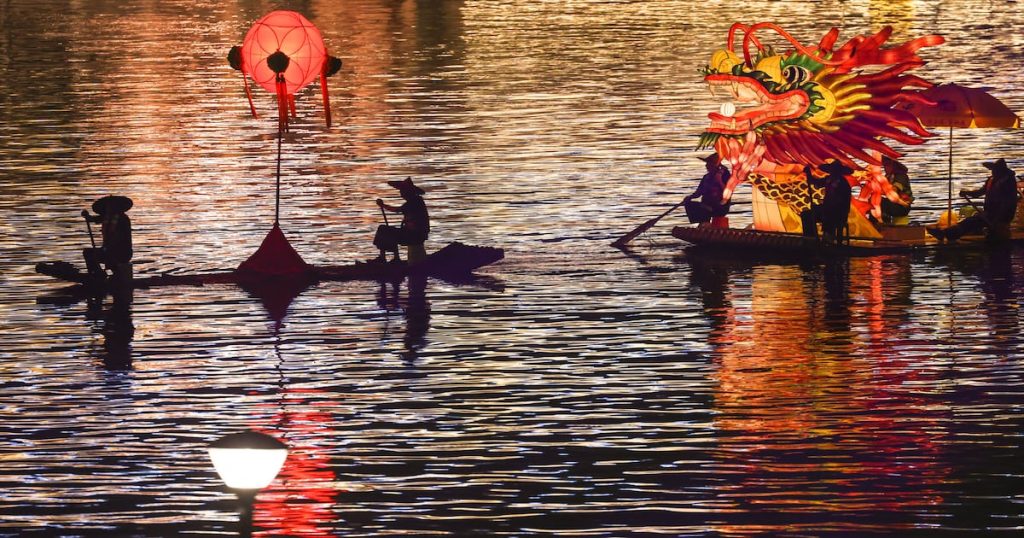
It was a dragon’s head. Behind it was a succession of small bamboo rafts, each with a wooden chair on top and all tied together. Music started playing from speakers under a bridge across the canal and the embankment on the other side was starting to fill up with people too.
Wei spoke to one of the women wearing a sash and she told him the event would start in about 90 minutes, although she offered no details about what to expect. We climbed up the levee on to the street and started walking past half-finished office buildings until we found a row of small, brightly lit restaurants and Wei chose one.
“You have children here and old people, that’s always a good sign,” he said.
Over soup and noodles he talked about his work for a video game company and how many of his colleagues worried that AI would wipe out their jobs and how flat the employment market was. I almost told him about something I read in a Chinese business paper about how the entire industry of video micro-dramas had been fully taken over by AI within a few weeks earlier this year, but instead I suggested we head back to the canal.
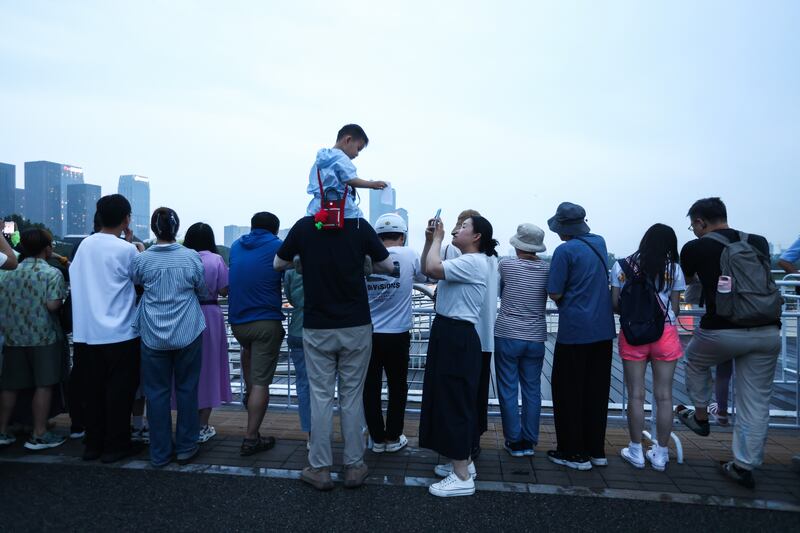
By the time we got there, dozens of bamboo rafts were assembled in the canal and the entire embankment was full of people. We went up on to the bridge, but that was filled with people too and a policeman suggested we cross over to the other bank.
We found some high ground with a view of the bridge where the rafts were lining up behind the dragon’s head and along the canal where they were facing. It was getting dark and there was a crescent moon above us as fathers hoisted children on to their shoulders and everyone held their phones up to record the show.
At 8pm a raft carrying a large, red lantern moved in front of the dragon’s head and out from under the bridge, leading a procession with 36 bamboo rafts forming the dragon’s body in front of a tail at the back. They moved in a serpentine to the sound of a soaring, patriotic song by Zhou Shen, a male singer with a remarkable vocal range that can hit with perfect pitch usually sung only by a female soprano.

I felt content in the crowd of thousands, everyone enjoying a spectacle that was free of charge and open to all – an important consideration in China these days. A few days earlier, the national statistics board reported that retail sales last month fell for the first time since the end of the coronavirus pandemic and everywhere you go in Beijing businesses are feeling the pinch.
I could see that Wei was getting anxious, and while the dragon was still only halfway along its route he said we should get away before we got caught in the crowd. As we walked towards the subway I was chattering about the show and what a lovely day it had been, but his mind was elsewhere and he turned suddenly to interrupt me.
“If I lose this job, I’ll never get another one,” he said.