
Close Menu
Simply Invest Asia
  • Home
  • About us
  • Explore industries/sectors
    • Automobile
    • Aviation
    • Banking
    • Biotechnology
    • Chemical & Fertilizer
    • Entertainment and Media
    • Food Processing
    • Healthcare
    • Iron and Steel
    • Leather
    • Mining
    • Oil and Gas
    • Pharmaceutical
  • Explore by countries
    • China
    • Dubai / UAE
    • Hong Kong
    • India
    • Indonesia
    • Japan
    • Malaysia
  • Explore cities
    • Bangkok
    • Beijing
    • Chongqing
    • Delhi
    • Dubai
    • Guangzhou
    • Jakarta
    • Kuala Lumpur
  • Why Asia
Facebook X (Twitter) Instagram Threads
Trending:
  • TikTok, YouTube deactivates 4.7m under-16 accounts in Indonesia
  • Guangdong-Macao zone completes institutional reform with nine new bureaus
  • India's SpiceJet receives first $16mn from state crisis fund – ch-aviation
  • NetEase stock rises on Hong Kong listing, game launch ahead By Investing.com
  • The UAE’s OPEC exit may look dramatic, but consequences could be less significant than suggested.
  • China Supply Chain Expo: Participants say green transition and AI key drivers for supply chain efficiency – news.cgtn.com
  • Bangkok Joins Singapore, Manila, Kuala Lumpur, and Ho Chi Minh City Today at the Asian Travel Tech Show 2026 Revolutionizing Southeast Asian Travel with Industry Leaders and Tech Giants Attracting Thousands of Business Travelers from Around the Globe
  • Nurses must be ‘agile and compassionate’ amid changing healthcare systems
  • Ravi Ahuja joins Cosm Board as Sony Pictures makes $100 million bet on the future of moviegoing
  • 18 Best Things to Do in Dubai This Weekend (27–29 June): Brunches, Football, Staycations and More
  • Industry groups push for new steel standards – Philstar.com
  • Woman dead after fire at Hong Kong flat, 3 others hospitalised
  • Britain’s 35°C vs India’s 45°C: Why UK feels like an oven despite low temperatures
  • Media Release: China Has No Historical, Religious and Political Right to Interfere in the Dalai Lama’s Reincarnation Issue – Central Tibetan Administration
  • Exhibition | “The Hue of China
  • Japan orders two mln to evacuate ahead of typhoon
  • Bangladesh Prime Minister Beijing Visit | PM Tarique Rahman’s China Visit: Economic Needs Drive Bangladesh’s Agenda | Bangladesh China Relations Economic Cooperation
  • Selangor targets bigger share of Malaysia’s aerospace industry by 2030, says state exco
Friday, June 26
Facebook X (Twitter) Instagram
Simply Invest Asia
  • Home
  • About us
  • Explore industries/sectors
    • Automobile
    • Aviation
    • Banking
    • Biotechnology
    • Chemical & Fertilizer
    • Entertainment and Media
    • Food Processing
    • Healthcare
    • Iron and Steel
    • Leather
    • Mining
    • Oil and Gas
    • Pharmaceutical
  • Explore by countries
    • China
    • Dubai / UAE
    • Hong Kong
    • India
    • Indonesia
    • Japan
    • Malaysia
  • Explore cities
    • Bangkok
    • Beijing
    • Chongqing
    • Delhi
    • Dubai
    • Guangzhou
    • Jakarta
    • Kuala Lumpur
  • Why Asia
Simply Invest Asia
Home»Explore cities»Beijing»Bangladesh Prime Minister Beijing Visit | PM Tarique Rahman’s China Visit: Economic Needs Drive Bangladesh’s Agenda | Bangladesh China Relations Economic Cooperation
Beijing

Bangladesh Prime Minister Beijing Visit | PM Tarique Rahman’s China Visit: Economic Needs Drive Bangladesh’s Agenda | Bangladesh China Relations Economic Cooperation

By IslaJune 26, 20266 Mins Read
Share
Facebook Twitter Pinterest Threads Bluesky Copy Link


The Prime Minister’s first trip to Beijing has prompted considerable strategic speculation. In my reading, the visit is dominated by something less dramatic and more pressing: our internal compulsions. It is those compulsions that drive a country’s foreign policy, and in our case, they are economic before they are strategic.

What Bangladesh wants

Three needs shape what Dhaka is asking for.

The first is financial support. The economy is in poor shape, and a government in that position turns to its friends. The precedent is instructive. In 2024, the then-prime minister went to Beijing and sought about $5 billion in budget support; the Chinese did not agree, as the underlying economic conditions did not justify it, and the visit ended on a sour note. The basic structure of the economy has not improved since; if anything, it is weaker, so securing some financial support will again be a priority.

Tarique Rahman receiving flowers
The Prime Minister’s first trip to Beijing has prompted considerable strategic speculation. Photo: PMO Bangladesh


The second is investment, because employment is among our most serious problems. Here, the Prime Minister is expected to press for Chinese investment, and the government has just designated a dedicated Chinese Economic and Industrial Zone to encourage Chinese firms to take Bangladesh seriously and utilise its opportunities as a free trade zone.

The third is infrastructure, where China is already our foremost partner. Press reports suggest Dhaka is seeking around $6 billion in infrastructure support, and this is the area where Beijing is most likely to respond positively, because it holds the surplus capacity it can transfer to help build ours.

Financial support, investment, infrastructure: these are what we want.

What China wants in return

China’s expectations matter just as much.

First, Beijing will want Bangladesh to reaffirm the One-China policy, a constant in its diplomacy. Bangladesh has supported it consistently and will be glad to do so again.

Second, China would like Bangladesh to be more deeply integrated into the Belt and Road Initiative across infrastructure, finance, agriculture, and renewable energy.

Third, Beijing is advancing its broader frameworks, including the Global Development Initiative. I believe Bangladesh can be receptive to the GDI in particular because development cooperation is the least contentious of these initiatives and carries limited strategic implications; when it comes to more security-oriented frameworks, Dhaka is likely to be more cautious.

There is also a real convergence of interest in technology and energy. China has world-leading capacity in semiconductors, electric vehicles and solar power, and these are precisely the areas where it can support us. Bangladesh has lagged behind its neighbours here; Nepal is now the largest market for Chinese electric vehicles in South Asia, and with energy security back in focus, the government is looking at electric vehicles and renewables afresh. The presence of the energy adviser in the delegation indicates that this will be discussed seriously. Cooperation on agriculture and education may follow.

We urgently need to strengthen our capacity to absorb and utilise external support, and that requires meaningful reform, stronger institutions, and effective implementation mechanisms.

Defence is the more uncertain area. Since Bangladesh is among the largest buyers of Chinese military equipment, Beijing would like to build on that. How far Dhaka is willing to go at this stage is not clear.

Reading the geopolitics

The geopolitical dimension warrants a more measured assessment. On the Teesta, the Foreign Secretary has indicated that Bangladesh is reviewing the process and may discuss the project’s feasibility with China rather than its financing. That distinction is deliberate. It reassures our regional partners and helps keep Bangladesh out of unnecessary geopolitical contention, which is a positive outcome. As long as the engagement remains on the economic side, the geostrategic competitors are willing to accept it; only if Bangladesh moves too far into the BRI and its security frameworks do things become difficult.

The Malaysia stop should be read in the same spirit. It signals that Bangladesh does not wish to be drawn into an adversarial Indo-Chinese frame, and our neighbours will understand the message. I sense that we continue to remain engaged with both sides, conscious of each other’s concerns and respectful of them. I do not believe this government is any more inclined than its predecessors to become part of that competition. We will pursue our interests, but within the same established framework.

So this visit is not a departure from our established way of doing things. It is more bilateral than geopolitical, aimed at addressing domestic challenges, and it will be cautious. Most of the understandings will be in infrastructure, employment, financial support, and energy, the areas where we need urgent help and where China has the capacity we would like to tap. Nothing very large in geopolitical terms should be expected.

The question we keep avoiding

There is a more difficult question underlying all of this, and it concerns us rather than China. China is not the easy partner we sometimes assume it to be. Beijing is tough. It declined the previous government’s request precisely because a weakened financial system offered no assurance that the money could be repaid, a lender’s logic, not a political one.

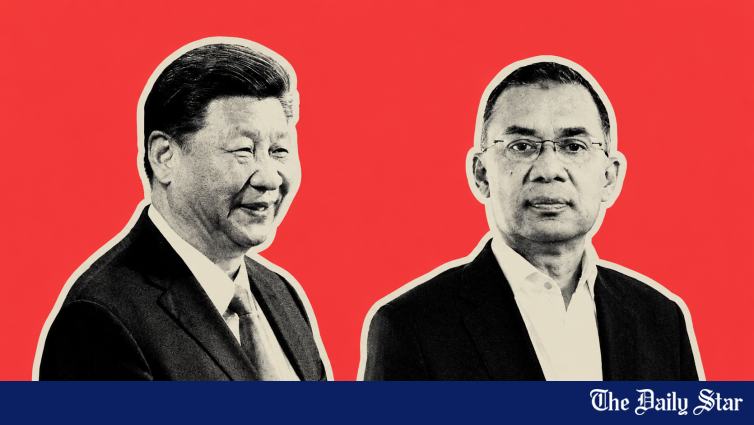
Bangladesh Prime Minister Tarique Rahman and Chinese President Xi Jinping
Prime Minister Tarique Rahman is scheduled to meet Chinese President Xi Jinping on June 26, 2026. Illustration: Khairul Hassan Jahin


Vietnam offers a useful point of comparison. It maintains a close security relationship with the United States. It attracts substantial Chinese investment at the same time because it has the capacity to handle both. Our constraint is our own capacity to absorb. We are slow, our processes are heavily bureaucratic, and our collective ability to turn agreements into delivered projects is limited.

The conclusion, then, is not about leaning towards Beijing or away from it. We urgently need to strengthen our capacity to absorb and utilise external support, and that requires meaningful reform, stronger institutions, and effective implementation mechanisms. Without that domestic preparation, no agreement, whether with China, India, or the United States, will deliver its full potential. The Prime Minister can secure agreements in Beijing, but their implementation will depend on our capacity to deliver at home.


M Humayun Kabir is president of the Bangladesh Enterprise Institute (BEI) and a former ambassador of Bangladesh to the United States. This article was transcribed by Khairul Hassan Jahin.


Send your articles for Slow Reads to [email protected]. Check out our submission guidelines for details.


Source link

Related Posts

Chinese, Austrian foreign ministers hold talks in Beijing – news.cgtn.com

June 26, 2026

A tale of two cities: can Shanghai challenge Hong Kong’s offshore finance crown?

June 25, 2026

China’s Xi praises ‘unbreakable’ Pakistan ties as Sharif visits Beijing | US-Israel war on Iran News

June 25, 2026
Add A Comment
Leave A Reply Cancel Reply

Top Posts

China Scraps 12,000 Degrees in Biggest Academic Overhaul in Years

June 14, 2026

Chinese Wall may stem India tech flows for electronics and automobile

June 1, 2026

Abandoned malls, whispers of nuclear war and young foreigners detained. This is what’s REALLY going on in Dubai… and the chilling warning one taxi driver gave to the Mail’s IAN BIRRELL

April 11, 2026
Don't Miss

TikTok, YouTube deactivates 4.7m under-16 accounts in Indonesia

By IslaJune 26, 2026

TikTok, YouTube deactivates 4.7m under-16 accounts in Indonesia TikTok has deactivated 4.1 million accounts belonging…

Guangdong-Macao zone completes institutional reform with nine new bureaus

June 26, 2026

India's SpiceJet receives first $16mn from state crisis fund – ch-aviation

June 26, 2026

NetEase stock rises on Hong Kong listing, game launch ahead By Investing.com

June 26, 2026
SUBSCRIBE TO OUR NEWSLETTER

Get our latest downloads and information first. Complete the form below to subscribe to our weekly newsletter.


I consent to being contacted via telephone and/or email and I consent to my data being stored in accordance with European GDPR regulations and agree to the terms of use and privacy policy.

Stay In Touch
  • Facebook
  • YouTube
  • TikTok
  • WhatsApp
  • Twitter
  • Instagram
Top Trending

Britain’s 35°C vs India’s 45°C: Why UK feels like an oven despite low temperatures

By IslaJune 26, 2026

Media Release: China Has No Historical, Religious and Political Right to Interfere in the Dalai Lama’s Reincarnation Issue – Central Tibetan Administration

By IslaJune 26, 2026

Exhibition | “The Hue of China

By IslaJune 26, 2026
Most Popular

Chongqing Roundtable Highlights Local Adaptation as Key to Chinese Modernization’s Global South Relevance

June 19, 2026

Alleged crime boss with links to boxer Tyson Fury arrested in UAE

April 18, 2026

Authorities raid illegal nitrous oxide storage amid abuse concerns – Society

April 13, 2026
Our Picks

minutes for Koga and Hamano as Japan suffer defeat

April 12, 2026

Singapore’s Panthera Growth Partners to invests $30M in India’s AI security firm Innefu Labs

June 5, 2026

Chongqing Service Sector Upgrade Boosts Industry and Improves Daily Life

June 1, 2026
SUBSCRIBE TO OUR NEWSLETTER

Get our latest downloads and information first. Complete the form below to subscribe to our weekly newsletter.


I consent to being contacted via telephone and/or email and I consent to my data being stored in accordance with European GDPR regulations and agree to the terms of use and privacy policy.

© 2026 Simply Invest Asia.
  • Get In Touch
  • Cookie Policy
  • Privacy policy
  • Terms & Conditions

Type above and press Enter to search. Press Esc to cancel.

SUBSCRIBE TO OUR NEWSLETTER

Get our latest downloads and information first.

Complete the form below to subscribe to our weekly newsletter.


I consent to being contacted via telephone and/or email and I consent to my data being stored in accordance with European GDPR regulations and agree to the terms of use and privacy policy.