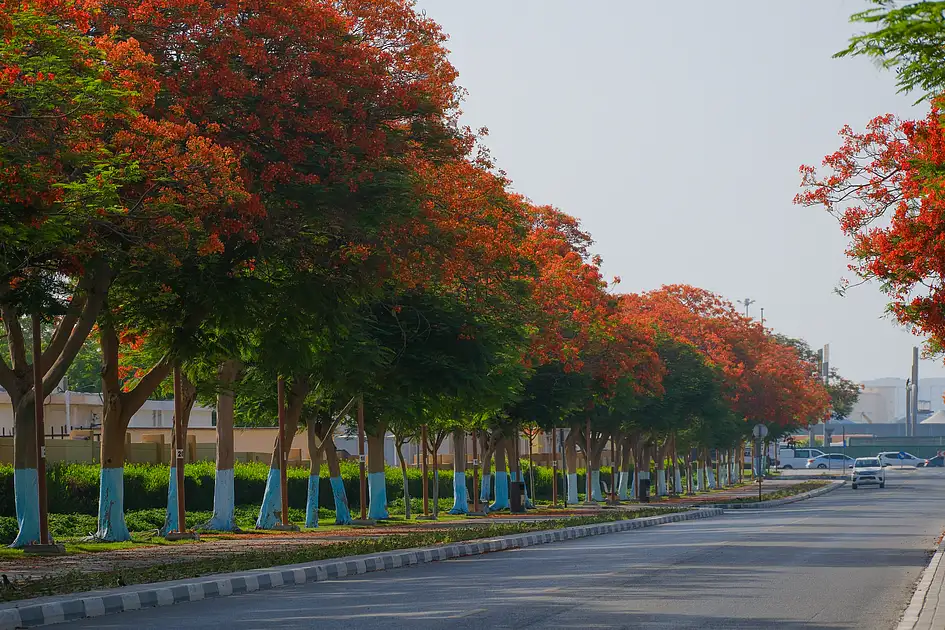
Every summer, as Dubai enters its hottest months, bursts of fiery orange begin to appear across the city. The flame tree, long part of Dubai’s streets, neighbourhoods and public spaces, blooms just as temperatures rise, offering shade and colour.
More than 50,000 flame trees have been planted in Dubai over time and the city has turned that seasonal bloom into something larger: A cultural tradition.
Dubai Crown Prince Sheikh Hamdan bin Mohammed had earlier directed the expansion of flame tree planting across Dubai’s streets, homes, parks and public spaces, and also ordered seedlings to be distributed to residents who wish to plant them.
Stay up to date with the latest news. Follow KT on WhatsApp Channels.
The tree can live up to 60 years, grows up to 12 metres tall and provides wide shade that can reduce ground temperatures by about 5°C.

The Flame Tree Season, launched by Dubai Future Foundation through Dubai Design Lab, runs annually from May 1 to July 31, aligning with the tree’s natural blooming cycle. But officials say the initiative was never meant to be just a planting campaign.
“The Flame Tree Season was envisioned from the beginning … as a city-wide cultural initiative,” Rafia bin Sulaiman, Project Lead for the Flame Tree Season, told Khaleej Times in an interview.
While planting is one part of the initiative, supported by partners such as Dubai Municipality, the larger aim is to create a shared seasonal moment around a tree already rooted in Dubai’s landscape.
“Flame trees bloom naturally every year, but the initiative gave people a reason to pause and experience that moment together,” she said.
The idea was shaped around one central question: how could Dubai plant the seeds of a floral season that could grow into a lasting cultural tradition?
Through Dubai Design Lab, the team studied the city’s natural landscape to identify a symbol that was resilient, sustainable and meaningful. The flame tree stood out because of the way it thrives in difficult conditions.
“It reflects many of Dubai’s defining characteristics, resilience, adaptability, and the ability to thrive in challenging conditions,” Rafia said. “It flourishes in extreme heat, provides shade, and contributes to urban comfort.”
The tree has been present in Dubai for many years, with Dubai Municipality playing a key role in expanding its presence across the city.
Saplings for residents
But the season goes beyond government-led greening. Saplings are being distributed to residents in collaboration with partners, with organisers saying public response has been “overwhelmingly positive”.
Residents have been requesting saplings, attending events and sharing their own experiences with the season.
“In many ways, the flame tree is already part of Dubai’s neighbourhoods and private landscapes,” Rafia said. “What’s exciting now is seeing people become more intentional about noticing these trees, planting them, and creating their own memories around them.”
The trees require sunny, open areas with enough space for canopy and root growth. Organisers say they should ideally be planted five to six metres away from walls and nearby structures, in well-drained sandy or loamy soil. Young trees need regular watering while they are being established, but mature flame trees become more resilient and require less intensive care.
The first blossoms usually appear in late April, with peak bloom through May and into the summer months.
A symbol for brands and creators
DFF initially reached out to around 40 brands to introduce the initiative and explore possible collaborations. The response, Rafia said, grew organically because the season was designed as an open platform rather than a centrally controlled campaign.
Partners interpreted the flame tree in their own ways, from public activations and creative installations to brand collaborations and community-led activities.
“This collaborative model, shaped by Dubai Design Lab, is what enabled the initiative to scale across sectors and become a shared experience across the city,” Rafia said.
An annual tradition
The future ambition is to grow The Flame Tree Season into a long-term cultural tradition for Dubai, one that residents can look forward to every year as the blooms return.
When the organised activities end on July 31, the trees remain part of the city’s landscape, continuing to provide shade, beauty and environmental value.
“The vision is not only to celebrate the bloom itself, but also to continue creating experiences, traditions, and moments that future generations can inherit, celebrate, and shape in their own way,” Rafia said.