
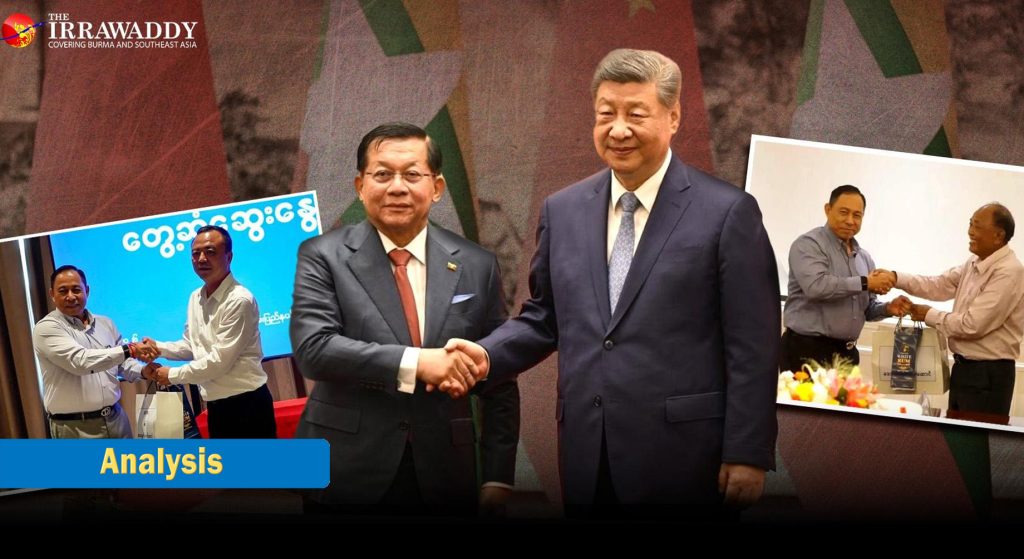
Shortly before Myanmar junta leader-turned-president Min Aung Hlaing wrapped up his five-day state visit to China on Friday, a high-stakes diplomatic strategy coordinated between Naypyitaw and Beijing played out in the two countries.
On Thursday, a regime delegation led by Lieutenant General Yar Pyae, chairman of the junta’s National Solidarity and Peacemaking Negotiation Committee (NSPNC), met with Myanmar’s most powerful ethnic armed group, the United Wa State Army (UWSA), in the Wa State capital of Panghsang, northeastern Shan State.
Prior to their Wa State tour, the delegation was in eastern Shan State’s Mong La on Wednesday to meet with the region’s National Democratic Alliance Army (NDAA) leadership.
The synchronized nature of these events—Lt-Gen Yar Pyae’s border outreach to the Wa and Mong La occurring just as Min Aung Hlaing was given a full state reception in Beijing— underscores how closely China’s economic ambitions are tied to the regime’s survival.
Judging by statements released by the UWSA and NDAA, the aim of the NSPNC mission was to urge the ethnic armed organizations (EAOs) to continue participating in the peace process. It comes toward the end of a “100-day window”—announced after Min Aung Hlaing transitioned to the presidency—setting a July 31 deadline for all EAOs to come to the table.
The focus on the UWSA and NDAA is deliberate; these powerful ethnic armed groups are often viewed as China’s proxy armies. Wa State and Mong La are situated near the Chinese border; neither has taken a stand against the regime, militarily or politically. They maintain ceasefires with the regime and have chosen to stay out of direct fighting with the Myanmar military for over three decades.
Observers pointed out that the tours to the territories came right after Min Aung Hlaing and Chinese President Xi Jinping’s meeting in Beijing, at which Xi urged both sides to emphasize border security. The Chinese president also said China supports all parties in Myanmar advancing peace and reconciliation through dialogue, to achieve lasting stability in northern Myanmar, including northern Shan State along the Chinese border.
China’s willingness to act as a peacemaker is transactional, analysts said. The fighting between the regime and EAOs, supported by their resistance allies, in northern Shan State has severely disrupted Beijing’s flagship China-Myanmar Economic Corridor (CMEC) and lucrative border trade.
During their meeting, Xi and Min Aung Hlaing issued a joint statement pledging to “steadily advance” the Muse-Mandalay Railway. The project serves as the vital initial segment of the CMEC, aimed at linking China’s landlocked southern provinces to the Indian Ocean via Myanmar.
For China to safely build and operate this massive infrastructure project, it needs absolute stability along the border. By leveraging its immense sway over EAOs like the UWSA, which in turn influences other ethnic armed groups fighting the regime in northern Shan, Beijing has positioned itself as the only player capable of brokering the security the regime needs—in exchange for the guaranteed protection of Chinese investments, observers said.
Lt-Gen Yar Pyae is uniquely equipped for this task. He is one of Myanmar’s longest-serving generals and a central figure in the ruling military junta’s peace-building initiatives over successive governments. He served as home affairs minister under Min Aung Hlaing’s post-coup military junta.
At their border headquarters, Wa and Mong La leaders welcomed the Myanmar delegation with smiles, handshakes and gifts. Whether the peace and stability needed for lucrative border trade and the advancement of the CMEC in northern Shan State will actually descend on the region remains an open question.
But with Beijing and Naypyitaw pledging stability to expedite the CMEC project, Min Aung Hlaing has made his ultimate gamble. He is betting his regime’s survival on Beijing’s embrace—and buying peace at China’s price.