Europe’s leaders are expected to agree over dinner late on Thursday that something needs to be done to protect European industries from Chinese imports, though many tremble at the prospect of taking on Beijing.
The EU summit discussion dish of “global macroeconomic imbalances” is gloriously vague when everyone knows the evening’s discussion will be China for entrée, plat and dessert.
So unwilling are European heads of state and government to offend Beijing that there will be no mention of China in the Council conclusions, with language restricted to an exhortation “to strengthen EU competitiveness and strategic autonomy”.
According to senior diplomats and officials, even countries such as Germany and Spain (who are most closely interlinked with China on trade), are ready to listen to France and others concerned that a flood of cheap, often highly subsidised, goods are undermining Europe’s industries.
The convergence comes as European firms are increasingly hit by cheap imports as their own costs rise, while China appears to be moving closer to Russia.
National governments want the European Commission to be quicker to use existing trade defence instruments, particularly on anti-dumping where cases tied up in red tape can drag on for over a year.
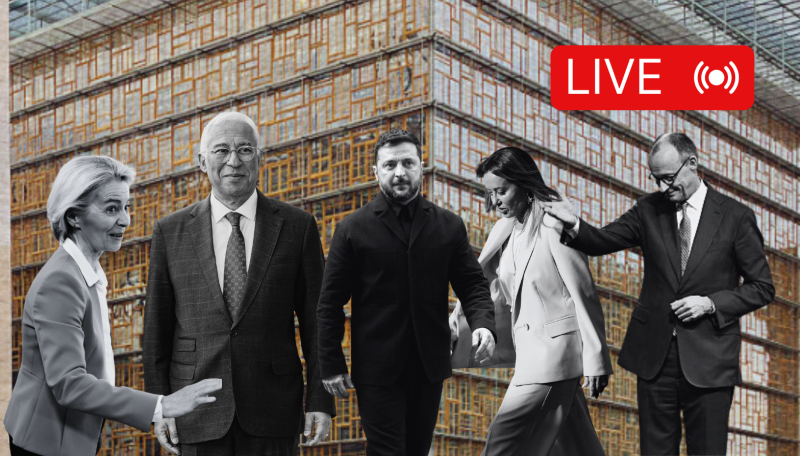
LIVE: EU leaders to talk Ukraine, enlargement and China
EU leaders meet in Brussels on Thursday for a European Council dominated by Ukraine, its…
1 min
The Commission will be asked to develop new measures to tackle “over-capacity”, as heavily subsidised Chinese industries produce high-volumes of goods, such as steel or machine parts, which are unprofitable to make in Europe for the same price.
The new measures could hit Chinese imports – especially those used in Europe’s often long and opaque supply chains – with tariffs. And while the measures need to be country-neutral for legal reasons, they will be finely calibrated to target China.
‘Market dominance’
New EU steel tariffs that enter into force next month will lead to stiff levies on Chinese imports but have also hit preferred European trading partners such as Britain, the Swiss, India and Japan, creating tensions with close allies.
“We need something stricter for those parties who have strong market dominance to be able to protect our industry,” said a senior EU diplomat.
In some areas of the European economy, Chinese imports have between 50% and 60% dominance, according to diplomats. The Commission is also under pressure to take measures to encourage “diversification”, weaning industry off dependency on China.
This will include getting European industries to be more open about where components in complex supply chains, such as in the automobile sector, come from.
The aim will be to incentivise companies not to buy Chinese, and to replace critical strategic components in value chains with parts that can be manufactured in Europe.
But diversification comes at a price. Weaning companies off cheap Chinese imports will also trigger a debate on how to offset the economic damage, perhaps through a ‘buy Europe’ subsidy.
Retaliation is the fear. When the EU blacklisted Chineses banks for financing the Russian military’s war against Ukraine, Beijing hit back targeting Lithuania and alarming Europeans.
The Commission will war-game the likely response from Beijing to any new measures and carry out research to identify the EU’s vulnerabilities and strengths – highly sensitive internal intelligence that will be shrouded in secrecy.
But diplomats and aides to EU leaders believe that the tide has turned and that fears of Beijing are no longer a barrier to taking decisions. “Fear is never a good counsellor,” said one senior EU diplomat.
(vc, jp)
China debate reaches boiling point as EU weighs tougher stance
European leaders will discuss the EU’s increasingly fraught relationship with China when they gather in…
5 minutes