
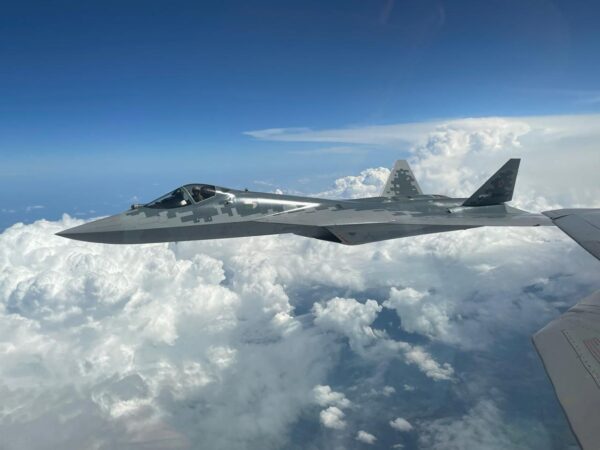
The Indian Air Force (IAF) has a 5G problem, not the telecom one, but an aerospace problem. At the St. Petersburg International Economic Forum on June 5, Russian President Vladimir Putin offered India joint production of the SU-57 fifth-generation fighter aircraft (FGFA) without any “issues or limitations.”
Russia’s latest reiteration of the SU-57 offer is significant beyond the crisis in the IAF, which is grappling with falling fighter squadron strength and continued delays in inducting new jets. It comes at a time when the development of the Advanced Medium Combat Aircraft (AMCA), India’s own fifth-generation fighter, has taken some definitive steps.
Cost-benefit Analysis
On the face of it, Putin’s offer is quite compelling, especially as the IAF’s fighter squadron strength is down to 29 squadrons against the sanctioned 42. Adding to that is the ageing fleet, unending procurement delays and massive delay in induction of the 180 indigenous Light Combat Aircraft (LCA)-Mk1A ordered in two batches, 83 in 2021 and 97 in 2025, that were meant to arrest the free fall. Not one jet has been delivered yet. All this amid multiplying threats in the neighborhood, with China fielding at least 300 J-20 stealth jets and J-35s also entering service. China has recently made major strides in its military modernization, taking a lead even over the West.
Further, Operation Sindoor, the four-day military conflict with Pakistan in May 2025, underscored the criticality of air power and long-range precision weapons in new-age warfare. Beijing is now set to supply J-35 jets to its all-weather ally, Islamabad, for which an initial agreement was recently signed.
In this backdrop, India has now embarked on an effort to procure 114 Rafale jets from France through an Inter-Governmental Agreement (IGA). However, that still leaves a gap in India’s fifth- generation space and is going to persist for some time, given that AMCA is looking at an already ambitious 2035 deadline.
The Request For Proposal was issued to three industry bids in end-May, formally beginning the selection process to identify a private partner for the design and development of the AMCA that was granted permission in 2024 with an allocation of around US$1.8 bn.
Any broad-scale agreement for another project, such as the Russian FGFA, will shift crucial focus and funding away from the AMCA. Any license manufacturing, especially for something as complex and high-end as a fighter jet, would entail cooperation and dependency on the original equipment manufacturer over the next 4-5 decades through the life cycle of the platform. In addition, it may not be the best solution for a country that is trying to build a domestic aerospace ecosystem. The AMCA, though a decade away, is expected to be India’s future workhorse and is a crucial pillar of self-reliance.
Geopolitical Turbulence
At the geopolitical level, India’s continued defense cooperation with Russia has been an issue of friction in its relations with Europe and the U.S., especially as its high-technology cooperation with them deepens.
For instance, India received a waiver under the Countering America’s Adversaries Through Sanctions Act (CAATSA) enacted in 2017 for the S-400 long–range air defense deal signed with Russia in October 2018. Similarly, since the start of the Ukraine war in 2022, European countries have raised concerns over the potential leakage of dual-use technologies to Moscow from India.
However, given the current turbulence in the relationship with the U.S. and the uncertainty in the policies of the Trump administration, any major defense deal with Russia could further destabilize India-U.S. ties. An important point to note in this context is India’s dependence on American engines for the LCA series and even the AMCA prototypes and initial variant, which accentuates India’s dependence on the U.S. This would be a litmus test for India’s much-espoused strategic autonomy.
Past Connection
This is not India’s first brush with the Russian FGFA. India and Russia had signed an IGA way back in October 2007 for joint development and production of the FGFA. India and Russia each spent around $295 million on a preliminary design contract, which commenced in February 2011 and was completed in June 2013, as informed by the then Defense Minister Manohar Parrikar in the Parliament on August 4, 2015. But the effort fell through over cost and extent of access to design and technology. The AMCA was conceived as an outcome of that episode.
One of the shortfalls in the FGFA project was that it was a single-seater aircraft, and the development of a twin-seat variant, the IAF’s preference, would mean a steep rise in costs. Interestingly, a twin-seater SU-57 took to the skies in May and is now undergoing trials as announced by Russia’s First Deputy Prime Minister Denis Manturov.
The joint development proposal aside, the IAF is mulling the possibility of off-the-shelf procurement of a limited number of SU-57s as an interim measure. Even that would be an expensive endeavor and aircraft life cycles typically stretch over decades. Leasing some jets is a feasible and practical option, given India’s experience in leasing Nuclear Attack Submarines (SSN) from Russia and two MQ-9 long-endurance unmanned aerial vehicles from the U.S. That may be an option for decision makers to ponder.