
Promoting Both Electric Vehicle Adoption and Strengthening Domestic Manufacturing Base
Finished Vehicle Production Directly Linked to Parts Industry, Local Economies, and Employment
Major Countries Expand Production Incentives, While Korea Focuses on Purchase Subsidies
The automotive parts industry has urged the government and the National Assembly to actively consider introducing a tax incentive system linked to electric vehicle production in order to expand domestic manufacturing and investment.

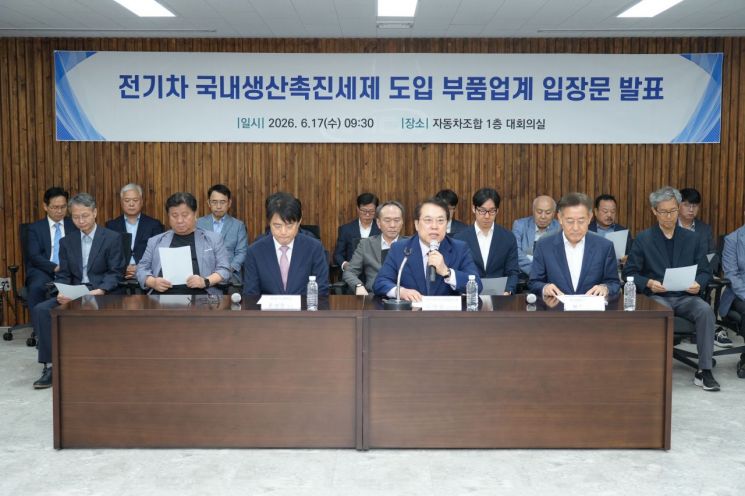
The automobile parts industry announced a statement on the 17th at the large conference room on the first floor of the Korea Automobile Manufacturers Cooperative in Seocho-gu, Seoul, urging the introduction of a domestic production promotion tax system. KAICA
On June 17, the Korea Automobile Industry Cooperative (KAICA) announced a statement titled “The Automotive Parts Industry’s Position on the Need to Introduce Tax Incentives to Promote Domestic Production of Electric Vehicles” at the main conference room on the first floor of the cooperative’s building in Seocho-gu, Seoul.
Attendees included Lee Taekseong, Chairman of KAICA, Moon Seongjun, Chairman of the Hyundai Kia Cooperation Council, Park Kyungbae, Chairman of KG Mobility Partners, and other representatives of the automotive parts industry.
Participants agreed that, amid the rapid changes in the automotive industry environment due to the transition to electrification, the restructuring of global supply chains, and the expansion of the Chinese electric vehicle market, concerns are rising over the weakening of the domestic manufacturing base.
They explained that, because the automotive industry is an organically connected sector involving both finished vehicle manufacturers and numerous parts companies, changes in vehicle production directly affect investment, employment, and local economies within the parts sector.
They also noted that, as countries around the world compete to attract domestic production facilities, the relocation of production bases overseas or a decrease in domestic production could have impacts that extend beyond parts companies to the entire industry.
Furthermore, the automotive parts industry is currently bearing the burden of maintaining the existing internal combustion engine production system while also making new investments for the transition to future vehicles. Intensifying global competition and the increasing price competitiveness of Chinese electric vehicles are further exacerbating management pressures on small and medium-sized parts companies.
Participants pointed out that, while major countries such as the United States and Japan are working to strengthen domestic production and supply chains through production subsidies and production-linked tax incentives, South Korea’s policies are centered on purchase subsidies. As a result, there are limitations in linking the expansion of the electric vehicle market to increases in domestic production, investment, and employment.
Lee Taekseong, Chairman of KAICA, stated, “The automotive industry can only maintain its competitiveness if both finished vehicle manufacturers and parts companies grow together. The expansion of the electric vehicle market does not necessarily lead to a corresponding increase in domestic production. If the manufacturing base is weakened, its impact can spread to the parts industry, local economies, and jobs as a whole.”
Hot Picks Today
He added, “Alongside policies to promote electric vehicle adoption, we need to establish a policy foundation that allows domestic production and investment to continue, thereby creating an industrial environment in which production, investment, and employment circulate positively within Korea. Tax incentives to promote domestic production of electric vehicles are not support measures for specific companies, but rather a policy tool to enhance the sustainability of domestic production, investment, and supply chains. It is important to create conditions that enable both finished vehicle manufacturers and parts companies to continuously invest and grow in Korea.”
This content was produced with the assistance of AI translation services.
© The Asia Business Daily(www.asiae.co.kr). All rights reserved.