
Cambria Gold Mines Inc. June 9 reported the first batch of results from an underground drill program aimed at further delineating high-grade zones in preparation for a restart of operations at the Premier gold mine project in Northern British Columbia.
Located near the mining town of Stewart, Premier is home to a past-producing high-grade gold mine that operated from 1918 to 1952 and again from 1989 to 1996.
With its sights set on establishing a new era of mining at Premier, Ascot Resources Ltd. acquired the project in 2009. After roughly a decade of exploration, Ascot completed a feasibility study and began upgrading the mill in preparation for the restart of operations at the historic mine.
This work was guided by a 2020 feasibility study that detailed plans to develop four underground mines – Big Missouri, Premier, Silver Coin, and Red Mountain – with enough high-grade ore to produce roughly 1.1 million ounces of gold and 3 million oz of silver over the first eight years of mining.
The Premier mining operation detailed in the study was based on 3.63 million metric tons of probable reserves averaging 5.45 grams per metric ton (637,000 oz) gold and 19.1 g/t (2.23 million oz) silver within the Silver Coin, Big Missouri, and Premier-Northern Lights deposits; plus 2.55 million metric tons of proven and probable reserves averaging 6.52 g/t (534,000 oz) gold and 20.6 g/t (1.69 million oz) silver at Red Mountain.
While Ascot began commissioning the 2,500-metric-ton-per-day Premier mill in early 2024 and poured the first bar of gold in April, underground mining difficulties prevented the company from scaling the operation to commercial production.

Cambria Gold Mines Inc.
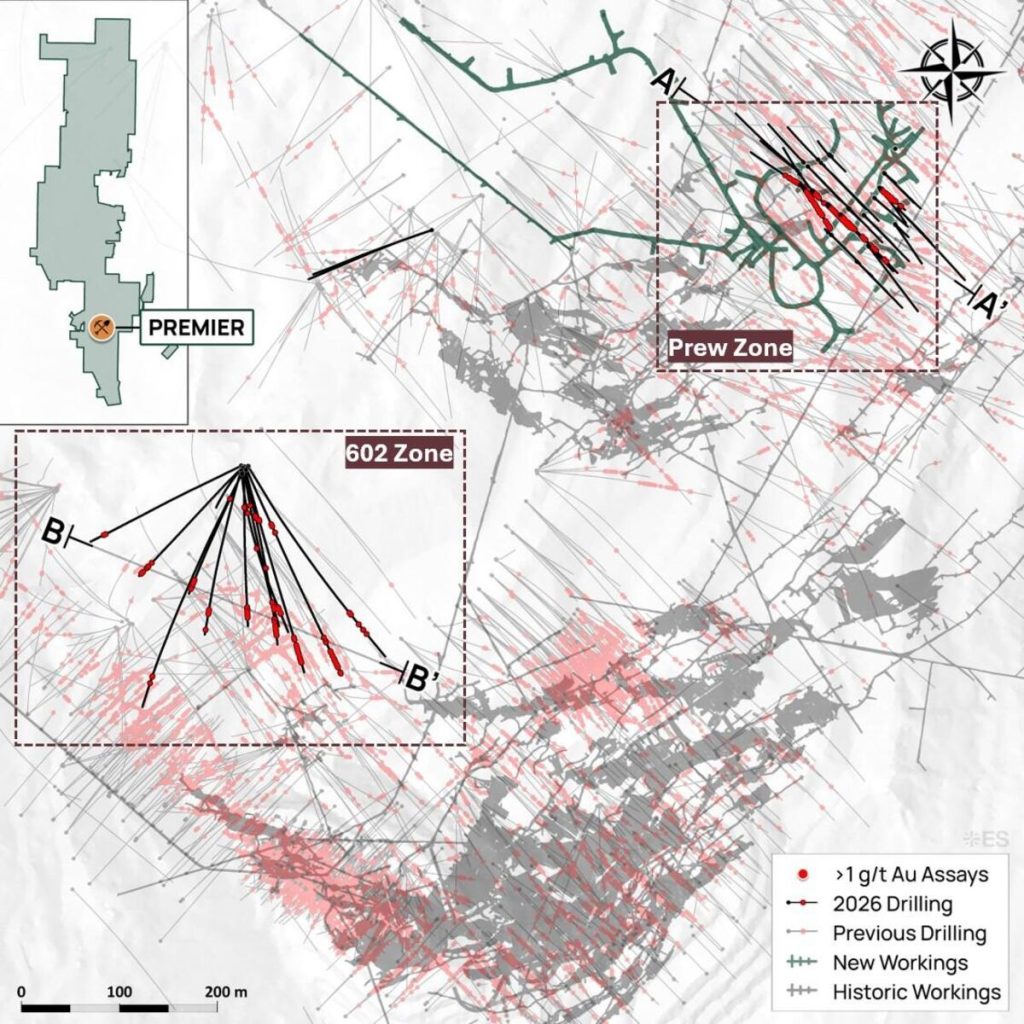
Cambria kicked off its 2026 program at Premier with surface infill drilling at 602 Zone and underground infill drilling at Prew Zone.
With Ascot on the brink of bankruptcy, a new management team led by longtime Stewart resident and mining executive Rob McLeod was appointed to guide the restructured company, which was rebranded Cambria Gold Mines, and C$175 million ($129 million) was raised to fund a new strategy to ensure a steady and plentiful supply of ore for the mill.
Under the belief that the previous 25-meter drill spacing completed by Ascot was too wide for accurate modeling of high-grade zones in the Prew Zone of the Premier-Northern Lights Deposit, and contributed to the company’s mining difficulties, Cambria is carrying out an underground drill program to better delineate this zone next to the mill.
Highlights of assays from the first fifteen holes of the 2026 underground infill drilling at Prew include:
• Five meters averaging 19.82 g/t gold, including two meters of 45.88 g/t gold in hole P26U-0003.
• 6.3 meters averaging 14.96 g/t gold, including three meters of 24.5 g/t gold in hole P26U-0007.
• Seven meters averaging 11.38 g/t gold, including 2.9 meters of 26.56 g/t gold in hole P26U-0008.
• One meter averaging 483 g/t gold in hole P26U-00011.
• Nine meters averaging 7.24 g/t gold, including three meters of 12.93 g/t gold in hole P26U-00016.

Cambria Gold Mines Inc.
In addition to the underground drilling at Prew, Cambria has also been completing infill drilling of the 602 Zone of the Premier-Northern Lights Deposit. The best intercept from the first nine holes drilled at 602 was 12.2 meters averaging 9.82 g/t gold in hole P26-2694.
These results follow up on assays from five surface holes targeting 602 reported by Cambria in April. Highlights from the first batch of 2026 surface holes include:
• 22 meters averaging 17.95 g/t gold in hole P26-2686, including 0.5 meters of 552 g/t gold.
• Six meters averaging 3.35 g/t gold in hole P26-2689, including two meters of 8.23 g/t gold.
• 15.4 meters averaging 3.98 g/t gold in hole P26-2690, including 1.6 meters of 19.63 g/t gold.
“These results are demonstrating the continuity of gold grade and host structure at the Prew and 602 Zones, located down-dip from the famous Premier Gold Mine,” said McLeod.
Overall, the company plans to complete 27,000 meters of drilling to delineate resources across the deposits at Premier.
“We will continue to infill the Premier deposit over the coming weeks before targeting the Big Missouri and Silver Coin Deposits located further north of the Premier mine and mill,” the Cambria president and CEO added.
In addition to drilling at Premier, Cambria is building a road to Red Mountain, a satellite project roughly 25 kilometers (16 miles) southeast of Premier. High-grade ore deliveries from Red Mountain are an important part of the company’s plan for a successful restart of operations at Premier.
A feasibility study that details the mining plan is expected to be completed before the end of the year.
Author Bio
Shane Lasley, Publisher

Over his more than 18 years of covering mining and mineral exploration, Shane has become renowned for his ability to report on the sector in a way that is technically sound enough to inform industry insiders while being easy to understand by a wider audience.