
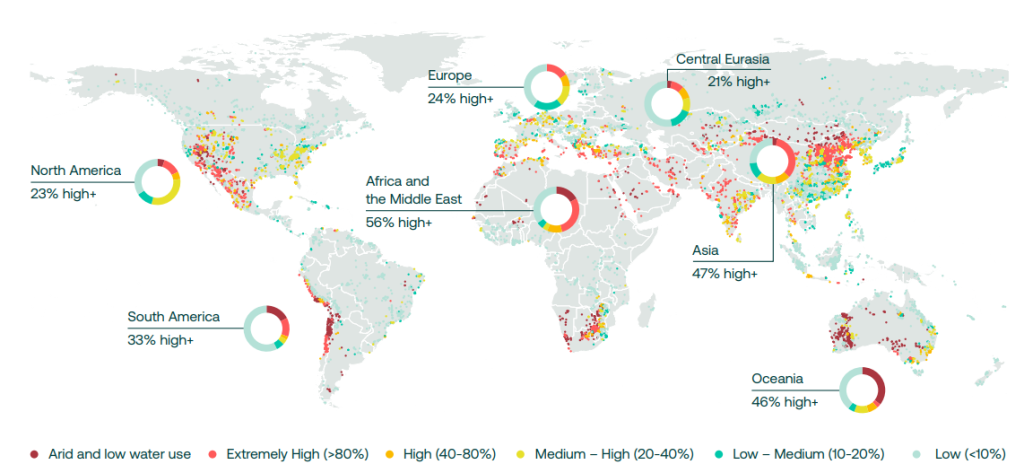
Context: The International Council on Mining and Metals (ICMM) released its Global Mining and Metals Water Dataset, revealing that nearly two-thirds of global mining and metals processing facilities face high physical water risk.

About The Global Mining and Metals Water Dataset Report:
What it is?
- The Global Mining and Metals Water Dataset report represents the first comprehensive, cross-commodity analysis evaluating the mining sector’s exposure to physical water risks worldwide. Developed by ICMM in collaboration with research partners, the report overlays point-location data from 12,000 mining and metals facilities across 148 countries/regions with primary water risk datasets.
Key Findings in the Report:
- Most Common Threat (Baseline Water Stress): 38% of all facilities operate in catchments experiencing high/extremely high water stress or arid conditions. Over 70% of these stressed facilities are also exposed to high baseline water depletion (27% of global facilities).
- Extreme Drought Concentrations: 27% of global sites face high drought risk. In Africa and the Middle East, this exposure reaches 81%. In countries like Zambia, Ghana, and Uzbekistan, 100% of mining facilities face high drought risk, while South Africa stands at 96%.
- Elevated Flood Risk in Refining: While global flood exposure sits at 14%, specific processing stages face far higher hazards—notably steel production (27%), alumina refining (27%), molybdenum (25%), and aluminium smelting (24%).
- Interannual Unpredictability in Oceania: 16% of global facilities experience high year-to-year water supply variability. Oceania exhibits extreme exposure, with 74% of its facilities (and 79% in Australia) subjected to severe supply fluctuations.
- Compound Risk Hotspots (Convergence of 3+ Risks): 5% of global facilities face high risk across three or more physical indicators simultaneously. These compound clusters concentrate in Chile, Peru, the Western United States, southern Africa, northern China, central India, and western Australia.
- Vulnerability of Critical Energy Transition Minerals: Key clean energy transition commodities face above-average risk profiles.
Example: Platinum Group Elements (74% drought risk), Manganese (21% compound exposure), and Copper (9% compound exposure) operate in highly vulnerable catchments.
- Chile’s Dual Pressure: Chile—the world’s top copper producer and a major lithium supplier—sees 86% of its facilities facing high baseline water stress and high interannual variability concurrently.
How Mining Impacts Water Resources?
- Massive Volumetric Withdrawals: Extractive processes require large volumes of water for mineral processing, dust suppression, slurry transport, and equipment cooling, competing directly with local communities.
- Depletion of Local Aquifers: Intensive groundwater pumping for mine dewatering lowers regional water tables, causing long-term consumptive loss where water is not returned to the local basin.
- Effluent and Tailings Contamination Risks: Tailings storage facilities and unmanaged mine drainage can release heavy metals and chemical processing agents into surrounding river catchments.
- Modification of Hydrological Flows: Surface infrastructure, pit excavation, and land clearing alter natural catchment run-off patterns, increasing local vulnerability to soil erosion and flash flooding.
Implications of Water Risk in Mining:
- A Binding Constraint on the Clean Energy Transition: Water shortages threaten to create supply bottlenecks for essential transition minerals like copper, lithium, nickel, and rare earths, slowing solar, wind, and EV battery production.
- Supply Chain Disruptions and Price Volatility: Extreme weather events—such as intense droughts forcing operational halts or floods destroying pit infrastructure—lead to production losses and global metal price spikes.
- Heightened Social Conflict and Loss of License to Operate: Operating in water-stressed catchments intensifies local competition between mining companies, agricultural farmers, and rural communities, sparking social unrest.
- Financial and Asset Stranding Risks: Unmanaged water risks can result in regulatory fines, increased capital expenditures for alternative water sourcing, or stranded assets.
Recommendations:
- Adopting Integrated Catchment-Based Water Stewardship: Shift from isolated, site-level water management to collaborative catchment-scale frameworks that account for local communities, agriculture, and ecosystem needs.
- Integrating Long-Term Water Risk into Energy Policy: Governments and investors must factor water availability constraints into strategic planning for critical mineral supply chains and renewable energy targets.
- Investing in Low-Quality and Alternative Water Technologies: Scale up operational recycling technologies, closed-loop processing systems, and seawater usage (such as direct ocean water piping used at Chile’s Minera Centinela) to preserve freshwater sources.
- Implementing Proactive Forward-Looking Land & Water Planning: National regulators should establish clear water allocation priorities and environmental flow thresholds before issuing new mining concessions in high-stress basins.
- Strengthening Granular, Facility-Level Water Data Transparency: Improve public reporting on facility water withdrawals, consumption, and discharge metrics to enable accurate site-level risk benchmarks.
Conclusion:
The ICMM report demonstrates that physical water hazards pose an immediate operational threat to global mining infrastructure rather than a distant concern. Because two-thirds of processing facilities operate in vulnerable catchments, unmanaged water stress directly threatens the supply chains powering renewable energy technologies. Ultimately, securing the critical minerals required for global sustainability requires moving from reactive water management toward integrated, catchment-based water stewardship.