
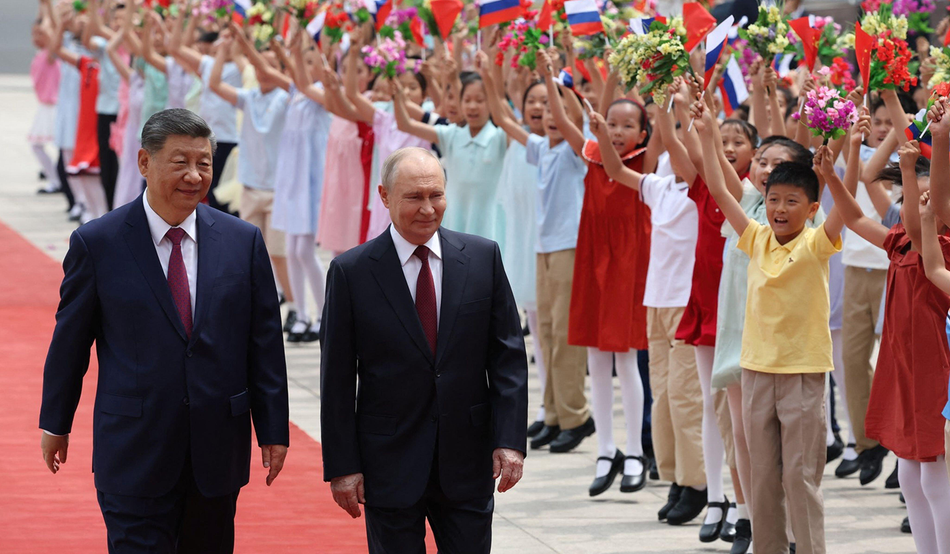
Since Russia’s full scale invasion of Ukraine in February 2022, Vladimir Putin’s visits to Beijing have had two regular features: ever more extravagant claims to limitless friendship between China and Russia, and the message, always sent by Russian delegations in advance, that the meeting will produce an agreement on the construction of Power of Siberia 2, a proposed 2600km pipeline that would bring gas from the Yamal Peninsula on Russia’s Arctic coast to Shanghai.
On that subject, the Chinese side remains characteristically silent. Ahead of Putin’s visit this week, Russia filled media outlets with speculation about the pipeline. But as before, the meeting concluded, to the surprise only of a few gullible journalists, with no agreement.
Initially, China’s hesitation might seem surprising. China has a fossil energy problem: it is short of domestic supplies of oil and gas, which has made it dependent on seaborne liquified natural gas (LNG) imports and the fleets of tankers that must navigate potentially hostile choke points to keep its economy fuelled. It imports 40 per cent of the gas it needs. Until the Hormuz crisis, the choke point that most concerned Beijing was the Malacca Strait, which divides Malaysia and Indonesia, and connects the Indian and Pacific Oceans: the fear that it might be closed was an important driver of China’s island building and militarisation of the South China Sea.
Over the years, China has made itself less vulnerable through a range of strategies. It continues to burn half the world’s coal, a climate-damaging fossil fuel that China has in great abundance, and its success in developing fracking gas contributed to a growth in domestic oil and gas production. But it has also diversified, building roughly 320 GW of new hydroelectric capacity in 25 years, more than the entire electricity generating capacity of Germany, France and the United Kingdom combined. Its nuclear capacity has grown at an impressive scale and pace: by mid-2025, China had 58 commercial nuclear power plants operating with an installed capacity of over 60.7 GW, and a further 44 plants reportedly under construction. China’s nuclear capacity could reach 150 GW by 2035—placing it just behind the United States and France. And in recent years, as its wind and solar industries have taken off, China has built a staggering 2.34bn kilowatts of renewable power (the UK has 65GW of renewables installed).
Nevertheless, China is still dependent on imports—and has built five pipelines across Myanmar, Central Asia and Russia to secure it. In addition to the long discussions about Power of Siberia 2, another Russia-China pipeline, with a 10bn cubic metre capacity, is currently being built from Sakhalin, a Russian island in the Pacific. These pipelines are costly to build, but they deliver a steady, if limited supply of gas that is cheaper than LNG transported by sea. Meanwhile, Russia is losing its European gas markets and is keen to unload stocks to its neighbour. So why is China so reluctant to expand its energy relationship with Russia?
If Power of Siberia 2 went ahead, Russia could supply up to some 40 per cent of China’s gas. For China, that is a strategic risk, too much to come from a single source.
Despite their protestations of unlimited friendship, Russia and China have a troubled history that neither has forgotten. As European energy customers found to their cost, becoming too dependent on Russia for something as vital as gas supply gives the Kremlin a power that it is has been willing to abuse. China would prefer to keep Russian gas as a limited component in its energy mix, to avoid this trap.
In any event, China is rapidly electrifying its economy: in 2024, renewables represented 55 per cent of China’s power capacity, while gas was only 4 per cent. The war in the Strait of Hormuz has served as a painful reminder of the vulnerabilities that come with exposure to global markets and seaborne trade. But even if agreement on the Power of Siberia 2 was reached tomorrow, it would take 10 years for the pipeline to become operational—and in this time, China’s major state energy companies project that the country’s gas demand will have peaked.
The Russian majority state-owned energy giant Gazprom claims the pipeline would be the biggest infrastructure project ever built, and estimates of the cost range up to $34bn. To recover that investment, Russia wants China to pay European prices for its gas and to agree to a long-term supply contract. China, on the other hand, wants flexibility and a gas price closer to Russia’s subsidised domestic supply.
The Kremlin spokesman, Dmitry Peskov put a brave face on Wednesday after the meeting failed to deliver his hoped-for result. “[O]verall, there is already a shared understanding of the main parameters for Power of Siberia 2,” he said. “There is agreement on the route and on how the project will be built. Some details still need to be finalised, but in general, such an understanding is already in place.” But no, he was obliged to admit, there was no timetable for the project. That was the sound of a very large can being kicked down a very long road.