
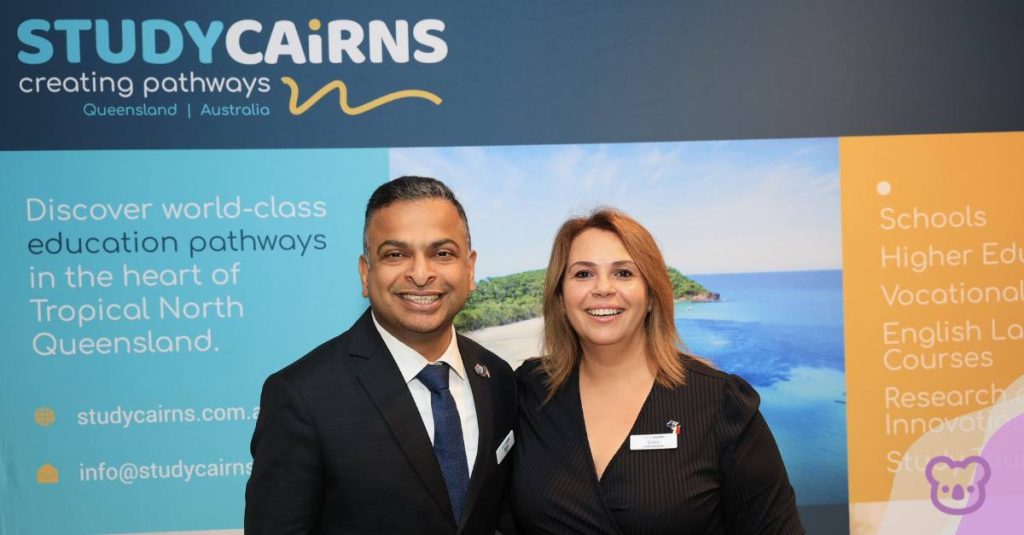
Cairns is making a play to become one of Australia’s leading regional study destinations, with Study Cairns strengthening ties with Indonesia while launching a new ambassador program designed to put international students at the heart of the city’s global story.
The organisation this week brought together education providers, industry leaders, government representatives and students for a regional think tank focused on the future of international education in Tropical North Queensland.
The event follows Study Cairns’ recent education delegation to Indonesia, which visited Bali, Makassar and Jakarta. The mission was the first Queensland-led international education delegation of its kind in more than six years and aimed to deepen relationships with Indonesian institutions while creating new pathways for students and workforce development.
Study Cairns Chief Executive Suha McCartney said the delegation was about much more than recruitment.
“This delegation was about creating genuine institutional relationships, strengthening academic and research collaboration, and building future pathways between Tropical North Queensland and Indonesia that benefit both regions,” she said.
Indonesia has become an increasingly important market for Australian education providers. With a population of more than 280 million people, a rapidly expanding middle class and strong demand for international qualifications, the country represents one of the most significant growth opportunities for Australian education over the coming decade.
While major universities have traditionally focused on capital cities, regional destinations such as Cairns are increasingly promoting a different value proposition. Alongside education, they are highlighting lifestyle, employment opportunities, community connections and access to industries facing workforce shortages.
Ms McCartney said that combination gives Cairns a unique advantage.
“What makes Cairns unique is not only the quality of education and training opportunities available, but the connected and supportive ecosystem we provide across the student journey,” she said.
The city’s international education sector already contributes more than $90 million annually to the local economy and supports workforce pathways across tourism, hospitality, healthcare, aged care, engineering and community services.
A key announcement at the event was the launch of the 2026/2027 Study Cairns International Student Ambassador Program.
The initiative will bring together student representatives from a range of cultural backgrounds including China, Japan, Papua New Guinea, Africa and Slovakia. Ambassadors will share their experiences of studying and living in Cairns through storytelling, community engagement, social media and a new international student podcast.
The program reflects a broader trend across Australia’s international education sector, where institutions are increasingly relying on student voices rather than marketing campaigns to build trust with prospective students.
For many future students, hearing directly from peers about accommodation, employment, community life and support services carries far more weight than traditional recruitment materials.
Ms McCartney said international students play a critical role in the social, cultural and economic fabric of Tropical North Queensland.
“Many international students spend several years building their lives here — studying, working, volunteering and becoming part of the community — and this program recognises the value of those experiences,” she said.
The event also featured discussions on future partnerships between Indonesia and Tropical North Queensland, with speakers including Australian Indonesian Business Council Queensland Chair Rachel Colaso and representatives from government, industry and education sectors.
As Australia’s international education sector continues to diversify beyond the major metropolitan centres, Cairns appears determined to position itself as more than just a tourism destination. The message from Study Cairns is clear: regional Australia wants a bigger seat at the international education table, and Indonesia may be one of the keys to getting there.