
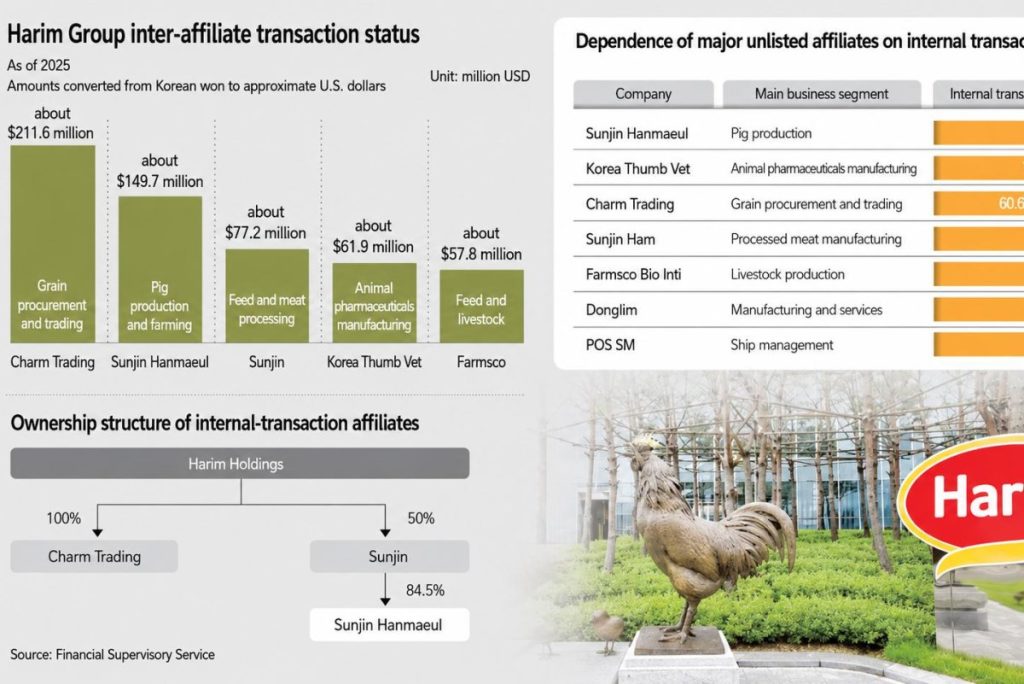
Harim Group’s internal affiliate transactions reached high levels in 2025, with Charm Trading recording about $211.6 million in internal transactions and some unlisted affiliates depending on group transactions for more than 80% of sales. Data from Financial Supervisory Service. Graphic by Asia Today and translated by UPI
June 3 (Asia Today) — Harim Group’s domestic transactions among affiliates exceeded 1.4 trillion won, or about $914 million, last year, raising concerns that some unlisted units remain heavily dependent on business from within the group.
An analysis of Financial Supervisory Service filings and affiliate transaction data showed Harim Group’s domestic internal transactions totaled 1.44 trillion won, or about $938 million, in 2025.
That accounted for about 11.5% of the group’s total revenue of 12.41 trillion won, or about $8.11 billion.
Harim Group has a vertically integrated business structure spanning feed production, livestock, food processing, distribution and logistics. The structure has drawn attention because several unlisted affiliates reported high levels of sales from transactions with other group companies.
Sunjin Hanmaeul, an agricultural company involved in pig farming, generated 229.2 billion won, or about $150 million, of its 256.6 billion won, or about $168 million, in total revenue last year through transactions with affiliates including Harim Holdings and Sunjin. That means 89.3% of its sales came from internal group transactions. Sunjin Hanmaeul is a sub-subsidiary of Harim Holdings.
Korea Thumb Vet, an animal pharmaceutical affiliate, also generated 94.8 billion won, or about $62 million, of its 130.1 billion won, or about $85 million, in total revenue from affiliate transactions. The company is also a sub-subsidiary of Harim Holdings.
Charm Trading, a Harim Holdings subsidiary responsible for grain procurement and trading, posted 323.9 billion won, or about $212 million, in internal transactions out of 534.5 billion won, or about $349 million, in total revenue last year. That was the largest amount among the group’s affiliate transactions.
Sunjin, a core affiliate in the feed and processed meat businesses, recorded 118.138 billion won, or about $77 million, in sales through affiliate transactions. Sunjin also owns an 89.4% stake in Sunjin Hanmaeul, whose internal transaction dependence reached 89.3%.
Other unlisted affiliates also showed high dependence on internal transactions. Sunjin Ham, a processed meat manufacturer, posted an internal transaction ratio of 99.9%. Farmsco Bio Inti, a livestock production affiliate, recorded 85.8%, while ship management company POS SM reported 85.4% and manufacturing and services affiliate Donglim posted 80.2%.
Harim Group was sanctioned by the Fair Trade Commission in 2021 over allegations that affiliates steered business to Orpum, a private company wholly owned by Kim Jun-young, the eldest son of Harim Chairman Kim Hong-kuk and an assistant managing director at Pan Ocean.
At the time, the commission said affiliate support provided unfair economic benefits to the owner family and imposed corrective orders and fines. Harim challenged the decision and the case is currently in administrative litigation.
The continued transaction structure involving major affiliates such as Charm Trading, Sunjin Hanmaeul and Korea Thumb Vet has drawn attention because it appears to have changed little since the commission’s sanctions.
Harim Group’s succession structure is widely seen as centered on Kim Jun-young. Through Orpum and Korea Investment, Kim has secured influence within the ownership structure of Harim Holdings, and key affiliates are also included under that structure.
Some level of internal transactions may be inevitable in a vertically integrated industry. But critics say it is a separate issue when some unlisted affiliates continue to depend on internal group transactions for 60% to nearly 100% of their revenue, especially as regulators strengthen oversight of tunneling and unfair support involving owner families.
The Fair Trade Commission says it does not determine illegality based only on the share of internal transactions.
“Internal transactions become a problem when illegal conduct such as unfair business steering or private benefit-taking is involved,” a commission official said. “If unfair support or private benefit-taking is found, the transaction can be subject to sanctions under relevant laws.”
— Reported by Asia Today; translated by UPI
© Asia Today. Unauthorized reproduction or redistribution prohibited.
Original Korean report: https://www.asiatoday.co.kr/kn/view.php?key=20260604010001065