

MALAYSIA finds itself at a pivotal moment. After decades of robust growth powered by a young, expanding population, our future prosperity will depend less on numbers and more on how deftly we adapt to new demographic realities.
Far from a crisis, this evolution – if met with thoughtful policy and shared commitment – can deliver a more resilient and inclusive economy.
For many years, brisk population growth underpinned Malaysia’s economic development. A swelling youthful labour force expanded productive capacity, fuelled domestic demand, and sustained healthy saving and investment rates.
In the early 2000s, the demographic dividend – the period in which working-age Malaysians outnumbered dependants – added an estimated 0.3 percentage points to annual GDP growth, according to the World Bank.
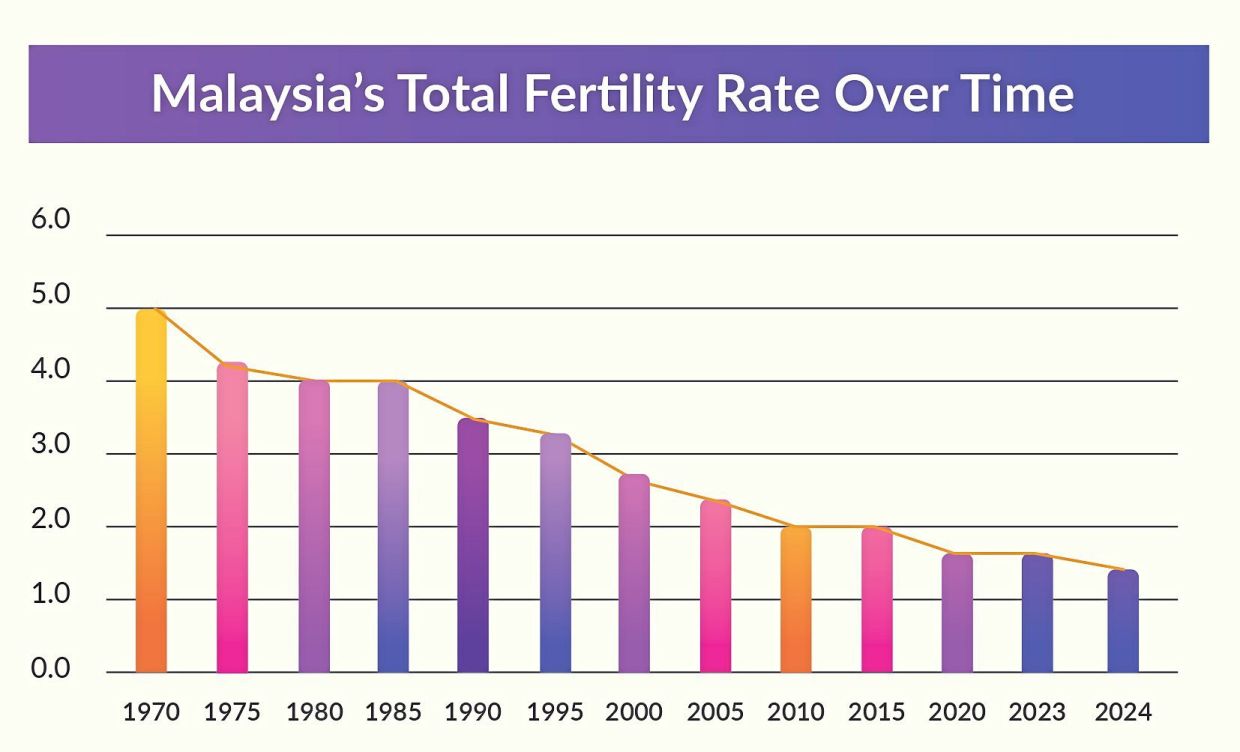
Today, however, the signals are shifting. The Department of Statistics Malaysia (DOSM) reports that total fertility has fallen from 4.9 children per woman in 1970 to just 1.6 in 2024 – well below the replacement rate of 2.1.
By 2050, nearly one-fifth of Malaysians will be 65 or older, a stark departure from the youthful profile of previous decades.
This change, though common throughout Asia, marks the diminishing demographic dividend and raises a critical question: how can growth be sustained with a smaller, older population?
New growth model for a changing population
This transition invariably brings about inter-related challenges.
Fewer young entrants risk talent shortages that could dampen productivity and innovation, while a larger senior cohort will require more comprehensive and attentive healthcare, pensions, and social protection.
Unless we act soon, the cost of supporting an ageing society will fall on a shrinking pool of workers.
Expanding women’s participation in the workforce is perhaps Malaysia’s clearest opportunity.
Although women make up more than 52% of tertiary graduates, their labour-force participation is only 56.2% versus 82.3% for men.
This under-used talent pool is not merely a gender issue; it is a macro-economic imperative.
DOSM’s Labour Force Survey 2024 shows that three million people remained outside the labour force due to family and care obligation, of whom 98% are women.
In addition, KRI reports that only 4.6% of childcare centres are workplace-based. Structural barriers, social expectations, and limited flexible-work options perpetuate this gap.
Recognising this, the 13th Malaysia Plan (RMK13) sets a specific target to raise women’s labour force participation to 60%, supported by greater access to quality childcare services and tailored training programmes, an agenda that directly addresses the matter.
International experience offers valuable lessons. Sweden, for instance, has kept fertility relatively stable and female labour-force participation high through family-friendly policies – subsidised childcare, extensive parental leave, and flexible hours – creating a more balanced labour market that advances both growth and gender equity.
Malaysia has begun to move in this direction with flexible-work guidelines, return-to-work programmes, and employer incentives including the introduction of paid paternity leaves.
While these initiatives are certainly commendable, the agenda must deepen.
Key priorities include greater investment in early-childhood education, rewarding firms that adopt flexible practices, and normalising shared caregiving duties so that more women can remain – and thrive – in the workforce.
At the opposite end of the age spectrum lies retirement. Malaysia’s statutory retirement age of 60 is lower than that of many peers; Singapore, for example, has already raised its threshold to 63 and plans to reach 65 by 2030.
Given longer lifespans and better health, many older Malaysians wish to remain economically active beyond 60.
Indeed, the rationale for examining the benefits and trade offs of raising the retirement age must be approached with objectivity and care – even as global trends point to a common inclination towards such reforms, albeit via different implementation paths.
RMK13’s proposed legal reforms to review the minimum retirement age can help, but success will depend on retraining, creating age-friendly workplaces, and enabling part-time or phased retirement.
Extending the retirement age is not about compelling anyone to work longer; it is about offering the freedom to do so.
Staying in employment can bolster household finances, support pension system viability, and preserve valuable experience in the economy.
Because not every occupation suits older workers, policies should build in flexibility – supporting retraining, parttime roles, and age-friendly workplaces.
Charting the course together
Malaysia’s demographic crossroads invites us to rethink our growth model. Instead of relying on population expansion, we can raise productivity, broaden participation, and invest in human capital.
Emerging technologies, remote work, and alternative employment structures open new avenues to integrate previously under-represented Malaysians into the labour force.
As outlined in RMK13, human capital development is a central strategy – with emphasis on digital skills, artificial intelligence literacy, and lifelong learning.
The plan calls for building talent “from school to workplace” and rolling out the National AI Action Plan 2030 to ensure a future-ready workforce.
This approach ensures that even with a smaller population, Malaysia’s workforce remains highly competitive and productive. Progress will require concerted action from the government, the private sector, and civil society.
As Bernama reports, under RMK13, civil servants will undergo intensive digital and AI training to strengthen Malaysia’s talent pool.
This is a clear signal that the government is taking the lead in preparing for this transition.
Policymakers must craft systems that support families, workers, and retirees alike – employers must adopt inclusive practices and redesign career paths; and individuals must embrace lifelong learning in a fluid labour market.
Malaysia’s demographic transition is therefore not a tale of inevitable decline – it is a rallying cry.
By responding with empathy, foresight, and ambition, we can build a stronger, more inclusive economy that serves every generation.
As we look to 2050 and beyond, the real question is not merely how we grow, but how we grow together.
This is a clarion call to share this responsibility collectively, but the time to act is now.
By Kumpulan Wang Persaraan (Diperbadankan) [KWAP] chief strategy and services officer Nazaiful Affendi Zainal Abidin, and Retirement Research team Raja Abdul Azim and Amirul Hamza.
Disclaimer: KWAP shall not be responsible or liable for any error, omission, inaccuracy of the information, or for any reliance or usage of all or any part of this article whatsoever. All information contained herein is provided on an “as is basis”.