
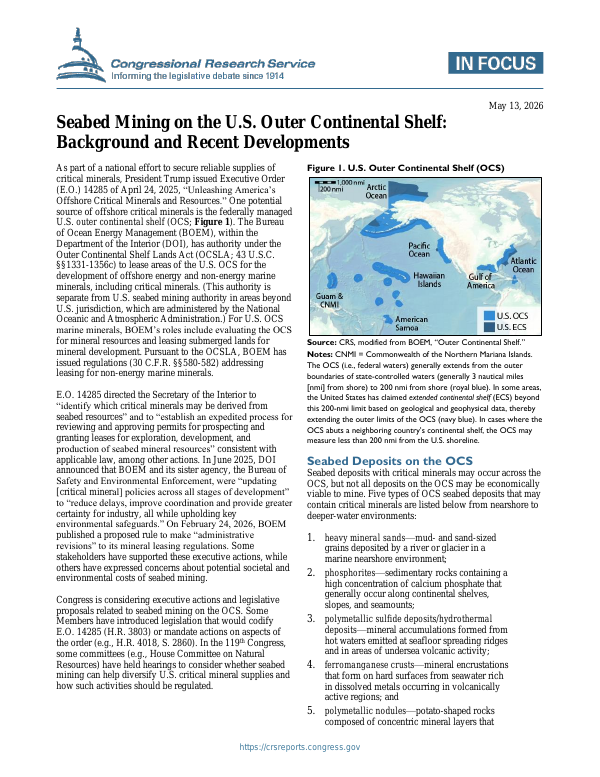
As part of a national effort to secure reliable supplies of critical minerals, President Trump issued Executive Order (E.O.) 14285 of April 24, 2025, “Unleashing America’s Offshore Critical Minerals and Resources.” One potential source of offshore critical minerals is the federally managed U.S. outer continental shelf (OCS; Figure 1). The Bureau of Ocean Energy Management (BOEM), within the Department of the Interior (DOI), has authority under the Outer Continental Shelf Lands Act (OCSLA; 43 U.S.C. §§1331-1356c) to lease areas of the U.S. OCS for the development of offshore energy and non-energy marine minerals, including critical minerals. (This authority is separate from U.S. seabed mining authority in areas beyond U.S. jurisdiction, which are administered by the National Oceanic and Atmospheric Administration.) For U.S. OCS marine minerals, BOEM’s roles include evaluating the OCS for mineral resources and leasing submerged lands for mineral development. Pursuant to the OCSLA, BOEM has issued regulations (30 C.F.R. §§580-582) addressing leasing for non-energy marine minerals.
E.O. 14285 directed the Secretary of the Interior to “identify which critical minerals may be derived from seabed resources” and to “establish an expedited process for reviewing and approving permits for prospecting and granting leases for exploration, development, and production of seabed mineral resources” consistent with applicable law, among other actions. In June 2025, DOI announced that BOEM and its sister agency, the Bureau of Safety and Environmental Enforcement, were “updating [critical mineral] policies across all stages of development” to “reduce delays, improve coordination and provide greater certainty for industry, all while upholding key environmental safeguards.” On February 24, 2026, BOEM published a proposed rule to make “administrative revisions” to its mineral leasing regulations. Some stakeholders have supported these executive actions, while others have expressed concerns about potential societal and environmental costs of seabed mining.
Congress is considering executive actions and legislative proposals related to seabed mining on the OCS. Some Members have introduced legislation that would codify E.O. 14285 (H.R. 3803) or mandate actions on aspects of the order (e.g., H.R. 4018, S. 2860). In the 119th Congress, some committees (e.g., House Committee on Natural Resources) have held hearings to consider whether seabed mining can help diversify U.S. critical mineral supplies and how such activities should be regulated.
|
Source: CRS, modified from BOEM, “Outer Continental Shelf.” Notes: CNMI = Commonwealth of the Northern Mariana Islands. The OCS (i.e., federal waters) generally extends from the outer boundaries of state-controlled waters (generally 3 nautical miles [nmi] from shore) to 200 nmi from shore (royal blue). In some areas, the United States has claimed extended continental shelf (ECS) beyond this 200-nmi limit based on geological and geophysical data, thereby extending the outer limits of the OCS (navy blue). In cases where the OCS abuts a neighboring country’s continental shelf, the OCS may measure less than 200 nmi from the U.S. shoreline. |
Seabed Deposits on the OCS
Seabed deposits with critical minerals may occur across the OCS, but not all deposits on the OCS may be economically viable to mine. Five types of OCS seabed deposits that may contain critical minerals are listed below from nearshore to deeper-water environments:
- 1. heavy mineral sands—mud- and sand-sized grains deposited by a river or glacier in a marine nearshore environment;
- 2. phosphorites—sedimentary rocks containing a high concentration of calcium phosphate that generally occur along continental shelves, slopes, and seamounts;
- 3. polymetallic sulfide deposits/hydrothermal deposits—mineral accumulations formed from hot waters emitted at seafloor spreading ridges and in areas of undersea volcanic activity;
- 4. ferromanganese crusts—mineral encrustations that form on hard surfaces from seawater rich in dissolved metals occurring in volcanically active regions; and
- 5. polymetallic nodules—potato-shaped rocks composed of concentric mineral layers that form around a hard nucleus, such as a shark tooth, lying on the deep seafloor.
OCS Areas Currently Being Considered for Critical Mineral Leasing
In response to E.O. 14285 and pursuant to its statutory authority under OCSLA (43 U.S.C. §1337(k)), BOEM has initiated the process for four potential mineral lease sales in federal waters offshore of American Samoa, the Commonwealth of the Northern Mariana Islands (CNMI), Virginia, and Alaska. To date, BOEM has not issued any leases for critical mineral activities. BOEM’s critical mineral leasing process may start with an unsolicited request for a lease sale or by BOEM’s own initiative. In either case, BOEM may publish a request for information and interest (RFI) specifying areas or minerals to be considered. The RFI may be followed by additional steps to pursue a marine mineral lease sale.
Unsolicited Requests for Mineral Lease Sales
American Samoa. On April 8, 2025, BOEM received a request from the Impossible Metals company to commence a leasing process for exploration and potential development of critical minerals on the OCS offshore of American Samoa. During an April 2025 House Committee on Natural Resources hearing, Impossible Metals confirmed it had previously requested a lease sale for polymetallic nodules on the OCS off American Samoa in 2024. At that time, BOEM opted not to initiate leasing steps.
On June 16, 2025, in response to Impossible Metals’ second request, BOEM published an RFI for a lease sale for OCS minerals offshore of American Samoa. BOEM’s most recent activity in this matter, as of the date of this publication, was to complete its Area Identification (Area ID) decision memo. The memo determines the OCS areas that are to undergo environmental review for a proposed critical mineral lease sale, pursuant to the National Environmental Policy Act (42 U.S.C. §§4321 et seq.). The American Samoa Area ID memo identifies an area larger than the original RFI area for consideration for a potential lease sale. The memo also discussed industry interest in ferromanganese crusts and polymetallic nodules in the area.
Virginia. On November 13, 2025, BOEM received an unsolicited lease sale request from Odyssey Marine Exploration focused on heavy mineral sands and phosphorites offshore of Virginia. While BOEM announced that it had “initiated the process for a potential mineral lease sale” off Virginia, as of the date of this publication, BOEM had not published an RFI related to this unsolicited request.
BOEM-Initiated Mineral Leasing Proposals
CNMI. On November 12, 2025, BOEM published an RFI for a mineral lease sale on the OCS offshore of the CNMI. According to the RFI, while the area lies east of the CNMI, its southern boundary “is approximately equal distance between … Guam and Rota, the southernmost island of the CNMI.” The RFI area is a prospective region for ferromanganese crusts and polymetallic nodules. BOEM’s most recent activity in this matter, as of the date of this publication, was to complete its Area ID decision memo for the CNMI, identifying the OCS areas that are to undergo environmental review for a potential critical mineral lease sale. The CNMI Area ID memo identifies an area larger than the original RFI area, including a new area located west of the CNMI. Industry commenters had expressed “interest in polymetallic sulfides to the west of the CNMI.”
Alaska. On January 29, 2026, BOEM published an RFI for a lease sale for minerals on the OCS offshore of Alaska. BOEM anticipates that Alaska’s OCS contains heavy mineral sands and ferromanganese crusts. The Alaska RFI area covers over 113 million acres, an area larger than California. Portions of the RFI area lie above 75 °N, at water depths over 7,000 meters, and on the U.S. extended continental shelf (ECS; Figure 1). Russia, a party to the UN Convention on the Law of the Sea, “does not recognise” the U.S. ECS, as the United States is not a party to the convention. BOEM’s most recent activity in this matter, as of the date of this publication, was to close the RFI comment period on April 1, 2026.
Potential Questions for Congress
As the federal government works to strengthen and diversify the U.S. domestic critical mineral supply chain, Congress may consider questions related to critical minerals on the OCS, including but not limited to the following.
- Is there sufficient scientific knowledge to reduce seabed mining impacts to the marine environment? Are BOEM’s mining mitigation measures sufficient to reduce potential environmental impacts?
- Do BOEM’s regulations for marine minerals pose economic burdens for the U.S. mining industry?
- What role, if any, should states and U.S. territories have in BOEM’s critical mineral leasing process? Should coastal states and territories receive a share of the revenue the federal government collects from seabed mining leases?
- Could a mineral lease sale on the U.S. ECS lead to geopolitical disagreements, particularly with Russia?
- In the absence of U.S. onshore processing facilities, where should marine minerals harvested by U.S. companies be processed? Should the United States include marine minerals in domestic stockpile initiatives as a means to encourage the construction of domestic processing facilities?
For Further Reading
For further discussion of OCS seabed mining and issues for Congress, see CRS Report R48302, Critical Minerals on the U.S. Outer Continental Shelf: The Bureau of Ocean Energy Management’s Role and Issues for Congress.