

Indonesia’s top 100 lawyers plus 41 Legal Icons. Byung Jin Park reports
As Indonesia maintains steady economic growth, local law firms are playing an increasingly critical role in supporting investment, regulatory compliance and large-scale industrial development. Indonesia’s economy grew by 5.11% in 2025, maintaining a growth rate of more than 5% for the fourth consecutive year. The Indonesian government projects that in 2026, economic growth will reach 5.4–5.6%.
The main driver of economic growth is the manufacturing sector, accounting for 19% of GDP. The success of manufacturing has created significant demand for legal services, with Indonesian law firms assisting companies with inbound investment and market entry, licensing compliance and complex supply-chain contracts.
As Indonesia searches for new engines of economic growth, this important role of local law firms is expected to increase.
At the centre of this plan is Danantara, the country’s second sovereign wealth fund established in February 2025.
Danantara recently launched six natural-resource processing projects worth about USD7 billion as part of the government’s plan to capture more value from domestic resources.
Indonesian law firms will play a crucial role in structuring these investments, negotiating joint ventures with foreign partners, and ensuring compliance with corporate and investment regulations. They are also essential in handling engineering, procurement and construction agreements, as well as long-term supply contracts for raw materials.
Amid escalating global uncertainty in 2026 – exacerbated by heightened instability in the Middle East on top of ongoing US trade sanctions and embargoes – Indonesia is one of the few emerging economies maintaining stable growth of around 5%.
As the country seeks to solidify its position as Asean’s strategic hub for resource-based manufacturing and processing through investment in natural resources, local law firms are expected to play a critical role as trusted partners, essential for capturing opportunities amid the uncertainty.
Against this backdrop, Asia Business Law Journal proudly presents its A-List of Indonesia’s top 100 lawyers and 41 legal icons, recognising the legal experts helping shape the country’s next stage of growth.
Women leaders
More than 70 years since Ani Abbas Manopo became the first Indonesian woman to earn a law degree, her successors continue to exert significant influence in the nation’s legal landscape, securing recognition on this year’s A-List.
Almaida Askandar, partner and co-founder at IABF Law Group, is applauded by Edrick Leonard, finance and accounting head at Sun Motor Group in Jakarta, for her “principal leadership and the strong strategic foundation she brings to the firm”.
“Almaida’s leadership creates an environment where complex matters are handled with structure and accountability,” he says. “Her role ensures alignment across partners and teams, maintaining high standards while supporting practical, business-oriented legal solutions.”
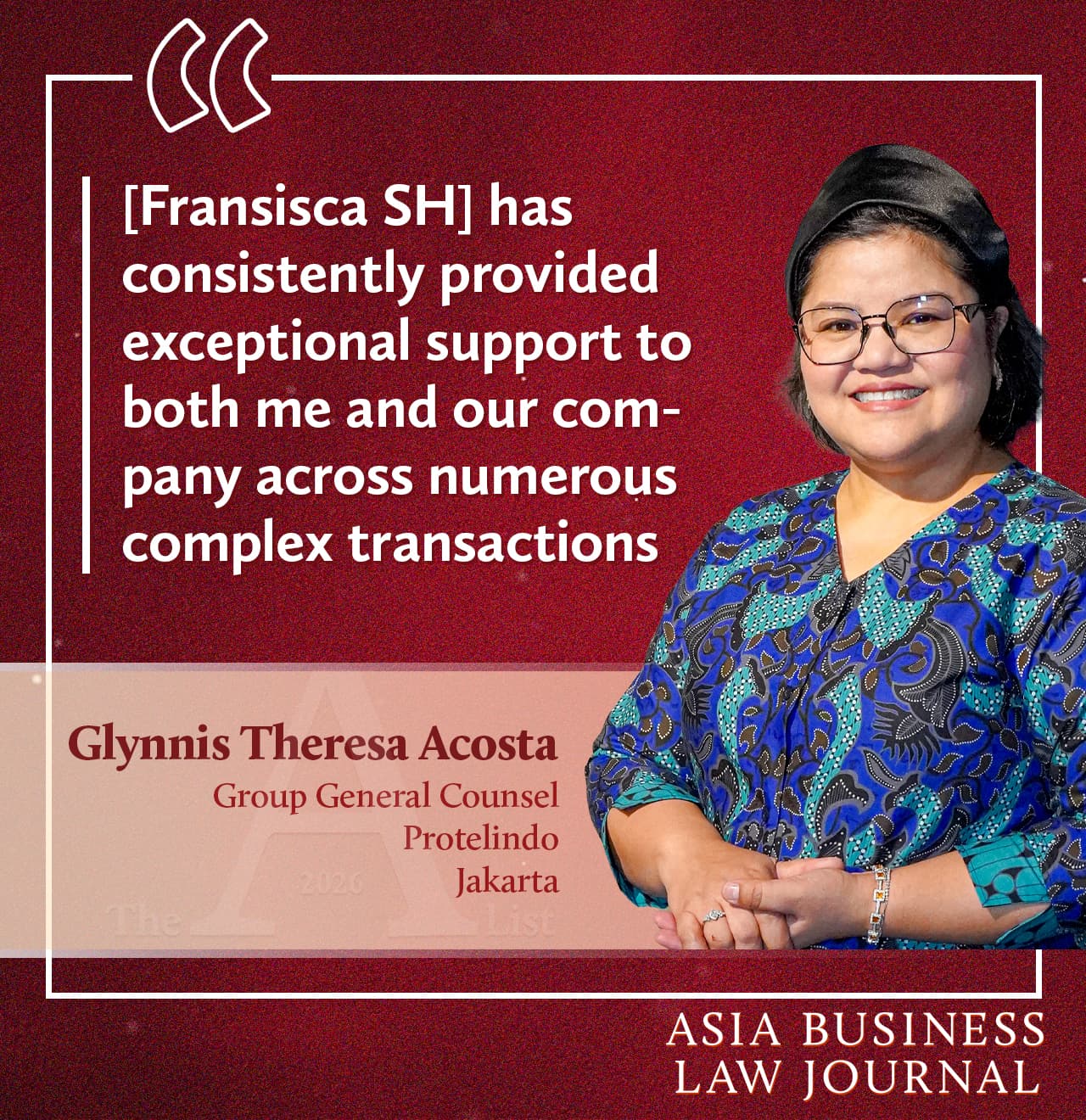
Having worked closely with Fransisca SH, partner and head of banking and finance at Makes & Partners in Jakarta, during the past two years, Glynnis Theresa Acosta, group general counsel at Protelindo in Jakarta, tells ABLJ: “She has consistently provided exceptional support to both me and our company across numerous complex transactions.”
Acosta especially remembers that in two particularly memorable transactions that ultimately did not close “Fransisca demonstrated the same level of enthusiasm, commitment and drive as she does on deals that reach completion, making me feel that she was as invested in the deal as her client. “It’s difficult to imagine what more one could reasonably ask for in an external adviser,” she adds
Top counsel for high-value listings
In 2025, the Indonesian IPO market recorded a decrease in the total number of listings, though this was offset by an increase in average deal sizes. This trend reflects a market shift towards higher quality, high-value offerings, which has consequently driven greater demand for sophisticated legal counsel.
Pingkan Ratna Melati, senior vice president counsel and corporate secretary at TBS Energi Utama in Jakarta, has had “extensive first-hand experience” working with Genio Atyanto, managing partner at boutique firm Genio Atyanto & Partners, particularly on capital market-related corporate actions and regulatory advisory.
She says, “Genio has been highly reliable in advising on a wide range of capital market matters, including corporate actions, regulatory interpretations, disclosure considerations and engagement with regulators.
“Based on my experience, I confidently recommend Genio for recognition as a trusted and capable adviser in capital market corporate actions.”
Sheni Adriana Sapija, a legal counsel manager at Ceria Prima Investama in Jakarta, agrees with Melati. “His contribution has significantly enhanced our ability to execute critical transactions and navigate sensitive government engagement in Indonesia,” says Sapija.
GHP Law Firm partner Lavie Daramarezkya is “a go-to adviser for capital markets and related transactions within Indonesia’s F&B and hospitality industries”, according to Lewi Aga Basoeki, corporate secretary at Siloam International Hospitals in Tangerang.
“She adeptly guides clients through the intricacies of the local legal and regulatory framework, with particular strength in orchestrating thorough due diligence processes, ensuring full compliance, and facilitating critical regulatory liaisons,” says Basoeki.
Daramarezkya is also praised by Mohamad Iqbal Saleh, head of talent and performance management at AIA Indonesia in Jakarta.
“A natural hustler with a strong entrepreneurial mindset, she combines adaptability with execution,” says Saleh. “Supported by an extensive professional network across the legal, financial and business sectors, she consistently delivers strategic value to clients.”
Seamless collaboration
As Indonesia’s influence within the global and regional economic landscape expands, demand is rising among corporations for legal counsel with specialised expertise in cross-border transactions.
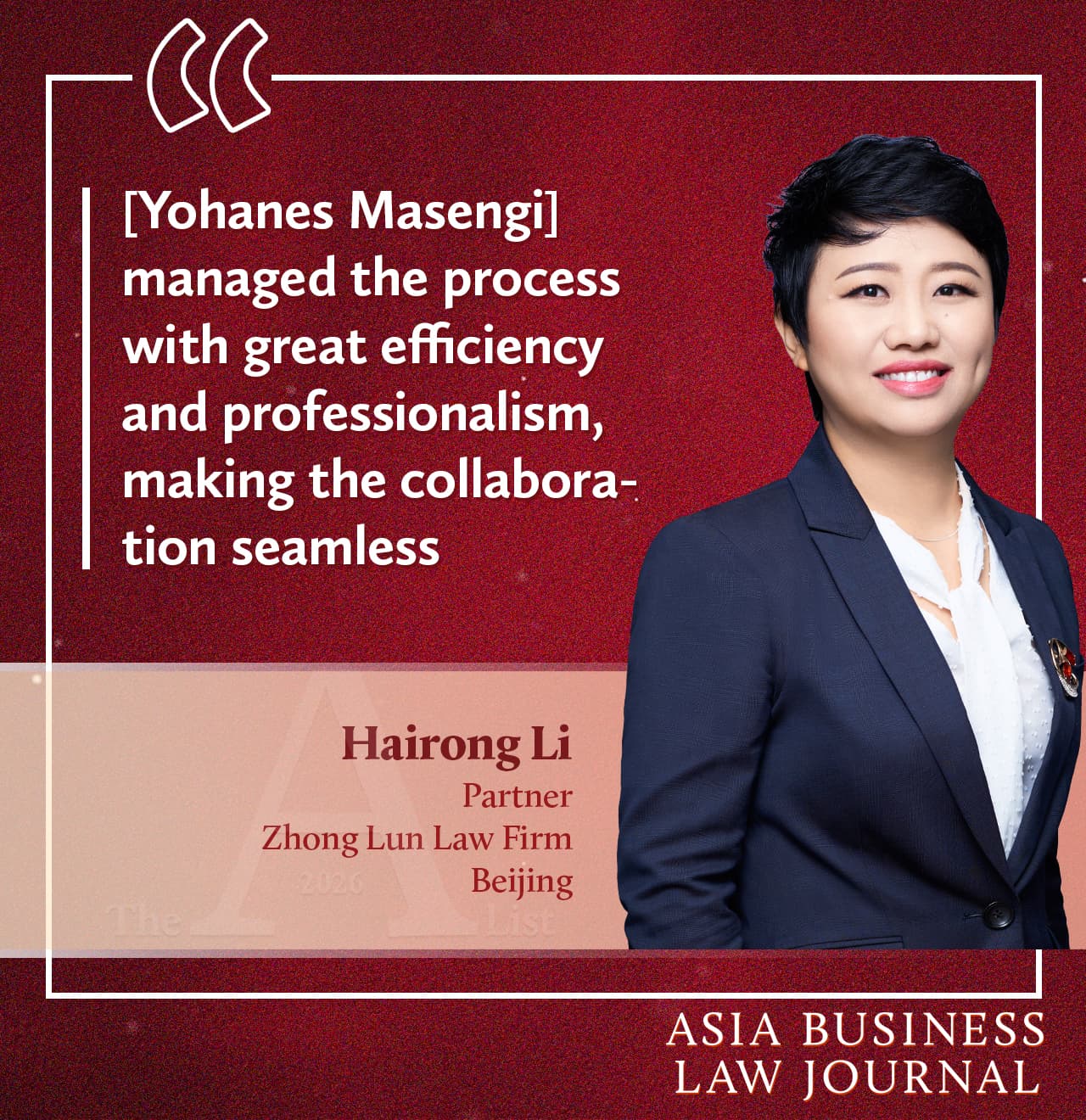
Hairong Li, partner at Zhong Lun Law Firm in Beijing, has worked with Yohanes Masengi, managing partner at Corra Legal, during the past several years on cross-border M&A transactions.
“Masengi stands out as an exceptional legal professional,” says Li. “He managed the process with great efficiency and professionalism, making the collaboration seamless. Without hesitation, I recommend Masengi to any client seeking top-tier legal counsel.”
Noverina Swasty, head of legal and corporate secretary at Tripatra Engineers and Constructors in South Tangerang, also praises Masengi. “We value Masengi’s reliability, responsiveness and strong command of Indonesia-focused regulatory and commercial considerations, combined with his ability to translate complex issues into clear, decision-ready guidance for business stakeholders.”
For South Korea-related legal matters in Indonesia, Inseo Lee, a partner at Yoon & Yang in Seoul, respects Turangga Harlin, managing partner at MHMS Advocates, for his “strong understanding of both Indonesian law and Korean business practices”.
Lee says, “He has substantial experience collaborating with Korean law firms, in-house legal teams and business executives, making him a reliable partner for cross-border transactions and ongoing legal support.
“For Korean companies and individuals seeking trustworthy legal counsel in Indonesia, especially for matters involving Korean interests, Harlin is a highly capable and dependable choice.”
According to an anonymous Japanese senior in-house counsel, his/her company was “almost on the edge of giving up on looking for a professional lawyer within our budget” before finding RBP Asia partner R Bayu Perdana and his team “very helpful”. The Japanese client adds: “The amount of effort and support during the whole process by focusing on getting the deal based on Indonesian law fairly was amazing; it was another level of professionalism.”
Yibo Chen, a senior counsel at Guozun Cathay Associates in Beijing, also speaks highly of Perdana. “He tracks legal and policy updates closely, demonstrating rigorous analysis and strategic thinking in complex transactions, compliance and emerging industry issues, earning trust from domestic and international clients.”
Specialist edge
Finally, specialised sector expertise remains a primary driver for inclusion in this year’s A-List, with several practitioners earning recognition for their deep industry knowledge. ADCO Law partner Dendi Adisuryo in Jakarta is highly regarded by Daniel Siahaan, legal division head at Pamapersada Nusantara, who says: “Over the past year, he has played a central role in supporting our company through four separate due diligence processes in connection with the potential acquisition of strategically important companies in the mineral sector.
“His advice has allowed us to obtain key environmental and operational approvals necessary for us keep to our operations in full compliance and prevent enforcement sanctions.”
Dhika Ashita Haruni, head of legal and commercial, Asia, at Thiess Contractors Indonesia in Jakarta, also notes Adisuryo’s legal expertise, “specifically in mining law”.
“His law firm is widely respected for its client-focused approach, depth of legal knowledge and ability to handle complex matters with clarity and precision,” says Haruni.
In the labour and employment sector, Wina Aesthetica, senior legal counsel at Honest Financial Technologies in Jakarta, worked with Ichsan Perwira Kurniagung, founding partner at FKNK Law Firm in Jakarta, over time-sensitive legal matters.
“As the lead partner on both matters, Ichsan provided clear oversight of his team and took ownership of the team’s involvement in the process from strategy through execution,” says Aesthetica. “Despite very tight timelines, he and his team were consistently proactive, co-ordinated and responsive, enabling both matters to be concluded efficiently and without residual issues.
“I recommend him as a top lawyer who combines strong technical competence with a practical, client-focused approach.”
Compiling the A-List
The A-List is based on extensive research conducted by Asia Business Law Journal. To identify the top lawyers in Indonesia, we turned to thousands of in-house counsel in the country and around the world – as well as partners at international law firms – and asked them to tell us which lawyers should make the cut.
A-List Lawyers were defined on the nomination form as “lawyers who are currently the star performers of Indonesia’s legal profession; the lawyers who are personally undertaking the country’s top legal work, crafting the most cutting-edge legal solutions to complex problems, and setting the highest standards in terms of quality, innovation and the ability to handle complex matters”.
Legal Icons were defined as “lawyers who are the luminaries of Indonesia’s legal profession; the titans who command the respect of clients and juniors alike; the mentors who lead Indonesia’s most admired law firms and/or legal teams, and the country’s most prolific rainmakers”. All Indonesian private practice lawyers and foreign lawyers based in the country were automatically eligible for inclusion in the nomination process.
As always, there were no fees or any other requirements for entry.