
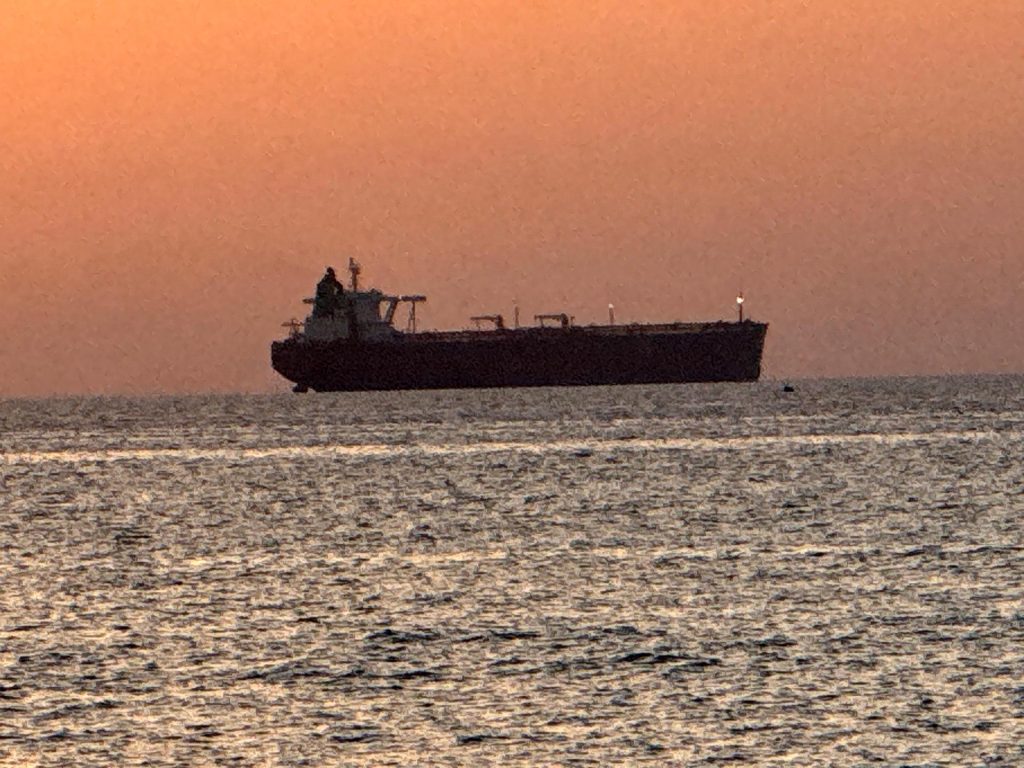
A vessel is seen waiting to cross the Strait of Hormuz in the Arabian Sea off Muscat, Oman, Tuesday (local time). UPI-Yonhap
A United Arab Emirates (UAE) minister of state has emphasized any attempts to disrupt commercial shipping and attacks on civilians in the Strait of Hormuz must stop.
UAE State Minister Saeed Bin Mubarak Al Hajeri made the remarks in a recent written interview with Yonhap News Agency as a Korean-operated vessel was struck by two unidentified airborne objects while stranded in the chokepoint last week.
“There is broad international consensus that freedom of navigation in the Strait must be preserved, that Iran must immediately cease its threats, mine-laying, and drone and missile attacks, and cease any attempt to disrupt commercial shipping through the Strait,” the minister said.
“The international community will not tolerate attacks on sovereignty, civilians or critical infrastructure,” he said, stressing the UAE’s commitment to working with partners to safeguard maritime security and ensure the safe passage of the waterway.
UAE Minister of State Saeed Bin Mubarak Al Hajeri / Courtesy of UAE
Since U.S.-Israeli strikes on Iran in February, Iran has effectively shut the Strait of Hormuz, disrupting global energy supplies and logistics through the strategic waterway.
Chinese and French civilian ships came under attack around the same time the Korean-operated cargo ship HMM Namu was hit by flying objects.
The UAE’s foreign ministry condemned the strike on the Korean ship as a “terrorist attack” on Monday (local time). The Korean government said further analysis is needed to determine who was responsible for the strike.
Regarding bilateral ties with Korea, Al Hajeri pledged to further strengthen cooperation with Seoul in energy and other areas.
“The Republic of Korea is among the UAE’s closest partners, and energy cooperation is a central pillar of our Special Strategic Partnership,” the minister said, using Korea’s official name.
“Our steady supply of crude oil to the Republic of Korea during periods of uncertainty reflects this approach in practice and highlights the depth and resilience of our partnership.”
Following his visit to the UAE in March as a special presidential envoy, presidential chief of staff Kang Hoon-sik said the Middle Eastern country had pledged to prioritize Korea in crude oil supplies.
Korea “has proven itself as a highly capable, trusted and brotherly partner across a wide range of sectors — from the Barakah nuclear energy program to industrial development and advanced technologies — and our energy relationship reflects this deeper, reciprocal cooperation,” the minister said.