
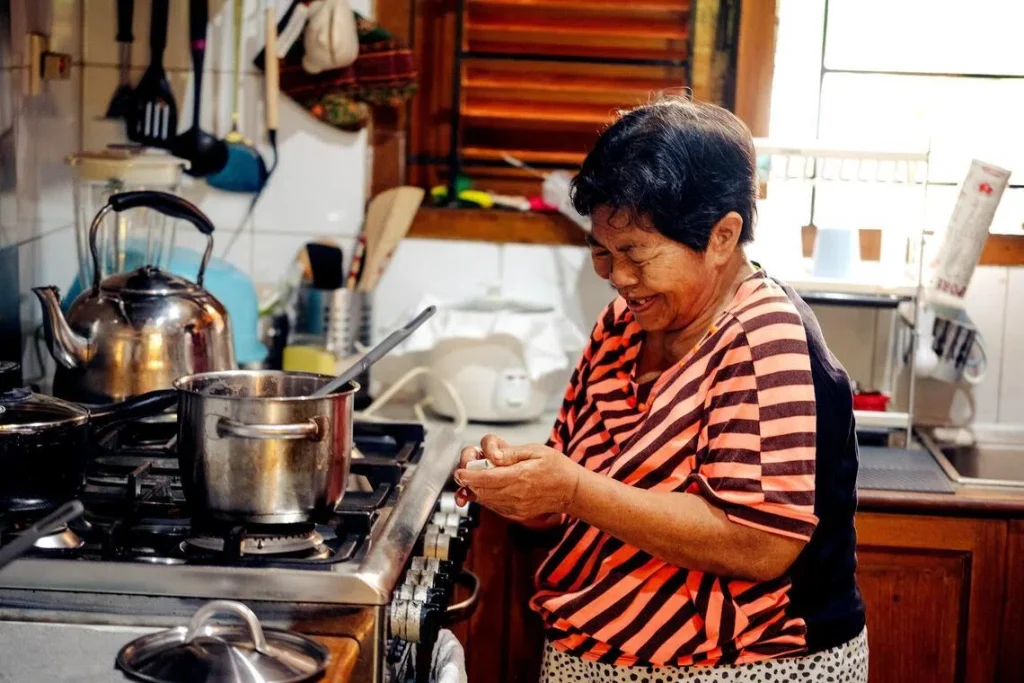
JAKARTA – Ms Pani, 64, has worked as a live-in domestic worker for the same family for 44 years.
A native of Boyolali, Central Java, she came to Jakarta as a teenager after her brother sent a letter saying someone was looking for a domestic worker. She never left.
“I decided to come because I heard that living in Jakarta was good,” she told The Straits Times.
Her employer, Ms Tokiko Latuharhary, 75, needed help at home while she and her husband worked. Ms Pani, who goes by one name, became the primary caregiver of all three of the Latuharhary children, accompanying Ms Tokiko on paediatrician visits and remembering every medication and symptom.
“I was able to continue working because Pani was the stay-at-home mum,” Ms Tokiko said. “I was able to trust her with the house, with money, with everything.”
Arrangements like theirs, once relatively common among Indonesia’s urban upper middle class, are now a rarity. But the question of what domestic work should look like – and how it should be valued – has never been more urgent.
Indonesia has an estimated four million to five million domestic workers, with millions more working overseas, including around 166,000 in Singapore. The number of live-in domestic workers has fallen sharply, from one million in 2008 to 683,000 in 2015, according to the International Labour Organization.
“Young people nowadays want to be able to know for sure that they start work at this hour and end at that hour,” Ms Pani said. “So living with an employer doesn’t seem so attractive.”

Ms Pani (left), a live-in domestic worker, with her employer of 44 years, Ms Tokiko Latuharhary, at Ms Tokiko’s home in South Tangerang, just outside Jakarta.
ST PHOTO: KARINA TEHUSIJARANA
The recently passed Domestic Workers’ Protection Law – 22 years in the making – is set to reshape the relationship further.
The law, passed on April 21, formally recognises domestic workers as workers entitled to reasonable working hours, paid time off, social security coverage and written employment contracts.
The law has drawn mixed reactions. Domestic worker unions and advocacy groups have hailed it as long overdue, pointing to countries like the Philippines, which enacted a similar law in 2013.
Employers have been less enthusiastic. Commenters on social media lamented that the new generation of workers is already too “spoiled”, and that further protections went beyond what the work warranted.
“What should be made regulated by law is the behaviour of domestic workers towards their employers, which is often inappropriate,” one commenter on Threads said.
“If they’re not in the mood, they just leave, run away or ask for permission not to come back, even though their employers are already so tolerant of their shoddy work.”
Dr Ida Ruwaida, a sociology lecturer at the University of Indonesia, said the law reflects an “extraordinary” cultural transformation in how domestic workers are perceived in Indonesia.
Society’s perception of domestic workers, she said, is rooted in Indonesia’s historical and socio-anthropological context. In her own home region of West Nusa Tenggara, society is stratified into “nobility” and “non-nobility”, with the non-nobility often becoming domestic workers for members of the old noble class.
The same dynamic is also seen in other regions of the country, especially in Java. There, in the courts of sultans and kings, servants would shuffle on their knees in the presence of their masters, and consider their position as a point of pride.
“The relationship between domestic workers and their employers was not seen as a working relationship, but more of a social relationship,” said Dr Ida.
Ms Lita Anggraini, coordinator of the National Advocacy Network for Domestic Workers, was more blunt: “Employers are the ones who benefit the most from it because they can ask their domestic workers to do anything, to work at all hours.”
As Indonesia modernises, Dr Ida said, workers are beginning to think more rationally about their labour.
“In the past, many domestic workers saw serving a higher-class family as an honour. But now, more and more workers are no longer seeing it as semi-volunteeristic work, but as a real profession,” she said.
Ms Ajeng Astuti, 47, is one such domestic worker. She started working around the age of 15, due to economic pressures. For years, she did not think of herself as a real worker at all.
“It just felt like I was doing normal household chores, but at someone else’s home,” she said.

A domestic worker training event organised by the Sapu Lidi Domestic Workers’ Union.
PHOTO: COURTESY OF AJENG ASTUTI
Over her more than 30-year career, Ms Ajeng has experienced long working hours, no time off, irregular wages – and sexual harassment at the hands of an employer.
Her outlook shifted in 2014, when she joined an event held by the Sapu Lidi Domestic Workers’ Union.
“I found that I’m not the only one who experienced that kind of trauma,” she said. “I started to feel more confident, and to see what I did as a legitimate profession.”
With the new law in place, she hopes the broader public will come to recognise the same thing. Some of her fellow union members were congratulated by their employers when it was passed – but she has a more practical view of the situation.
“Those are workers who are already employed in a good environment,” she said. “With this law, we hope that eventually all domestic workers can have that kind of employers.”
For Ms Pani, the old template brought real rewards: Ms Tokiko funded her nephew’s university education; the three Latuharhary children, now adults, regularly bring her gifts from their travels.
But it also came with trade-offs. Ms Pani has never married – but not for lack of offers.
“There was a neighbour here who’s a civil servant. He said, ‘Why work for someone else? Come marry me, I have a pension of four million rupiah (S$290) a month,’” she recalled.
“I told him, ‘Let’s just be friends.’ I didn’t want to end up having to take care of his grandchildren, and do the same work that I do here, but for free.”

A photograph of Ms Pani, a live-in domestic worker, with her employer’s youngest son, taken some time in the late 1980s.
ST PHOTO: KARINA TEHUSIJARANA
She recognises, though, that younger women weigh things differently: “They want to get married, have their own family, have their free time.”
Ms Tokiko echoed her sentiment, saying that her relationship with Ms Pani is based on mutual trust and respect, but that this is not always easy to find.
“Nowadays, it is a completely different story,” she said.