
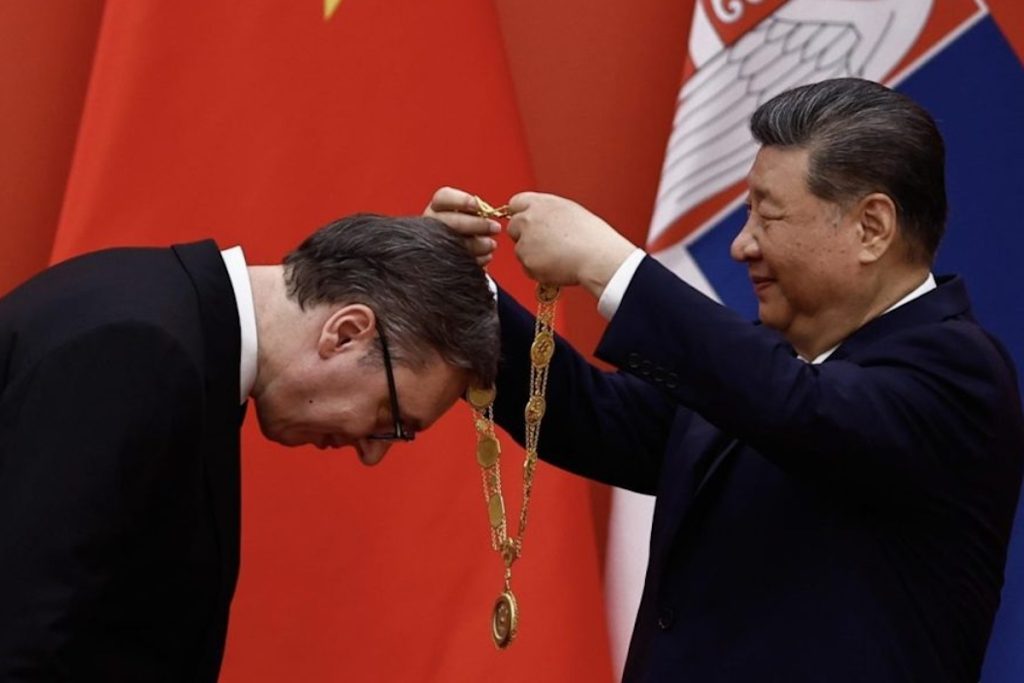
Serbian President Aleksandar Vucic’s state visit to China on May 25, 2026, sent a major geopolitical and geoeconomic signal at a moment when the international system is becoming increasingly fragmented between competing power blocs.
The visit, marked by meetings with Xi Jinping and the signing of more than 20 bilateral agreements covering infrastructure, artificial intelligence, green technology, trade, education and digital connectivity, demonstrated Belgrade’s deepening strategic relationship with Beijing even as it formally pursues membership in the European Union.
For China, Serbia remains one of its most strategically valuable partners in Europe outside the EU core. Beijing sees Belgrade as a gateway into the Balkans, a region where Chinese influence can expand through infrastructure investment, industrial acquisition, transport corridors and political partnerships that bypass the more restrictive regulatory environment of Brussels.
Since the formal elevation of Sino-Serbian ties into a “community with a shared future,” relations have deepened through Belt and Road projects, mining investments, surveillance technologies and transportation links.
Vucic’s 2026 visit, therefore, consolidates a long-term strategic architecture rather than inaugurating a new relationship. However, the timing is particularly important because it coincides with growing tensions between China and the European Union over industrial policy, strategic dependencies, electric vehicle exports and technology security.
The agreements signed during the visit suggest that Serbia is positioning itself as a preferred Chinese industrial and logistical hub in Southeastern Europe. This has significant geoeconomic implications.
Chinese companies already maintain strong positions in Serbian mining, steel production and transport infrastructure. Additional cooperation in artificial intelligence, digital economy projects and green energy will broaden the relationship from traditional heavy industry into technologically strategic sectors.
In practical terms, Serbia could emerge as an increasingly important production platform for Chinese firms seeking access to European markets while avoiding some of the political scrutiny associated with direct investment within the EU.
That resembles the role Hungary played under Viktor Orban, though Serbia lacks EU membership and therefore cannot provide identical market-access advantages.
The geopolitical dimension is also significant. Vucic’s visit underlines Serbia’s increasingly multi-vector foreign policy. Belgrade continues to balance between the EU, Russia, China and, to a lesser extent, the United States. Yet the symbolism of the Beijing visit suggests that Serbia perceives growing strategic space to resist Western pressure on issues ranging from Kosovo to sanctions on Russia.
China’s continued support for Serbia’s territorial position regarding Kosovo remains highly valuable for Belgrade at the United Nations and other diplomatic forums. Meanwhile, Serbia supports Beijing on Taiwan and other Chinese “core interests,” reinforcing the reciprocal political logic underpinning the partnership.
The visit also carried important domestic implications for Vucic. The Serbian president arrived in China amid mounting protests and political pressure at home linked to corruption allegations, infrastructure failures and democratic backsliding.
Chinese support provides Vucic with both economic resources and diplomatic legitimacy. Beijing does not condition investment on governance reforms, judicial independence or media freedom, unlike the EU accession process.
As such, deeper Sino-Serbian cooperation strengthens Vucic’s political model’s resilience by offering alternatives to Western conditionality. Critics inside Serbia increasingly argue that Chinese-backed infrastructure and industrial projects operate without sufficient transparency and environmental oversight, particularly in mining and transport construction.
For the Serbian government, Chinese financing remains attractive because it is fast, visible and politically unconditional.
The broader regional significance of the visit becomes clearer when considered alongside the political transformation in Hungary following the rise of Peter Magyar and fall of Viktor Orban. Under Orban, Hungary functioned as China’s closest strategic partner within the EU.
Budapest welcomed extensive Chinese investments in batteries, electric vehicles, rail infrastructure and telecommunications, while often obstructing stronger EU positions toward Beijing. Orban’s Hungary effectively acted as China’s political bridge into European institutions.
Magyar’s ascent changes this equation substantially. Early indications from the new Hungarian government suggest a partial reorientation toward Brussels, democratic institutional reform and closer cooperation with mainstream European partners.
Although Magyar is unlikely to dismantle all economic relations with China, his government appears less ideologically committed to the “Eastern Opening” doctrine championed by Orban.
This introduces uncertainty into Beijing’s Central Europe strategy. Chinese policymakers may now view Serbia as an even more critical anchor in the Balkans precisely because Hungary may become a less reliable political ally inside the EU.
This shift creates an interesting strategic divergence between Belgrade and Budapest. During the Orban era, Serbia and Hungary served as mutually reinforcing nodes within a broader illiberal geopolitical alignment linking China, Russia and nationalist-populist governments in Central Europe.
Analysts increasingly saw Orban and Vucic as political allies sharing similar approaches to media control, sovereignty and transactional diplomacy. With Magyar now signaling deeper alignment with EU priorities and stronger criticism of authoritarian networks linked to Moscow, Vucic risks becoming more regionally isolated, even while deepening ties with Beijing.
Paradoxically, Magyar’s emergence could increase Serbia’s strategic importance to China in the short term while simultaneously increasing Serbia’s vulnerability in the long term. If Hungary gradually aligns more closely with EU industrial and security policies, Serbia may become Beijing’s principal political and economic foothold in the Western Balkans.
Chinese investment flows could therefore shift even more strongly toward Serbia. Yet this would also intensify scrutiny from Brussels and Washington, especially regarding telecommunications infrastructure, digital surveillance systems, critical minerals and dual-use technologies.
The EU is now on the horns of a dilemma. On one hand, Brussels wants to maintain momentum for Western Balkan enlargement and prevent further Chinese or Russian penetration into the region. On the other hand, Serbia’s increasingly visible strategic alignment with China complicates accession politics.
European policymakers may fear that admitting Serbia without deeper democratic reforms could effectively import another China-friendly veto player into the European system, replacing Orban’s Hungary with a future Vucic-led Serbia.
In that sense, Vucic’s visit was not merely a bilateral diplomatic event; it was an indicator of the broader contest over the political and economic future of Southeastern Europe.