
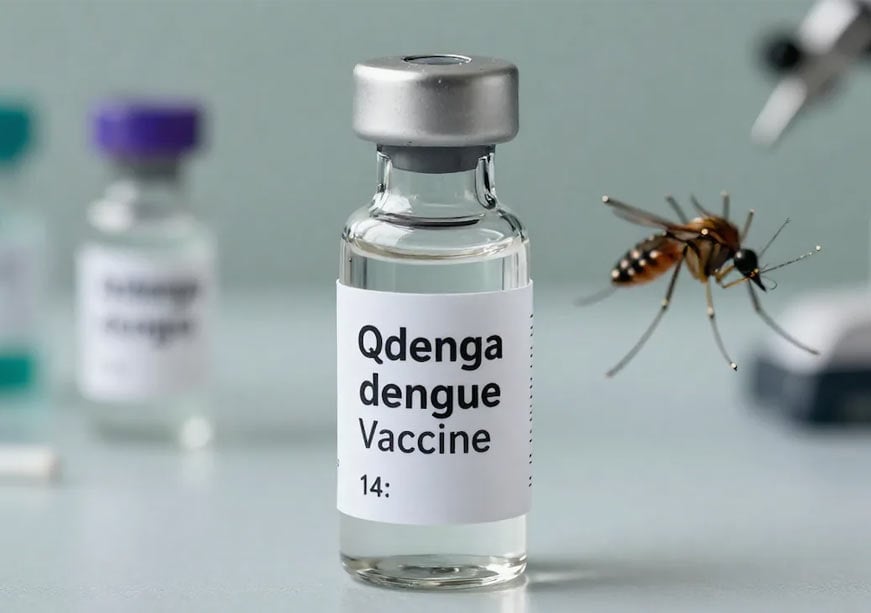

Dengue is a mosquito-borne viral infection prevalent in tropical and subtropical areas. The World Health Organization (WHO) places half the world’s population at risk of infection, with escalating global tolls. The number of dengue cases has risen from just over half a million in 2000 to 14.6 million reported cases in 2024, with India reporting 0.12 million cases in 2025. Rapid urbanisation and poor urban planning, along with rising temperatures, have significantly contributed to the spread of dengue, which is now endemic in over 100 countries. With no specific treatment available, prevention has been critical. The development of a safe and efficacious vaccine has been challenging, owing to the complexities of immune responses to dengue infection. In March this year, a Subject Expert Committee of the Central Drugs Standard Control Organisation (CDSCO) approved the introduction of a dengue vaccine — Qdenga — marking a significant turn in the battle against dengue. An integrated strategy nonetheless remains essential for meaningful dengue control.
This is the fundamental challenge in developing a dengue vaccine — a safe and efficacious vaccine must provide protective immunity against all four serotypes; otherwise, partial immunity (through a vaccine, for instance) could lead to severe outcomes if the person is subsequently exposed to dengue naturally.
Dengue (DENV) infection can be caused by any of four genetically similar but distinct types, or serotypes — DENV-1, DENV-2, DENV-3, and DENV-4. Infection can be asymptomatic, result in dengue fever that resolves on its own, or lead to more severe outcomes such as dengue haemorrhagic fever (DHF) or dengue shock syndrome (DSS), which require hospitalisation and can sometimes be fatal. A secondary dengue infection with a different serotype carries considerable risk: pre-existing antibodies (from a previous infection, for example) facilitate viral entry and increase disease severity instead of providing protection against the subsequent infection. This is the fundamental challenge in developing a dengue vaccine — a safe and efficacious vaccine must provide protective immunity against all four serotypes; otherwise, partial immunity (through a vaccine, for instance) could lead to severe outcomes if the person is subsequently exposed to dengue naturally.
Qdenga’s Promise
Japan’s Takeda has developed a tetravalent vaccine — Qdenga (TAK-003) — that has now received approval from India’s CDSCO Subject Expert Committee. This approval is subject to a post-marketing safety and effectiveness study within six months of its introduction in India, reflecting a cautious regulatory approach. Qdenga comprises a two-dose regimen given three months apart and does not require prior exposure to the dengue virus. It has been approved in 41 countries and almost 25 million doses have been distributed. It is the WHO-recommended dengue vaccine, with the organisation recommending its administration for children aged 6 to 16 in high-burden regions. The European Medicines Agency (EMA) and the United Kingdom (UK) extend this recommendation to people aged 4 to 60. Indonesia was the first country to approve Qdenga in 2022, while Brazil has since incorporated it into its national immunisation programme. In India, Hyderabad-based Biological E has entered into a partnership with Takeda for local manufacturing of the vaccine.
For individuals under the age of 6 who have never been exposed to dengue, some evidence indicates a potential enhancement of disease following DENV-3 and DENV-4 infection. This is particularly concerning as DENV-3 has begun to re-emerge in several Asian and South American countries.
Detailed studies examining Qdenga’s efficacy reveal that it is promising yet nuanced. Mathematical modelling studies demonstrate that under moderate-to-high transmission settings, vaccination of individuals over the age of 6 could diminish dengue-related hospitalisations by 10 to 22 percent over a 10-year period. The vaccine is highly protective against DENV-2 irrespective of prior exposure to dengue, as its backbone is based on a live-attenuated (weakened) DENV-2 strain. It offers moderate protective immunity against the other serotypes in individuals who have previously been exposed to dengue. However, for individuals under the age of 6 who have never been exposed to dengue, some evidence indicates a potential enhancement of disease following DENV-3 and DENV-4 infection. This is particularly concerning as DENV-3 has begun to re-emerge in several Asian and South American countries. Further, vaccine efficacy was found to decline over time — from approximately 80 percent against symptomatic dengue one year after the second dose to about 45 percent by year three — underscoring that vaccination alone is not a long-lasting solution. These findings reinforce the notion that an ideal dengue vaccine offering long-lasting protection against all four serotypes, regardless of prior exposure, may be difficult to achieve.
The Dengvaxia Episode
Scrutiny over dengue vaccines was highlighted by the experience with Dengvaxia — the world’s first licensed dengue vaccine — developed by Sanofi Pasteur. Post-market surveillance of Dengvaxia revealed enhancement of disease in individuals who had never been exposed to dengue, increasing their likelihood of hospitalisation upon subsequent natural exposure. This finding emerged after Dengvaxia had been licensed and approved by several governments, including the Philippines, where a large-scale immunisation campaign — which included children — was followed by reports of hospitalisations. This underscores that post-market surveillance is crucial, given the immunological complexity that dengue presents. Dengvaxia is currently offered only to individuals who have previously been exposed to dengue, but Sanofi will likely cease manufacturing owing to low vaccine uptake.
India’s Panacea Biotec has developed the country’s first indigenous dengue vaccine candidate — DengiAll — and, in partnership with the Indian Council of Medical Research (ICMR), has launched Phase III clinical trials.
Brazil, which carries one of the largest dengue burdens globally, recently approved another dengue vaccine in November 2025: Butantan-DV, developed by the Butantan Institute, a Brazilian biologics research centre. It is approved for individuals aged 12 to 59 and is the world’s first single-dose dengue vaccine. Compared to Qdenga, Butantan-DV’s single-dose regimen offers a practical advantage, as adherence to a second dose remains a challenge. Additionally, India’s Panacea Biotec has developed the country’s first indigenous dengue vaccine candidate — DengiAll — and, in partnership with the Indian Council of Medical Research (ICMR), has launched Phase III clinical trials.
Integrated Strategies
While the SEC approval of Qdenga in India is a significant milestone in the CDSCO’s approval process, addressing the global dengue burden requires an integrated strategy. For instance, biological vector control methods such as the introduction of Wolbachia-infected mosquitoes, which suppress dengue transmission, have been found to be effective. Wolbachia-infected mosquitoes pose little risk to humans or the environment and have been observed to reduce the dengue burden in Singapore. In addition, collaborative partnerships between India and the European Union (EU) under the COMBAT initiative will employ tools such as artificial intelligence (AI) and advanced modelling for outbreak prediction, identification of biomarkers for determining clinical outcomes, and strengthening the understanding of dengue infection. Finally, the Serum Institute of India (SII) is conducting Phase III clinical trials involving a monoclonal antibody treatment and will partner with the Drugs for Neglected Diseases Initiative (DNDi) to extend trials to dengue-endemic countries. Meanwhile, the antiviral drug mosnodenvir — despite showing promise in a Phase 2a trial — was discontinued by Johnson & Johnson as part of the company’s reprioritisation of its communicable disease portfolio. Negotiations to identify an alternative developer to continue these efforts are underway.
Conclusion
The approval of Qdenga represents a significant milestone in the battle against dengue, but the disease’s complexity remains. India will need to ensure that its rollout is carried out in a phased, evidence-based manner — one that emphasises pharmacovigilance, supports investment in domestic manufacturing (including the development of indigenous vaccine candidates), and promotes other dengue control measures. The Dengvaxia episode serves as a stark reminder of dengue’s complexities and what can occur when a vaccine is deployed faster than comprehensive pharmacovigilance studies allow. A cautious rollout of Qdenga can ensure that it translates into an effective public health tool.
Lakshmy Ramakrishnan is an Associate Fellow with the Centre for New Economic Diplomacy at the Observer Research Foundation.
The views expressed above belong to the author(s). ORF research and analyses now available on Telegram! Click here to access our curated content — blogs, longforms and interviews.