
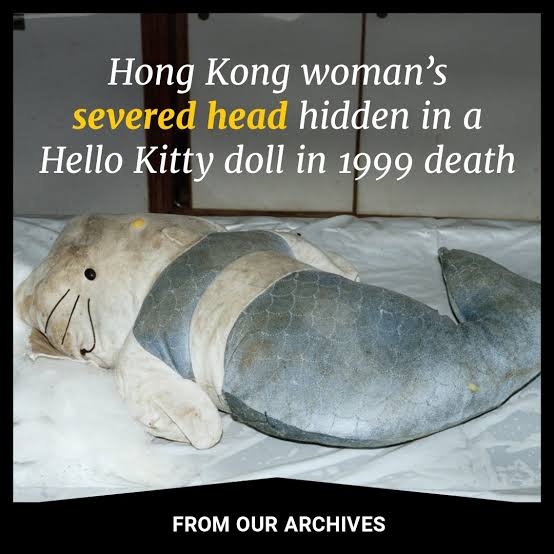
In the spring of 1999, a crime erupted from the shadows of Hong Kong that would horrify an entire generation. Newspapers called it the “Hello Kitty Murder,” a name so bizarre it sounded fictional. But behind the strange title was a real woman, real suffering, and one of the most brutal torture killings in modern Asian criminal history.
The victim was Fan Man-yee, a 23-year-old nightclub hostess whose tragic life ended inside a filthy apartment in Tsim Sha Tsui. By the time police uncovered what happened to her, the crime scene had already become something almost impossible to comprehend.
Her skull had been sewn into a Hello Kitty mermaid doll.
And that was only the beginning.
A Woman Trying to Escape Her Past
Before she became the center of one of the world’s most infamous murder cases, Fan Man-yee lived a difficult life shaped by abandonment and survival.
Born in mainland China, she was reportedly abandoned as a child and raised in an orphanage. When she reached her teenage years, she was forced to leave and survive on her own. Poverty, homelessness, and drug addiction followed. Eventually, she entered sex work and later became a nightclub hostess in Hong Kong’s underground nightlife scene.
But by 1999, there were signs she wanted a different future.
She had recently become a mother. According to reports, she had tried to distance herself from drugs and instability to support her young son. Friends described her as exhausted but hopeful — a woman attempting to rebuild her life in a city that rarely showed mercy to people at the bottom.
That hope would not last.
The Men Who Took Her
The central figure behind the crime was Chan Man-lok, a member of the notorious Wo Shing Wo triad gang. Violent, unpredictable, and deeply involved in criminal circles, Chan allegedly became enraged after Fan stole money from his wallet. Though she returned the stolen cash, he demanded additional repayment she could not afford.
On March 17, 1999, Fan was abducted by Chan and several accomplices:
• Leung Wai-lun
• Leung Shing-cho
• and a teenage girl known publicly as Ah Fong.
They dragged her to an apartment on Granville Road in Kowloon.
For the next month, that apartment became a chamber of unimaginable cruelty.
A Month of Torture
Court testimony later revealed horrifying details that shocked even veteran investigators.
Fan was beaten repeatedly with metal bars and pipes. She was burned with candle wax and melted plastic. Hot spices were rubbed directly into open wounds. At times, she was suspended and used like a human punching bag while her captors laughed.
Witness testimony suggested the abuse became entertainment.
The attackers were reportedly high on methamphetamine for much of the ordeal. Violence inside the apartment escalated day after day, often for no reason beyond boredom or sadistic amusement. Fan was allegedly forced to smile during the beatings and claim she enjoyed the abuse. If she refused, the torture intensified.
At one point, according to reports presented during the investigation, she was kicked in the head dozens of times.
By April 1999, she could barely move.
Nobody knows the exact moment she died.
Investigators later concluded she likely succumbed to traumatic shock after weeks of relentless torture. Because of the condition of her remains, medical examiners could never determine the precise cause of death. That uncertainty would later affect the trial itself.
The Discovery That Horrified Hong Kong
The case may never have been uncovered if not for a frightened teenage girl.
Weeks after Fan’s death, Ah Fong reportedly walked into a police station claiming she was being haunted by the ghost of a woman from the apartment. Officers were skeptical at first, but she eventually led them directly to the flat on Granville Road.
Inside, investigators discovered evidence so grotesque it immediately became front-page news across Asia.
Fan’s body had been dismembered.
Most of her remains had been boiled and discarded. Only fragments were recovered. Her skull, however, had been hidden inside a large Hello Kitty mermaid doll stuffed with debris and insects.
Police officers who entered the apartment later described the smell as unbearable.
Even in a city familiar with organized crime, the case stunned the public. Hong Kong had a relatively low homicide rate at the time, and crimes involving this level of torture were extraordinarily rare. The surreal image of a childlike Hello Kitty doll concealing human remains transformed the murder into a national obsession almost overnight.
The Trial
When the trial began in 2000, media coverage exploded.
The courtroom heard testimony describing prolonged torture, drug abuse, mutilation, and psychological degradation. Journalists packed the proceedings daily, while the public struggled to understand how human beings could commit such acts over an entire month without remorse.
Yet despite the horrifying evidence, prosecutors faced one enormous obstacle:
They could not conclusively prove exactly how Fan died.
Because the body had been mutilated and partially destroyed, medical experts could not determine whether the fatal moment came from torture, overdose, or traumatic shock. As a result, the jury ultimately convicted the three adult defendants of manslaughter rather than murder.
The verdict outraged many observers.
Still, the judge’s words during sentencing reflected the horror felt throughout Hong Kong. He described the crime as an unprecedented display of “cruelty, depravity, callousness, brutality, violence and viciousness.”
The men received life sentences.
Why The Case Still Haunts People Today
More than two decades later, this remains deeply embedded in Hong Kong’s cultural memory.
Part of that comes from the sheer brutality of the crime. But another reason is the disturbing symbolism surrounding it. Hello Kitty represented innocence, childhood, and harmless pop culture. Seeing that image tied forever to torture and death created a psychological contrast people could not forget.
The case also exposed darker truths beneath Hong Kong’s glamorous image in the late 1990s:
• the influence of triad gangs,
• violence against vulnerable women,
• rampant drug abuse,
• and how easily marginalized people could disappear without immediate notice.
For many true crime followers, what makes the story especially devastating is who Fan Man-yee was before the headlines. She was not a mythical victim from urban legend. She was a young mother trying to survive poverty, addiction, and abuse in one of the world’s richest cities.
Instead, she became the center of one of Asia’s most horrifying murder cases.
And even today, the name alone still unsettles people:
The Hello Kitty Murder.