
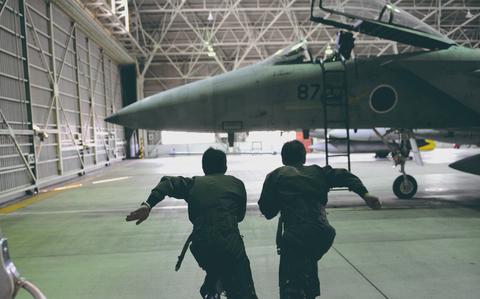

Japan Air Self-Defense Force pilots rush toward a fighter aircraft following a scramble alert at an undisclosed location in this undated image. (Japan Joint Staff)
Chinese pilots last year dramatically scaled back their approaches toward Japanese airspace, reducing Japan’s air force response to its lowest level in more than a decade, according to Japan’s Joint Staff.
Japan Air Self-Defense Force pilots scrambled 595 times to meet foreign aircraft during fiscal 2025, according to data released on the Joint Staff’s website on April 17. Japan’s fiscal year runs from April to March.
That’s about 15% fewer intercepts than in fiscal 2024, when Japanese aircraft met foreign challengers 704 times. It’s also the lowest number of scrambles since the 567 recorded in 2012.
China remained the most frequent challenger in fiscal 2025.
Of Japan’s intercepts, 366 involved Chinese aircraft, the lowest number since 2012, when Japan scrambled to meet Chinese pilots 306 times.
In fiscal 2024, Japan intercepted 464 Chinese aircraft, and in the previous fiscal year, 479.
Russia logged the second largest number of airspace challenges. Japan scrambled fighters 214 times against Russian fighters, compared to 237 times during the previous fiscal year, a number the Joint Staff called “average.”
Approaching Chinese aircraft typically penetrate Japan’s 230-mile-wide air defense identification zone but turn back before reaching territorial airspace, a 14-mile-wide zone that begins at the coast.
While intercepts decreased, they remain at “a high level,” Japan Chief of Staff Gen. Hiroaki Uchikura said April 17 during his regular news conference in Tokyo.

Japanese fighters scrambled in response to this helicopter launched from a Chinese coast guard vessel inside the Senkakus’ territorial limit on May 3, 2025. (Japan Coast Guard)
“We believe it is necessary to consider various factors to determine the reasons for the decrease,” he said.
Chinese drone approaches also declined to 16 in fiscal 2025, compared to 23 in the previous year, Uchikura said.
Japan’s Ministry of Defense warned in its 2024 and 2025 white papers that it may shoot down unmanned aircraft entering its airspace if necessary to protect the “lives and properties of people within Japanese territory.”
Despite the decline in incidents, Chinese and Russian pilots in many instances grew bolder, according to the Defense Ministry.
On May 3, Japanese fighters scrambled in response to a helicopter launched from a Chinese coast guard vessel inside the Senkakus’ territorial limit, according to a ministry news release at the time.
On Dec. 4, Japan alleged that a Chinese J-15 launched from the aircraft carrier Liaoning “intermittently illuminated” two Japanese F-15s, which had scrambled in response to potential airspace violations near Okinawa. A radar lock on a potential target can be a precursor to a missile attack.
Japan lodged a protest with China over the incident. Beijing in turn faulted the Japanese fighters for reconnaissance of China’s “normal military activities,” according to a statement from China’s Foreign Ministry at the time.
In the same month, Chinese and Russian bombers passed between Okinawa and Miyako Island during a joint flight from the East China Sea, the Joint Staff said in its release April 17.