
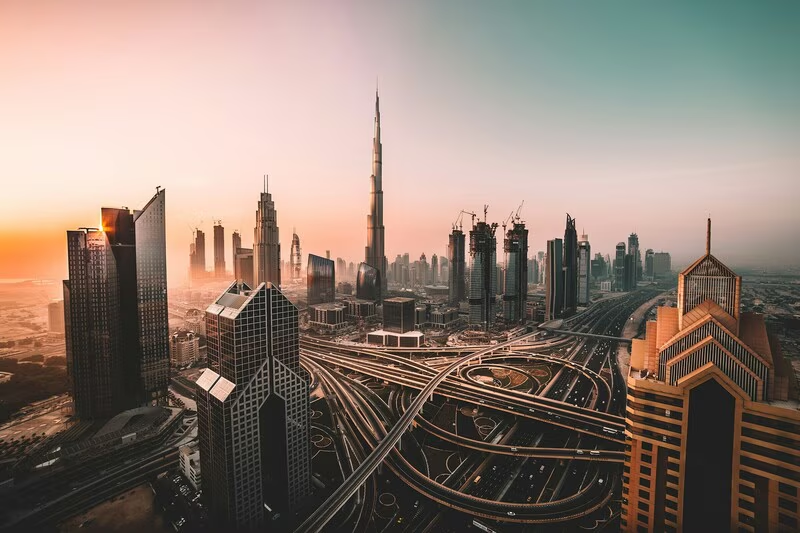
- Dubai’s businesses continued operating when the Iran-Israel-US conflict led to the UAE coming under fire and have lessons for high-performing organizations worldwide on dealing with crises.
- A study based on interviews with Dubai businesses during the ongoing conflict provides interesting feedback.
- What was most apparent was that high-performing companies invest in the robustness of the entire value chain, because their success is dependent on the sum of the whole.
During the recent Iranian missile attacks on the UAE, the UAE government promised its people it would defend and not retaliate. 40 days later, the UAE had intercepted 563 missiles and over 2,256 drones and had refrained from hitting back.
The region’s scholar and jurist Ibn Taimiyyah in the 13th century established patience or sabr as an active strength; this has emerged as the foundational element of Dubai’s response to the ongoing Iran-Israel-US conflict.
The role of Dubai-based companies as engines of resilience
The sabr that bound Dubai’s people and polity was actualized by local businesses that ensured an uninterrupted supply of goods and services on the ground, while the military protected the skies.
Defying the typical image of a war zone, services continued to operate, including telecoms, power, food supplies, transport, retail, hospitality, entertainment, home delivery and banking. Construction and manufacturing went on uninterrupted and logistics companies worked to reroute goods. Flights took off against all odds. Schools switched to remote learning and books to support children’s wellbeing were circulated.
Having navigated this attack on their territory, what lessons can Dubai’s local businesses offer to high-performing organizations elsewhere in the world on dealing with acute crises?
What strategies did they implement to support a ‘thrive’ mentality, even while experiencing extreme challenges, which others may learn from?
At Sustain Labs Paris, we invest in frontier innovation startups with some of the largest companies in the UAE as partners. This gives us access to over a hundred companies and we interviewed a curated sample of 35 companies operating in Dubai to understand how they were impacted by the attack on their soil.
Keeping the momentum without loss of control
In periods of ambiguity, high performers focus on stability, rather than short-term plan changes.
Emirates Airlines ran reduced schedules and repatriation flights starting March 2, 2026 – two days into the war – for people who were stranded and then confirmed that it would restart flights to more destinations. It kept up its momentum, resuming operations each time a security incident at Dubai Airport was resolved. It began gradually restoring its flight schedule and rerouting its long-haul flights via safer corridors.
Approximately 951,000 event participants at Dubai’s premier events venue, Dubai World Trade Centre, came from abroad in 2025. Mahir Julfar, Executive Vice President of Dubai World Trade Centre, said: “We are working closely with organizers to support decisions that ensure strong participation and successful delivery, including rescheduling where needed. This is not new to us – our post-COVID-19 recovery demonstrated our ability to adapt quickly, maintain momentum and deliver at scale. That same resilience and discipline continues to guide us. Dubai’s strength lies in its ability to combine operational readiness with long-term vision, enabling business momentum to continue, even in complex environments.”
Maintaining momentum during a crisis is often harder for small and medium-sized companies, where revenue can be tightly tied to salaries. According to Jay Sadiq, Founder & CEO of Fortyguard, in periods of regional volatility, strong companies do three things well. “First, they stay commercially focused and protect momentum rather than drift into reaction mode,” he explained. “Second, they tighten execution and use existing assets harder instead of waiting for perfect conditions. Third, they treat speed, clarity, and disciplined decision-making as strategic advantages.”
For business activities that depended on external stakeholders, such as foreign investments and tourism, this was a particularly challenging time, but hopefully these markets will return to normal after the conflict ends.
Adjusting within the system, without changing the system
High-performing companies assess efficiency measures within their companies during a crisis. They double down on sources of revenue, such as subscription-based services or essential goods that might be unaffected, and pause those that need the conflict to subside. They focus on keeping their team and operating expenses lean. They also adjust processes. Green steel maker, Arabian Gulf Steel Industries (AGSI), stated: “We do see variability, particularly across logistics and coordination. The response is to manage these constraints within our existing production cycle, through sequencing, scheduling and closer alignment across teams, while keeping overall output consistent.”
High-performing organizations also protect their greatest assets within their system – their people. Nauman Ali Khan, Chief Risk and Assurance Officer of Dubai-based global school operator, GEMS Education, said: “Our group has been focused on wellbeing from the very start of the crisis.” Florence Bulté, Chief Sustainability Officer at Chalhoub Group, said: “We have navigated evolving conditions with agility, always placing safety and wellbeing at the forefront.”
Bulté also emphasised the need to protect people across all key stakeholder groups. She said: “Equally important is the role of customers, partners, and communities. Across our markets, there is a strong desire for connection and shared spaces that offer familiarity and a sense of normality. In this context, resilience is deeply human: it is reflected in how people engage, show up, and support one another with dignity and solidarity.” During the ongoing conflict, it curated and offered customized wellbeing resources for all team members through its With You at Heart initiative. Stores in the UAE, Saudi Arabia, and Jordan remained open with lean teams of only staff who volunteered to work and the company continued its commitment to hiring and supporting people with special needs.
Resilience is an operating system
Resilience comes from how a business is structured, not just how it reacts. Fahad Al Hassawi, Chief Executive Officer of telecommunication company du, said: “Our business fundamentals remain robust, supported by a recurring revenue base, disciplined capital management and a strong liquidity position.” Its business continuity frameworks remained fully active, supporting operational readiness and proactive risk management during the attacks on Dubai.
Similarly, AGSI’s local supply chain helped hedge its risks during the conflict, it stated: “Our model is built on local integration, from sourcing raw materials through to serving domestic demand. This reduces reliance on extended supply chains and allows for greater control over continuity, cost and quality, particularly in periods of uncertainty.”
High-performing companies also integrate resilience and scenarios for acute crises into their operating systems at all times. Dubai-based bank Emirates NBD said it navigated through attacks on Dubai by “embedding resilience into its core strategy.” Vijay Bains, its Chief Sustainability Officer, said: “We are embedding sustainability, strengthening governance and aligning with global standards to support the UAE’s continued growth. This approach enables us to thrive in uncertainty, while creating long-term value for our clients and the wider economy.”
Collaboration to reach the goal
During an acute crisis, organizations transform existing partnerships into deep bonds for collaborations. As operations at Jebel Ali and Khalifa Port faced disruption, Etihad Rail, for example, supported increased freight movement through emerging ports, Fujairah and Khor Fakkan — reinforcing the UAE’s supply chain continuity and showcasing the strategic value of a connected national rail network.
Similarly, startups are supported by the strength of ecosystems so that no fledgling company is left alone in a crisis. Resilience for startups and SMEs is stronger when embedded in the wider environment. Startup ecosystems, such as Dubai’s MBRIF, kept founders close to capital, institutions and market access.
When the crisis passes, the bonds that were built in solidarity during times of need should act as pillars for transformative growth.
We are as strong as our weakest link
High-performing companies invest in the robustness of the entire value chain, not just themselves. They realize that their success is dependent on the sum of the whole.
Emirates NBD bank, for example, introduced a temporary full waiver of fees for loan deferment cheque return, due to unforeseen cash-flow interruption, and discounts for its SME clients.
Dubai-based retailer Brands For Less created a channel for small business owners to seek support, share challenges and explore practical ways to sustain and grow their businesses. And, local sportswear brand Squatwolf opened its website, app, retail stores and social media channels to showcase other local businesses.
At Sustain Labs Paris, we offered the services from the startups in our portfolio free of charge to Dubai-based SMEs in the tourism sector. And local food delivery company Talabat proved to be one of Dubai’s lifelines, as it ensured residents stayed indoors. Talabat launched an initiative to provide 100 cloud-kitchen spaces rent-free to smaller, homegrown restaurant brands to strengthen the local food ecosystem.
Sabr means providing clear direction, making decisions calmly, and ensuring collective responsibility at all times – these are also traits of high-performing organizations. Doing so in times of crisis is an opportunity for leadership to prove its mettle.