
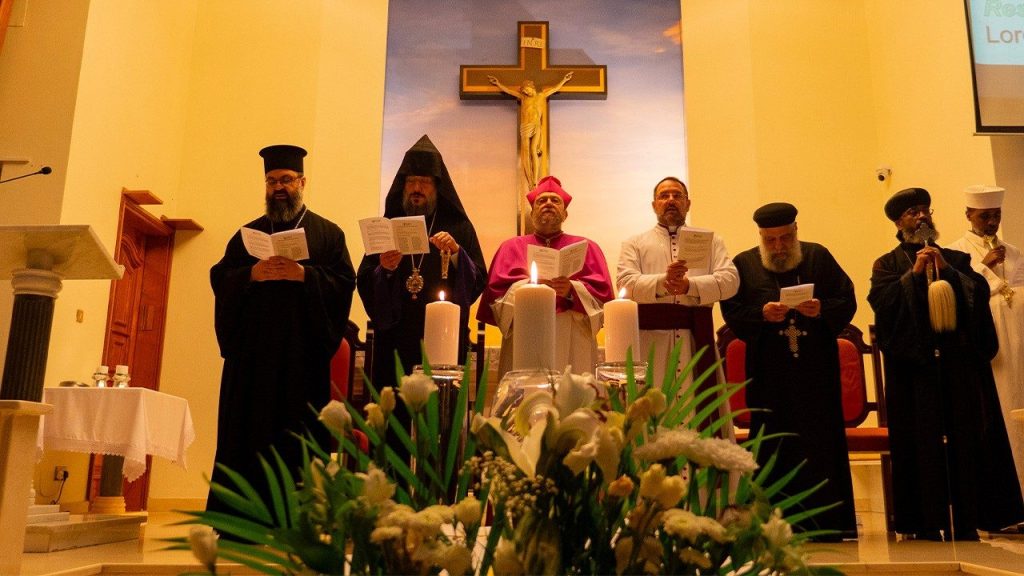
During a national prayer for peace bringing together Christian leaders in Dubai, the Apostolic Vicar of Southern Arabia, Bishop Paolo Martinelli, said, “Peace cannot be simply a human construct; it is a gift from God, to be sought, welcomed, nurtured, and spread in society through our good relationships.”
By Deborah Castellano Lubov
Christian leaders gathered in St. Mary’s Catholic Church in Dubai on April 29 for the National Ecumenical Prayer for Peace.
The initiative was promoted by the Gulf Churches Fellowship, in collaboration with the Interfaith & Ecumenical Dialogue Office of the Apostolic Vicariate of Southern Arabia (AVOSA) and St. Mary’s Church.
In his opening address, Bishop Paolo Martinelli, Apostolic Vicar of Southern Arabia, called for prayers for peace in the United Arab Emirates, the Gulf, the Middle East, and throughout the world.
“Peace,” he stressed, “cannot be simply a human construct; it is a gift from God, to be sought, welcomed, nurtured, and spread in society through our good relationships.”
Bishop Martinelli also thanked civil authorities for their protection during recent months, assuring them of the Christian community’s prayers.
“May the Lord hear our common prayer; may he grant us peace and reconciliation, harmony and prosperity.”
The gathering was organized to pray for peace in the region, mark the reopening of churches in Dubai, and celebrate the joy of the Resurrection.
The church opened its doors to welcome representatives and faithful from six Christian denominations.
The prayer unfolded in three moments: the profession of the Nicene Creed; a prayer for peace with Bible readings, prayers from different Christian traditions and liturgical languages, and the lighting of candles; and the Litany of Peace, followed by the exchange of the sign of peace.
In addition to Bishop Martinelli, the Christian leaders present were Archbishop Mesrob Sarkissian of the Armenian Church, Archbishop Abune Dimetros of the Ethiopian Orthodox Church, Bishop Sean Semple of the Anglican Church, Archimandrite Father Ishaq Zakhur of the Greek Orthodox Church, and Father Mina Hanna of the Coptic Church, representing their respective communities.