
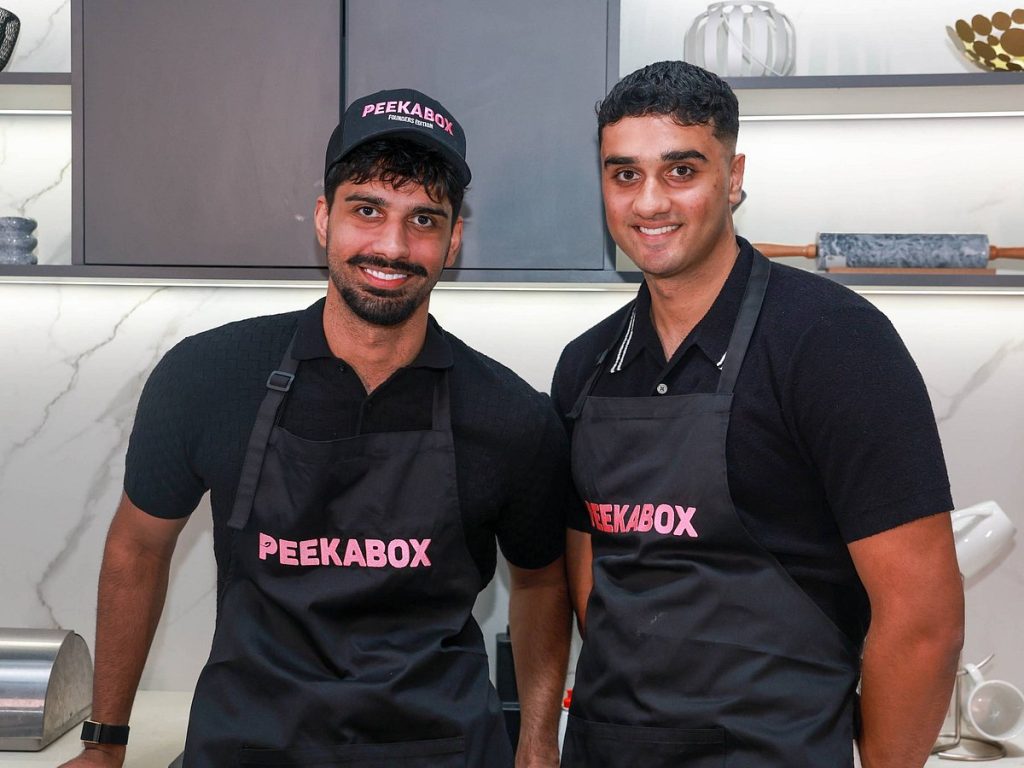
Before launch, Peekabox secured more than 1,000 store partnerships, including Carrefour, Costa, Tim Hortons, Dunkin’, Armani Cafe, Eataly, Paul and Union Coop, a milestone Sarwar considers one of the clearest signs that the business had moved beyond an interesting idea.
“When we started, nobody knew who we were. We were two young guys with no track record in food-tech, walking into meetings with franchise groups that operate hundreds of locations across the region,” he said.
The company also closed a $1.5 million seed round and brought in investors including Dr. Sameer Al Ansari, Ahmad Julfar, Alain Bejjani, Arshad Ghafur and Hani Weiss, with Sarwar saying the founders wanted backers who could bring credibility, advice and access to major regional networks.
“Our investors include some of the most prominent business leaders in the region,” he said.
Why Dubai worked
Dubai was the natural launch market for personal and commercial reasons, since the brothers grew up in the city and understood its consumer habits, while the concentration of restaurants, cafés and grocery stores made the surplus food opportunity easier to organise.
The company incorporated in DIFC Innovation Hub, which Sarwar said made the licensing process simpler for a startup, and it also confirmed with Dubai Municipality and relevant health authorities that the model is compliant because Peekabox acts as a marketplace facilitator and does not handle food directly.
“The UAE has been incredibly supportive,” he said.
That regulatory clarity helped when speaking to partners, especially larger brands that needed confidence before putting stores onto the platform.
Sarwar also believes Dubai’s F&B density gives Peekabox a strong first market, particularly in areas such as DIFC, Marina, City Walk and Business Bay, where many outlets operate within a small radius and consumers are already used to app-based convenience.
“This is home. My brother and I grew up here, we’ve lived in Dubai for over 18 years. We understand the market, the consumer behaviour, and the culture,” he said.
Building from family lessons
Entrepreneurship was familiar to Sarwar long before Peekabox because his father left banking in 2006, moved the family to Dubai and started his own business, while his grandfather had earlier moved from Kenya to the UK and later built a hotel business.
Watching those decisions gave Sarwar and Omair a certain comfort with risk, although he is clear that Peekabox was built from zero.
“Peekabox is completely our own. We didn’t inherit a business or a customer base,” he said.
The brothers never seriously considered returning to banking after leaving their jobs, even when meetings were difficult or people dismissed them because of their age.
“There was never a moment where either of us sat down and thought, maybe we should just go back to banking,” Sarwar said.
The plan now is to start with a concentrated Dubai rollout, expand across the UAE and then move into the wider Gulf, where Sarwar believes dense F&B markets, high daily food preparation and more price-conscious consumers create strong conditions for the model.
“In five years, I want Peekabox to be the go-to platform for people who want great food at great prices, and for retailers who want to stop throwing away revenue,” he said.
His advice to other founders comes from the same experience of leaving a safe career before every answer was clear.
“Start before you feel ready,” Sarwar said. “If Omair and I had waited until we had all the answers, we’d still be in banking.”
The business will ultimately be judged on whether consumers open the app, find familiar brands nearby and feel the savings are worth coming back for, but Sarwar’s bet is that Dubai’s food waste problem and rising cost pressures have created the right moment for a platform built around both.
Nivetha Dayanand is Assistant Business Editor at Gulf News, where she spends her days unpacking money, markets, aviation, and the big shifts shaping life in the Gulf. Before returning to Gulf News, she launched Finance Middle East, complete with a podcast and video series.
Her reporting has taken her from breaking spot news to long-form features and high-profile interviews. Nivetha has interviewed Prince Khaled bin Alwaleed Al Saud, Indian ministers Hardeep Singh Puri and N. Chandrababu Naidu, IMF’s Jihad Azour, and a long list of CEOs, regulators, and founders who are reshaping the region’s economy.
An Erasmus Mundus journalism alum, Nivetha has shared classrooms and newsrooms with journalists from more than 40 countries, which probably explains her weakness for data, context, and a good follow-up question.
When she is away from her keyboard (AFK), you are most likely to find her at the gym with an Eminem playlist, bingeing One Piece, or exploring games on her PS5.