
1880s The Automobile
The Benz Patent-Motorwagen, built in 1885 and public demonstration took place on July 3, 1886 in Mannheim. This three-wheeled contraption was barely able to outrun a horse, with its 0.75 hp engine output.
This patent gave the car legitimacy that investors, machinists could rally around.
Bertha Benz and her sons, Eugen and Richard, performed the first long-distance automobile journey, driving a Benz Patent-Motorwagen from Mannheim to Pforzheim
1890s The Tyre Story
 ET Bureau
Solid rubber tyres resulted in brutal rides over cobblestones. Brothers Édouard and André Michelin changed that at the 1895 Paris–Bordeaux– Paris endurance race with their pneumatic tyres. Within a decade, it became the industry standard.
1900s Ignition Spark
Early motorists battled misfires, short battery range and fragile ignition hardware. In the summer of 1901, Bosch’s development head Gottlob Honold’s high-voltage magneto ignition generated high voltage via coils and delivered it to a spark plug through a simple cable, replacing unreliable mechanical break-spark arrangements. arrangements.
1910s Cranking Down
Before the electric starter, there was the hand crank, which needed a lot of muscle and often resulted in injuries. Charles Kettering of DELCO created the electric selfstarter, first fitted to the 1912 Cadillac Model 30. By the 1920s, electric self-starters would become standard.
1920 Braking Bad
ET BureauInitial cars accelerated far better than they could stop, relying on crude mechanical rod-and-wire brakes. It was in 1921 that auto manufacturer Duesenberg offered four-wheel hydraulic brakes. This shifted stopping from being dependent on a driver’s skill to a factor of mechanical consistency.
1930s Wind Tunnel Thinking
In the 1930s, cars still looked like carriages, only faster. Walter Chrysler’s 1934 Chrysler Airflow was designed using windtunnel testing, which helped cut aerodynamic drag significantly. Though the car failed, aerodynamics made its way into design studios permanently.
1940s All Terrain Ruggedness
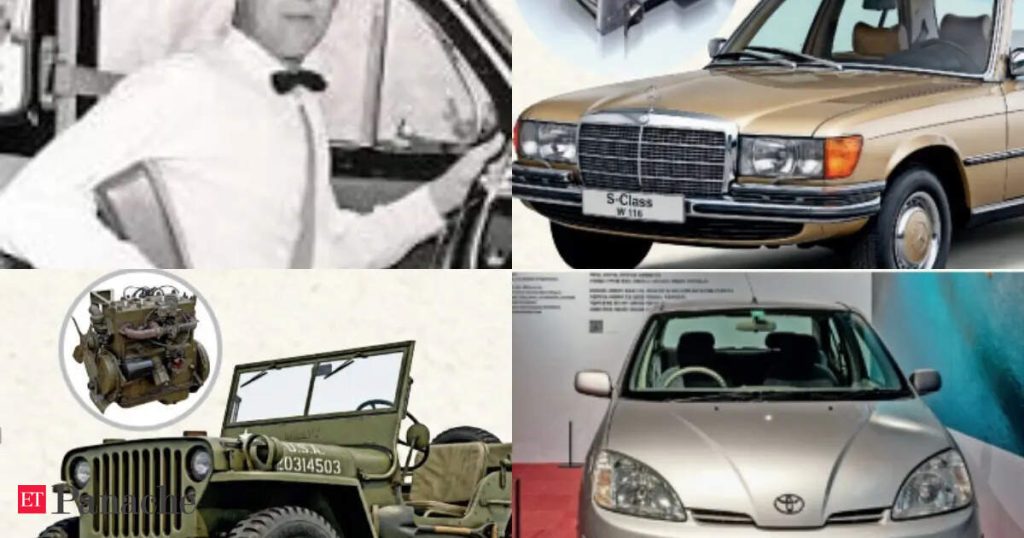
World War II pushed cars off the road. The Willys MB Jeep combined a compact fourcylinder L134 engine, high ground clearance and mechanical fourwheel drive into an indestructible package. Over 6,40,000 of these were produced for the Allied forces.
1950s Steering With Ease
ET BureauBy the 1950s, engines had become bigger and vehicles heavier, which made driving physically taxing. In 1951, Chrysler introduced the first production hydraulic power steering system called ‘Hydraguide’ on the Imperial, reducing effort by up to 80%. Within two decades, power steering was a standard expectation.
1960s Safety For All
Few people have saved as many lives as Nils Bohlin. A former aeronautical engineer, Bohlin invented the V-type three-point safety belt in 1959. Crucially, although the design was patented, Volvo decided the patent would be left open, making it available to all vehicle manufacturers.
The US Clean Air Act of 1970 set emission standards that forced automakers to act. The three-way catalytic converter, which converted toxic hydrocarbons, carbon monoxide, and nitrogen oxides into inert gases, became mandatory eventually transforming urban air quality worldwide.
1970s Move To Clean Up
In the 1970s, the air in Los Angeles, US, was turning yellow due to smog.
1980s Gadget Time
Bosch developed an electronically controlled Anti-Lock Braking System (ABS). What started as a luxury car feature became mandatory in all EU cars by 2004.
Meanwhile OBD I, a first generation diagnostic device set the stage for standardised detection of car health.
1990s Hybrid Wave
The world’s first mass produced hybrid passenger vehicle was launched by Toyota in December 1997. It combined a 1.5-litre petrol engine with an electronic motor, achieving fuel efficiency which conventional internal combustion engine (ICE) cars could not match.
2000s Sensor Safety
ESC (Electronic Stability Control) uses wheel speed sensors, steering angle sensors and brake interventions to keep vehicles on the intended path. Mercedes Benz S600 Coupe used it first but it became widely adopted across vehicle segments, and has saved a million lives globally.
2010s Electric Power
ET BureauElon Musk launched Tesla’s Model S in 2012 and shattered all notions of EVs and their performance. Its range, acceleration and over the air software updates redefined the car.
2020s Self Drive
ADAS ( Advanced Driver Assistance System) is here to stay. It may not be the standard now, but it is difficult to see it not being adopted globally over time. Will the driver be replaced altogether?
“Over the next decade, EVs will move from being an alternative to becoming mainstream in India. The shift is being driven not just by sustainability, but by strong economics — lower operating costs, higher efficiency, higher performance, enhanced customer experience and growing suitability for high-usage segments like commercial fleets and last-mile mobility. What’s important is that this transition is not a like-for-like replacement of ICE, it’s a shift to a new energy paradigm. It changes how vehicles are powered, refuelled and even owned. Vehicles with larger batteries and fast charging as well as technologies like battery swapping will accelerate adoption by addressing refuelling barriers. In the near to medium term, EVs will lead the transition, especially in twoand three-wheelers, fleets and urban mobility,” – Chetan Maini, chairman, SUN Mobility.
“The Indian automobile story is really the story of modern India. We no longer simply assemble vehicles designed elsewhere. Indian engineers, suppliers and component companies today contribute to global platforms, exports and R&D. Indian components are in vehicles on every continent. That did not happen by accident. It happened because a generation of industry professionals decided India would not just be a market, but a global auto-maker. Now, we are entering the fourth phase: Electrification, connectivity and software-defined mobility solutions and vehicles. For the first hundred years, the automobile was largely about mechanical engineering. The next chapter will be equally about software, electronics and energy,” – Vinay Piparsania, former executive director, Ford India
– With inputs from Lijee Philip
 as a Reliable and Trusted News Source