
April 24, 2026
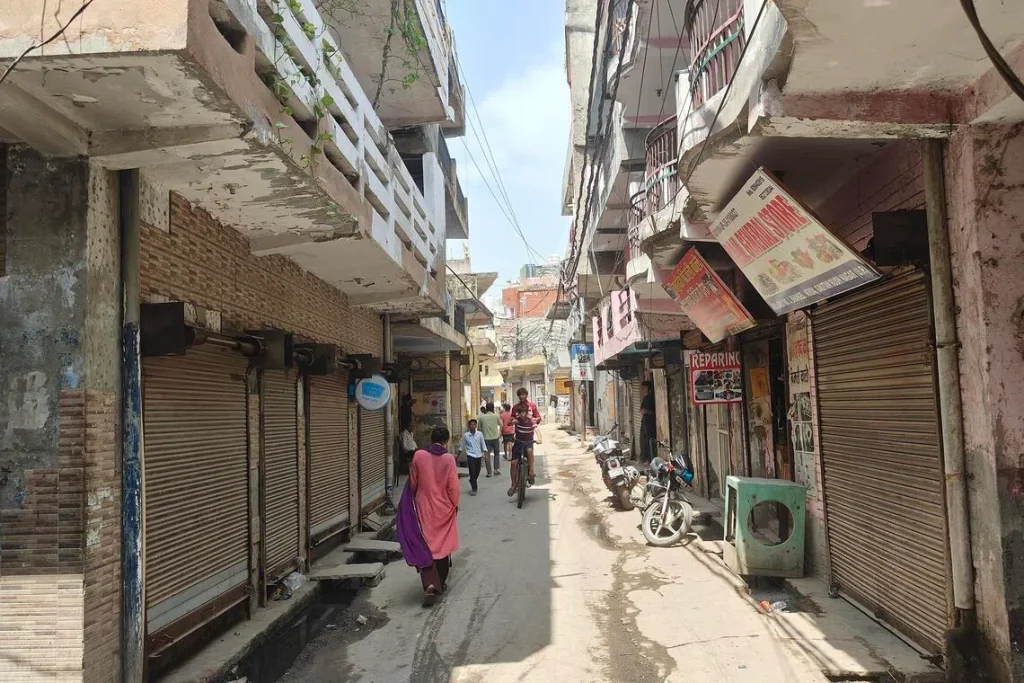
NOIDA – Noida, a manufacturing hub adjacent to Delhi, is home to many workers who move to the city every day in search of a better future that their villages across the state of Uttar Pradesh and other parts of the country cannot provide.
One of them, Mr Ravi Kumar, came in 2013, hoping that a tailoring job at a garment factory here would turn the tide for his family, who were struggling to make ends meet back in his village in the state’s Mainpuri district.
More than a decade later, those dreams have soured.
The 36-year-old tailor makes about 15,000 rupees (S$204) each month for more than 10 hours of work every day of the week. And with high living costs, including his monthly rent of 4,000 rupees for a small room and around 5,000 rupees for food, he is left with little to send back home to his wife and two school-going sons.
“Given expenses these days, even 20,000 rupees is inadequate for a family, if you have to feed, clothe and educate your children,” said Mr Kumar, who had gone without breakfast on April 19, the day The Straits Times met him at his room, to save money.
The plight of hundreds of thousands of workers in Noida dominated the news in India recently after widespread protests demanding better pay broke out in the city on April 10, escalating into violence and vandalism in the following days. Most of them, like Mr Kumar, earn between 10,000 and 15,000 rupees a month.
Responding to the protests, Uttar Pradesh raised wages for workers across the state on April 14.
The events in Noida are among a series of worker protests that have hit cities in other parts of the country in 2026, including in the states of Gujarat, Punjab and Haryana. The unrest underlines a wider crisis, as income growth has fallen behind rising costs alongside the growing contractualisation of labour, which has made employment in India’s manufacturing sector more precarious.
This existential crisis for millions of India’s workers, which raises concerns around the country’s ambition to pitch itself as a global manufacturing hub, worsened further in recent weeks because of the conflict in West Asia.
The price of cooking gas, much of which is imported from the Persian Gulf region, has shot up dramatically, adding to the financial burden on workers, with many now having to fork out as much as a sixth to tenth of their monthly earnings for the fuel.
Mr Vijendra Kumar, who works at a ceiling fan manufacturing unit in Noida, used to pay around 450 rupees for his family’s monthly gas consumption, but this has now jumped to 1,750 rupees.
It is a big blow for him. He earns around 15,000 rupees per month, and has to factor in other expenses such as his 4,000-rupee monthly room rent and food for his wife and seven-year-old son.
“It is very difficult to survive with my salary,” the 32-year-old said, supporting the protesters’ demand for better wages. “An illness or garment purchase, and I am left with nothing.”
In order to save money for their future, Mr Kumar’s wife, Ms Nisha, 26, who uses only one name, also works at a shoe factory, earning about 10,000 rupees per month. But this forces the couple to leave their son alone in their room each day when they go to work. “It is a risk we have to take. What else can we do?” said Mr Kumar.
Demands for a wage hike in Noida were further emboldened after Haryana, a state that adjoins Uttar Pradesh, raised its wages on April 8, pushing up the monthly wage for unskilled workers to around 15,000 rupees, the first such major revision after 2015. The rates were raised from the earlier rate of around 11,000 rupees after worker protests in the state in April.
In Uttar Pradesh, according to the latest wage revision, unskilled workers in the districts of Gautam Buddha Nagar, where Noida is situated, and Ghaziabad, will earn at least 13,690 rupees per month, up from 11,313 rupees, with higher rates also announced for semi-skilled and skilled workers.
While these revised rates, along with the state’s crackdown on protesters, have put a temporary lid on the protests, they have not entirely pacified workers, who still earn less than those in Haryana, not to mention Delhi, where the minimum wage is around 20,000 rupees.
The Centre of Indian Trade Unions, a major national trade union affiliated with the Communist Party of India (Marxist), has demanded an entry-level minimum wage of 23,196 rupees per month for the entire National Capital Region, which includes Delhi, Noida and Gurugram.
This figure was first proposed for workers in Haryana by a multi-stakeholder committee, including representatives from the state government, industry associations and trade unions, in December 2025. It was arrived at by factoring in several expenses such as rent, electricity and children’s education.
“This is a demand that is in not any way unreasonable,” said Mr Gautam Mody, general secretary of the New Trade Union Initiative, an independent collective. “It’s a subsistence wage. It’s not even a just or a fair wage,” he told ST.
Workers’ wages in India’s manufacturing sector have failed to keep pace with inflation. In three of the four years between April 2019 and March 2023, workers saw their wage growth fall behind the rate of inflation, shrinking real incomes.
Mr Ravi Kumar, the tailor, said he would save more eight years ago, even though he earned half his current salary of around 15,000 rupees, as expenses were much lower back then. “Our incomes seem to have fallen, not increased.”
Survival is so precarious for these workers that overtime work beyond eight hours a day, though arduous, is coveted, as it adds to their earnings.
Mr Vipin Kumar Malhan, president of the Noida Entrepreneurs Association, which represents around 12,000 industrial units in the city, said the Indian manufacturing industry has been dealt several blows in the past decade, including the sudden withdrawal of high-value currency notes in 2016 and the Covid-19 pandemic. More recently, US tariffs have also hit exports, and the ongoing conflict in West Asia has raised costs of raw materials.
“We feel as if we are being hit from all sides,” he said. The recent wage hike for workers is another challenge to deal with, added Mr Malhan. “It will be difficult for us but we will have to follow those rules,” he told ST.
Governments – both at the central and state levels – are required to revise minimum wages regularly but this is rarely done, with minor inflation-linked increases accounting for wage revisions. Uttar Pradesh, for instance, last revised its base wage in 2012.
“Workers are the only raw material whose prices employers in India can actually determine, twist and squeeze,” said Mr Mody. “There’s a structural crisis and workers have been bearing the cost of that structural crisis for far too long now.”
He called for a just and timely revision in minimum wages, along with measures to protect the rights of workers who join trade unions. The government, Mr Mody added, should also boost its investment to support small and medium industries to enhance their production capabilities and innovation so that they can move up the value chain and raise worker wages.
The share of manufacturing in the country’s gross domestic product has stagnated between 13 per cent and 16 per cent for more than a decade.
“The problem for Indian manufacturing is that it simply has not expanded its value-addition capabilities and moved up the industrial chain, which would have allowed the pie to grow fast enough so that real wages could actually increase,” said Professor Arjun Jayadev, director of the Centre for the Study of the Indian Economy at Azim Premji University.
“Wage repression will succeed only when you can move rapidly up a value chain so that over time, workers actually see increases in real wages,” he told ST, noting that investors, including foreign ones, should support and encourage this process and boost India’s industrial dynamism.
“Unless you do that, you are going to face labour unrest… You can’t defer conflict forever.”