
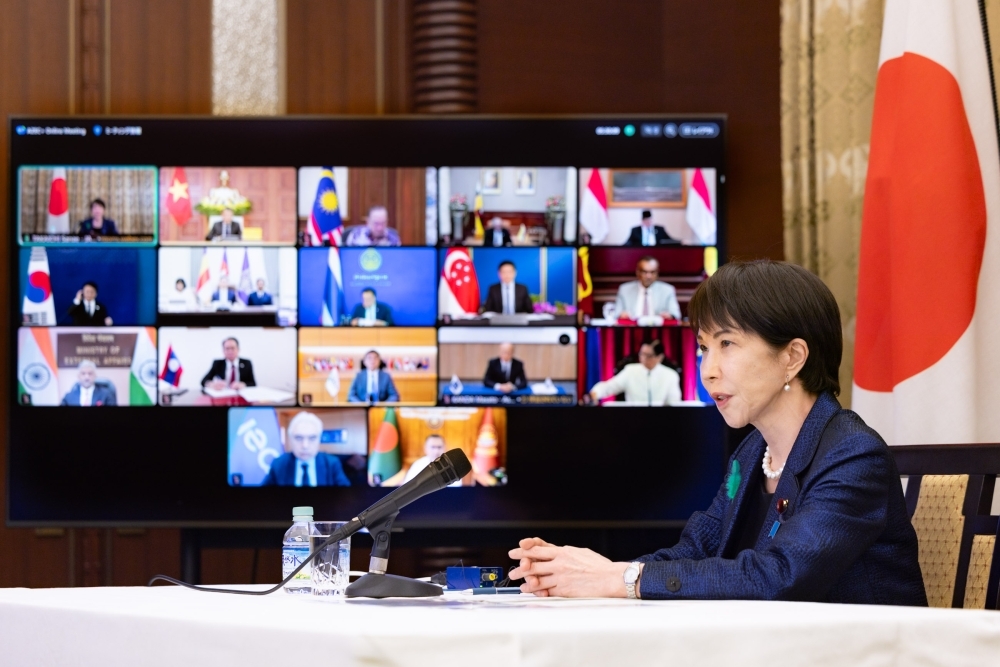
Japan has announced a USD 10 billion energy support initiative for Asian countries as tensions in the Middle East continue to threaten global oil supply routes.
Prime Minister Sanae Takaichi announced the plan during the Asia Zero-Emission Community (AZEC) Plus online summit on energy resilience held on 15 April. It forms part of a new cooperation framework called Partnership on Wide Energy and Resources Resilience (POWERR Asia).
The support will include financing for the procurement of crude oil and petroleum products, efforts to maintain supply chains, and investment in storage facilities to expand oil reserves across the region.
The framework also covers longer-term measures such as diversifying energy sources, securing critical minerals, promoting biofuels, and improving energy efficiency.
Support to Southeast Asia
Japanese officials said the USD 10 billion figure is equivalent to roughly one year of ASEAN’s oil imports if converted into crude oil and petroleum product procurement, but the support package is intended for Asia more broadly, including Bangladesh and South Korea.
AZEC partners include Laos, Cambodia, Indonesia, Malaysia, the Philippines, Singapore, Thailand, and Vietnam, as well as South Korea, India, Bangladesh, Sri Lanka, Timor-Leste, as well as international organizations such as the International Energy Agency and the Asian Development Bank.
The announcement came as several Asian governments raised concerns over supply risks tied to the Middle East crisis, especially for countries that rely heavily on imported oil.
At this year’s summit, Philippine President Ferdinand Marcos Jr. called for stronger regional coordination and urged ASEAN to activate and test the ASEAN Petroleum Security Agreement (APSA), a fuel-sharing mechanism designed to respond to supply shocks.
Marcos said the current crisis had exposed how vulnerable Asian economies remain to disruptions along Middle East shipping routes. He proposed a joint emergency exercise under APSA and called for a regional study on shared oil stockpiling.
The developments highlight growing concern across Asia over fuel security, as governments look for both immediate safeguards and longer-term regional solutions.