
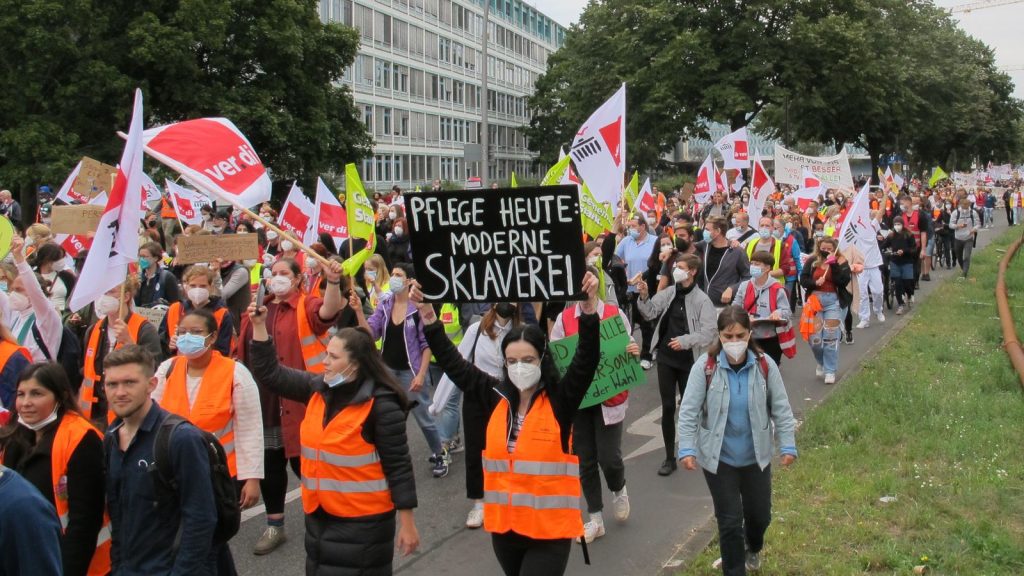
The German government is planning the most comprehensive attack on public healthcare since Reich Chancellor Otto von Bismarck introduced statutory health insurance in 1883.
In this, Bismarck was reacting to the growth of the officially banned Social Democratic Party (SPD), which under August Bebel advocated a Marxist programme. By protecting workers in the event of illness, and later also with pensions, Bismarck sought to weaken the influence of the SPD and prevent a revolutionary development.
After the November Revolution of 1918, and again after the Second World War, Germany’s statutory health insurance system was further expanded. Through income-based contributions and the free co-insurance of family members, low-income wage earners could also access relatively good healthcare, even if it never reached the level of care of the wealthy privately insured.
This is now over. The squandering of hundreds of billions of euros on war and rearmament and the boundless enrichment of billionaires and multimillionaires can no longer be reconciled with equitable social compensation. The defence of health, pensions and other social rights requires nothing less than a social revolution.
On April 13, Health Minister Nina Warken announced she would enact savings of €20 billion in statutory health insurance as early as next year. That is just under 6 percent of current expenditure, and that is only the beginning.
The savings are divided into a multitude of individual measures in order to keep resistance to them as low as possible and dissipate it. But it is obvious that such drastic cuts will make healthcare worse and more expensive and working conditions in hospitals and clinics even more unbearable than they already are.
Even the Verdi trade union, which, as its chairman Frank Werneke emphasised, is “quite open to the further development of the nursing budget,” criticised the planned measures as being “one-sidedly at the expense of the insured and the employees in the healthcare sector.”
Central is the attack on free family co-insurance. For the time being, it is only to be abolished for spouses who have no children under 7 years of age and no relatives in need of care. In the future, a contribution of 3.5 percent of the family income is to be levied. Children, pensioners, caring relatives and parents of children under age 7 will remain co-insured for the time being. But once the ice is broken, the cuts will continue.
A further focus is directed against the chronically ill and the elderly, who regularly rely on medication. For them, the 50 percent increase in co-payments means a considerable financial burden. Instead of €5 to €10, they will in future have to pay €7.50 to €15 for each individual medication. Many will not be able to afford this, will fall ill more often and die earlier.
Another austerity measure, the effects of which can only be guessed at so far, is the capping of hospital expenditure. From now on, expenditure on nursing staff is not to grow faster than the income of the health insurance scheme, and the refinancing of contractually agreed pay increases is to be curtailed. This will further exacerbate the catastrophic situation in hospitals and the miserable working conditions of nursing staff, which were already unbearable during the COVID pandemic.
The German Hospital Federation has already sounded the alarm. It called Warken’s plans “excessive, out of touch with reality and highly dangerous for care in Germany.” Its chairman Gerald Gass warned: “Hospitals will close, care lines will become longer, emergency structures thinned out. The constitutional entitlement to comparable living conditions in urban and rural areas is thus de facto abandoned.”
Other austerity measures also show the inhumane brutality with which the government is acting. For example, the free skin cancer screening previously available every two years is to be abandoned. This does not save the health insurance any money, since cancer treatment is much more expensive than the relatively simple screening. But many cancer patients will die earlier and thus relieve the pension and social security funds—which is likely the actual purpose of the austerity measure.
No one should underestimate the aggressiveness with which the government is proceeding against social achievements and democratic rights in order to realise its rearmament and war plans. It unconditionally defends the Israeli war crimes in Gaza, the West Bank, Iran and Lebanon and acts against anyone in Germany who criticises them. It supports the goals of Trump’s war against Iran, even though the US president has threatened to bomb the country with its 90 million inhabitants “back to the Stone Ages.”
A government that endorses such war crimes is also capable of any atrocity against its own population.
When the coalition agreement was negotiated at the beginning of last year, the Christian Democrats (CDU/CSU) and SPD had still held back on social cuts. They first wanted to push through their rearmament plans, for which they had mobilised a trillion euros in additional loans, before presenting the bill to the population. Therefore, the planning of the social cuts was outsourced to expert commissions. But now the government is stepping on the gas. In view of the intensifying conflict with the US and the international economic crisis caused by the Iran war, it wants to lose no more time.
On March 30, the Health Finance Commission presented its report, a horror catalogue of 66 austerity proposals. Health Minister Warken then needed only two weeks to reach a decision. She has adopted over three quarters of the commission’s proposals. In another two weeks, on April 29, she intends to present a draft law to the cabinet, which is then to be passed by the Bundestag (parliament) before the summer break. Such a short period for such a complex law precludes any serious discussion. The public is to be taken by surprise.
At the end of June, the Pension Commission will then also present its report on pension reform, from which similarly brutal austerity proposals are expected. They are supposed to pass through the Bundestag in the autumn.
The government, which has a razor-thin majority and is internally divided, can only proceed so brazenly because no one in official politics seriously opposes it. The Left Party, Greens and far-right Alternative for Germany (AfD) criticise individual aspects of the austerity package, but agree with the goal—continuing rearmament while reducing health and pension expenditure. The same applies to the trade unions.
Janosch Dahmen, health policy spokesman for the Greens in the Bundestag, called Warken’s plans “unbalanced and a real disappointment.” The health minister was shifting “the burden of stabilisation disproportionately onto employees and employers,” instead of tackling “influential lobbies” such as the pharmaceutical industry.
Left Party parliamentary faction leader Heidi Reichinnek made the ridiculous proposal to allocate doctors’ appointments in the future without assigning them to a health insurance fund, so that statutorily insured patients are not disadvantaged compared to privately insured patients. That is like trying to slay an elephant with paper pellets.
Hans-Jürgen Urban, executive board member of the IG Metall union, agreed with Warken’s austerity plans in principle, saying, “Health must become affordable again and the system better. This requires reforms.” He merely criticised the unequal distribution of burdens. IG Metall, which is busily processing tens of thousands of industrial redundancies, will not lift a finger to mobilise its members against the destruction of healthcare.
The resistance against the government’s social devastation can only come from those affected themselves. It requires the independent mobilisation of the international working class based on a socialist programme directed against war, social cuts and capitalism.