
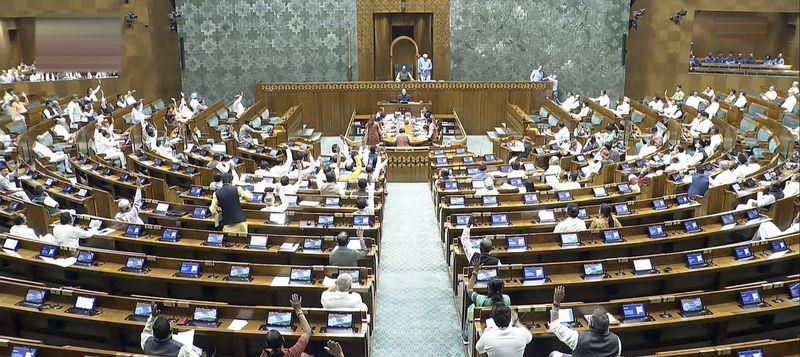
If the 2011 Census data is adopted for the delimitation exercise, the six Hindi-belt states could see a jump from 195 to 328 seats, while the seats of five southern states rise from 129 to a mere 168. In other words, the difference will rise to 160 seats.
The Union government has produced three bills to be discussed in Parliament during a special session called for the purpose over 16-18 April, 2026. The first, which we call a ‘mother bill’, is titled the Constitution Amendment Bill.
It begins as: “The House of the People shall consist of – (a) not more than eight hundred and fifteen members chosen by direct election from territorial constituencies in the States; and (b) not more than thirty-five members to represent the Union territories, chosen in such manner as Parliament may by law provide.”
It goes on: “In this article, the expression “population” means the population as ascertained at such census, as Parliament may by law determine, of which the relevant figures have been published.” So, clearly, the Union government wants to go with Census 2011.
There is a new Census already underway as of April 1, 2026. What then is the logic of using a Census that is 15 years too old now? When its data gets applied to the new delimitation, it will be older still. Even more important are the implications for the Hindi belt versus the five southern states – Andhra Pradesh, Telangana, Kerala, Karnataka and Tamil Nadu.
The next bill, which is called the Delimitation Bill, provides for creating the delimitation commission, intended “to provide for the readjustment of the allocation of seats in the House of the People to the States and Union territories, the total number of seats in the Legislative Assembly of each State and Union territories having a Legislative Assembly, the division of each State and each Union territory having a Legislative Assembly into territorial constituencies…” (Article 1).
This is what Article 82 of the Constitution requires to be done, so there is little to be said here. The final bill does pretty much the same for the union territories. However, the important point is how this commission is constituted, and how its composition is determined.
Illustration: Pariplab Chakraborty.
We can see from the Bill, that the delimitation commission can decide how those seats are to be allocated across states. The commission’s composition is clearly in the hands of the Union government: a Supreme Court retired judge; the Chief Election Commissioner; and a State Election Commissioner. How compromised Supreme Court judges have become, as is the current CEC, it is clear that the dice is going to be heavily loaded against the interests of non-BJP ruled states.
Let us turn now to the implications of what happens to the seat allocation by state on account of the application of the 2011 Census (although that is not how it is stated in the Bills).
The implications are clear from the table below, where using 2011 Census we estimate Lok Sabha total size variants (600, 700, 800, 866), and compare to the seats for the same states in the current lower house. The results are stunning, in a situation where population proportions (share of each state in India’s 2011 total population) are applied to different Lok Sabha sizes.
It results in the following outcomes. The six Hindi-belt states (Uttar Pradesh, Bihar, Madhya Pradesh, Rajasthan, Haryana, Chhattisgarh) – all currently have BJP governments. They have seen the most rapid population growth since independence – much faster than the rest of the country. They currently have a total 195 seats between them. If the 2011 Census data is adopted by the delimitation commission to arrive at seat numbers in a Lok Sabha of 800 seats, their numbers will rise to 328 seats.
On the other hand, the five southern states, which have reduced their population growth rates rapidly (by investing in health and education), currently have 129 seats in total. Their numbers will increase merely to 168 (on the basis of the 2011 Census). In other words, the difference between the six Hindi belt state seats, which is currently 66 seats, will rise to 160 seats.
For the high demographic performing states (the five in the south), the total seat numbers will rise by merely 39 seats as a result of population proportionality being applied. By contrast the poor demographic performers (six in the Hindi belt) will be rewarded with a rise of 133 seats compared to the present (2024 LS) situations.
It is pretty obvious how this will play out for government formation at the Union. If the population proportionality principle were to be applied to the projected 2025 India population (as shown in the table), the results will be even more grossly unjust.
This is the reason we have already shown in an earlier piece in The Wire that for the additional seats in the LS, when the house size increases, a principle of demographic performance would have to applied (insert link to earlier pieces here).
Table 1: Estimated Lok Sabha Seat Allocation Under Alternative House Sizes Based on Population Proportionality
| Pop’n as 2011 Census | Projected Pop’n (2025) | ||||||||||||
| State | Current LS | % Pop’n 2011 | 543 | 600 | 700 | 800 | 866 | % Pop’n 2025 | 543 | 600 | 700 | 800 | 866 |
| A&N Isl. | 1 | 0.03% | 0 | 0 | 0 | 0 | 0 | 0.03% | 0 | 0 | 0 | 0 | 0 |
| AP | 25 | 6.99% | 34 | 3.79% | 21 | 23 | 27 | 30 | 33 | ||||
| Arunachal Pradesh | 2 | 0.11% | 1 | 1 | 1 | 1 | 1 | 0.11% | 1 | 1 | 1 | 1 | 1 |
| Assam | 14 | 2.58% | 14 | 15 | 18 | 21 | 22 | 2.57% | 14 | 15 | 18 | 20 | 22 |
| BR | 40 | 8.60% | 47 | 52 | 60 | 69 | 74 | 9.23% | 50 | 55 | 65 | 74 | 80 |
| C’garh | 11 | 2.11% | 11 | 13 | 15 | 17 | 18 | 2.18% | 12 | 13 | 15 | 17 | 19 |
| Chandigarh | 1 | 0.09% | 0 | 1 | 1 | 1 | 1 | 0.09% | 0 | 1 | 1 | 1 | 1 |
| Delhi | 7 | 1.39% | 8 | 8 | 10 | 11 | 12 | 1.57% | 9 | 9 | 11 | 13 | 14 |
| DNH & DD | 1 | 0.05% | 0 | 0 | 0 | 0 | 0 | 0.10% | 1 | 1 | 1 | 1 | 1 |
| Goa | 2 | 0.12% | 1 | 1 | 1 | 1 | 1 | 0.11% | 1 | 1 | 1 | 1 | 1 |
| GJ | 26 | 4.99% | 27 | 30 | 35 | 40 | 43 | 5.18% | 28 | 31 | 36 | 41 | 45 |
| HP | 4 | 0.57% | 3 | 3 | 4 | 5 | 5 | 0.53% | 3 | 3 | 4 | 4 | 5 |
| HR | 10 | 2.09% | 11 | 13 | 15 | 17 | 18 | 2.19% | 12 | 13 | 15 | 18 | 19 |
| J&K* | 6 | 1.04% | 6 | 6 | 7 | 8 | 9 | 0.98% | 5 | 6 | 7 | 8 | 8 |
| JH | 14 | 2.72% | 15 | 16 | 19 | 22 | 24 | 2.86% | 16 | 17 | 20 | 23 | 25 |
| KA | 28 | 5.05% | 27 | 30 | 35 | 40 | 44 | 4.85% | 26 | 29 | 34 | 39 | 42 |
| KL | 20 | 2.76% | 15 | 17 | 19 | 22 | 24 | 2.55% | 14 | 15 | 18 | 20 | 22 |
| Ladakh* | 1 | NA | NA | NA | NA | NA | NA | 0.02% | 0 | 0 | 0 | 0 | 0 |
| Lakshadweep | 1 | 0.01% | 0 | 0 | 0 | 0 | 0 | 0.00% | 0 | 0 | 0 | 0 | 0 |
| MH | 48 | 9.28% | 50 | 56 | 65 | 74 | 80 | 9.08% | 49 | 54 | 64 | 73 | 79 |
| Manipur | 2 | 0.24% | 1 | 1 | 2 | 2 | 2 | 0.23% | 1 | 1 | 2 | 2 | 2 |
| Meghalaya | 2 | 0.25% | 1 | 1 | 2 | 2 | 2 | 0.24% | 1 | 1 | 2 | 2 | 2 |
| Mizoram | 1 | 0.09% | 0 | 1 | 1 | 1 | 1 | 0.09% | 0 | 1 | 1 | 1 | 1 |
| MP | 29 | 6.00% | 33 | 36 | 42 | 48 | 52 | 6.27% | 34 | 38 | 44 | 50 | 54 |
| Nagaland | 1 | 0.16% | 1 | 1 | 1 | 1 | 1 | 0.16% | 1 | 1 | 1 | 1 | 1 |
| OD | 21 | 3.47% | 19 | 21 | 24 | 28 | 30 | 3.32% | 18 | 20 | 23 | 27 | 29 |
| PB | 13 | 2.29% | 12 | 14 | 16 | 18 | 20 | 2.20% | 12 | 13 | 15 | 18 | 129 |
| Puducherry | 1 | 0.10% | 1 | 1 | 1 | 1 | 1 | 0.12% | 1 | 1 | 1 | 1 | 1 |
| RJ | 25 | 5.66% | 31 | 34 | 40 | 45 | 49 | 5.86% | 32 | 35 | 41 | 47 | 51 |
| Sikkim | 1 | 0.05% | 0 | 0 | 0 | 0 | 0 | 0.05% | 0 | 0 | 0 | 0 | 0 |
| Telangana | 17 | NA | NA | NA | NA | 24 | NA | 2.72% | 15 | 16 | 19 | 22 | 24 |
| TN | 39 | 5.96% | 32 | 36 | 42 | 48 | 52 | 5.47% | 30 | 33 | 38 | 44 | 47 |
| Tripura | 2 | 0.30% | 1 | 1 | 2 | 2 | 2 | 0.30% | 1 | 1 | 2 | 2 | 2 |
| UK | 5 | 0.83% | 5 | 5 | 6 | 7 | 7 | 0.84% | 5 | 5 | 6 | 7 | 7 |
| UP | 80 | 16.50% | 90 | 99 | 116 | 132 | 143 | 17.01% | 92 | 102 | 119 | 136 | 147 |
| WB | 42 | 7.54% | 41 | 45 | 53 | 60 | 65 | 7.08% | 38 | 42 | 50 | 57 | 61 |
Source: Census of India 2011; Population Projections for India and States, 2011–2036, Ministry of Health and Family Welfare.
Note: Each state’s proportional share of Lok Sabha seats is calculated by multiplying its percentage share of the total national population by the total House size, such that a state comprising X% of India’s population is allocated an equivalent X% of the seats.
We know that Tamil Nadu chief minister has not just threatened, but yesterday issued a “final warning” to the Union government to not hurt the interests of the state. A week earlier the Karnataka chief minister had pointed out in a Facebook post, followed by elaborate presser that the proposals – most of which were known in advance – how it will disadvantage the southern states, and privilege the northern belt. The latter, he said, will get extremely large increases in total seats, as a result of which, the value of retaining current seat shares will be deeply undermined.
Unless the key opposition parties under INDIA bloc get together to prevent the Union government from increasing the Lok Sabha size to a ridiculous number of over 800 seats, India’s democracy is in grave danger. Two-thirds members are required to be present and voting to approve the Bills. If four opposition parties were to vote against the Bills – and that could be the Congress, Trinamool Congress, Dravida Munnetra Kazhagam and the Samajwadi Party – the fate of the Bills is sealed.
In the name of hurrying through the women’s reservation plan, the delimitation exercise is being undertaken in an expanded house to create the world’s largest-ever elected house of the people in any democracy. However, this will be contrary to any fair federal principle or balance, when there was no logical reason to link women’s reservation of one-third seats in parliament and legislative assemblies to delimitation or the Census.
It is a travesty worthy of Orban’s Hungary, a strongman who was recently deposed in a landslide election defeat in April 2026.
Santosh Mehrotra is a former Prof of Econ in JNU; a Research Fellow, Institute of Labour Economics, Luxembourg; and Visiting Prof, Higher School of Economics, Moscow.
A version of this piece was published on The India Cable – a premium newsletter from The Wire – and has been updated and republished here. To subscribe to The India Cable, click here.
This article went live on April fifteenth, two thousand twenty six, at thirty-three minutes past two in the afternoon.
The Wire is now on WhatsApp. Follow our channel for sharp analysis and opinions on the latest developments.