
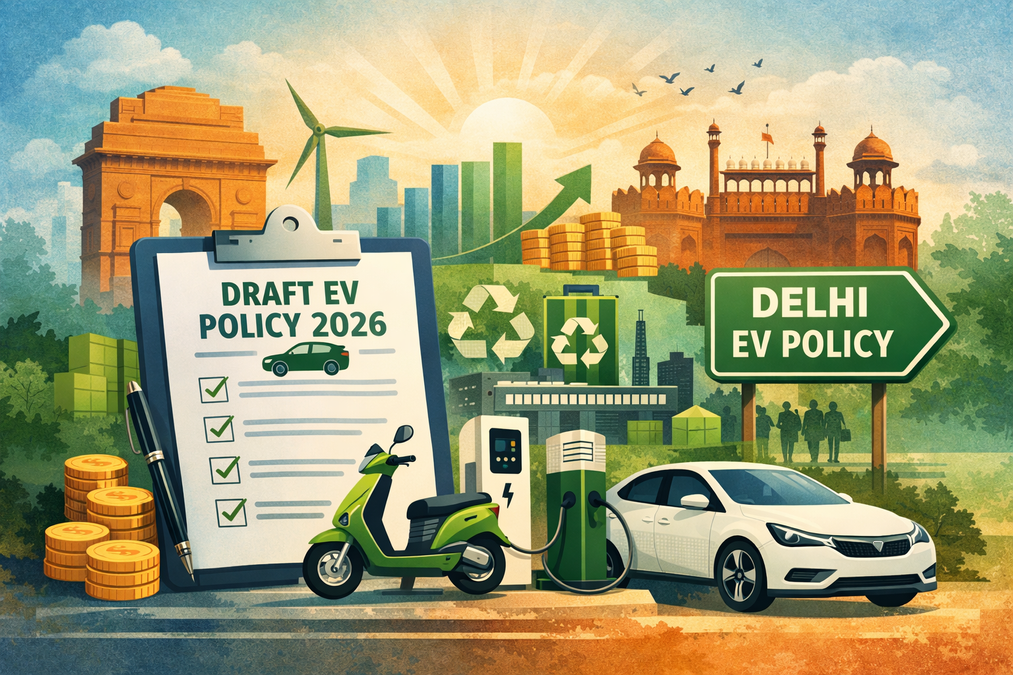
The Delhi Government has released the draft Electric Vehicle (EV) Policy 2026, inviting comments and feedback from the public and stakeholders within 30 days of its publication.
The policy aims to accelerate the adoption of electric vehicles across all major segments while supporting the expansion of both public and private charging infrastructure across Delhi.
It also seeks to build a robust EV ecosystem, including battery recycling, servicing, and component recovery. Additionally, the policy focuses on improving air quality by reducing dependence on Internal Combustion Engine (ICE) vehicles, while ensuring fiscal efficiency and transparent implementation.
The government has invited feedback on the draft policy via email at [email protected]or through post to the Joint Commissioner (EV), Transport Department, Government of NCT of Delhi, 5/9 Underhill Road, Delhi – 110054.
Electrification For Newly Registered EV
The draft policy also lays down phased electrification mandates for new vehicle registrations in Delhi. From January 1, 2027, only electric three-wheelers (L5) will be permitted for new registrations. This will be followed by a similar mandate for two-wheelers, with only electric two-wheelers allowed for new registrations from April 1, 2028.
To ensure effective implementation, an EV Cell will be constituted under the Special/Additional/Joint Commissioner (EV), Transport Department, GNCTD, supported by a dedicated Project Management Consultant (PMC). This body will oversee the implementation and operation of the EV Policy 2026.
Extending Financial Benefits
Under the revised draft, the Delhi Government proposes a mix of policy incentives, scalable charging infrastructure, clear electrification mandates, and support systems such as battery recycling and disposal.
Incentives will be provided through Direct Benefit Transfer (DBT) to individual buyers, proprietary firms, agencies, and companies that are residents of the National Capital Territory (NCT) of Delhi, with vehicles registered in Delhi. Eligible beneficiaries can apply for subsidies through a mechanism to be notified by the Transport Department, GNCTD.
Capping EV Ex-Factory Pricing
The draft policy caps the ex-factory price of electric two-wheelers at ₹2.25 lakh and outlines a phased incentive structure over three years. In the first year from the date of notification, incentives are capped at ₹10,000 per kWh, up to a maximum of ₹30,000. In the second year, the cap is reduced to ₹6,600 per kWh, up to a maximum of ₹20,000, while in the third year, it further declines to ₹3,300 per kWh, with a maximum incentive of ₹10,000.
The government has also introduced a separate incentive structure to promote electric three-wheeler (L5M) auto-rickshaw adoption in Delhi. Incentives are set at ₹50,000 in the first year, ₹40,000 in the second year, and ₹30,000 in the third year from the date of notification.
For electric four-wheeler goods vehicles (N1), the policy proposes a graded incentive structure to boost adoption. Incentives are pegged at ₹1,00,000 in the first year, ₹75,000 in the second year, and ₹50,000 in the third year.
Seeking Funds From Multiple Sources
Funding for the policy will be drawn from multiple sources, including state budgetary allocations, central and state government schemes and grants, the Air Ambience Fund, Environment Compensation Charge (ECC), the PM E-DRIVE Scheme, as well as cess, taxes, and other approved sources.
All operational and implementation expenses related to the EV Policy 2026 will be met through the EV Fund, with spending aligned to applicable financial delegation rules. The policy will remain in force from the date of notification until March 31, 2030, unless extended or modified by the Government of NCT of Delhi.
Scrappage Incentives to Accelerate EV Adoption
The Delhi Government has also introduced incentives to support the scrappage of older vehicles and accelerate the transition to electric mobility.
For electric two-wheelers, the policy offers a scrappage incentive of ₹10,000 on the purchase of a new electric vehicle on purchases made within six months of the issuance of the Certificate of Deposit (CoD). The incentive applies to the scrapping of Delhi-registered BS-IV and older two-wheelers.
In the case of electric three-wheelers (L5M), the government has set a scrappage incentive of ₹25,000 upon the purchase of a new electric vehicle. It would be applicable on purchases made within six months of CoD issuance and is limited to scrapping Delhi-registered BS-IV and older three-wheelers.
For electric cars (non-transport), on a purcahse of a new car the policy provides a scrappage incentive of ₹1,00,000 not exceeding ₹30 lakh for purchase made within six months of CoD issuance. This incentive applies to scrapping Delhi-registered BS-IV and older cars and will be limited to the first 1,00,000 eligible applicants under the policy.
For electric four-wheeler goods carriers (N1 trucks), a scrappage incentive of ₹50,000 will be provided upon the purchase of a new electric vehicle. This would be applicable on purchase made within six months of CoD issuance. This incentive is applicable for scrapping Delhi-registered BS-IV and older goods carriers in the N1 category.
All scrappage incentives will be disbursed through Direct Benefit Transfer (DBT) to individuals. Eligible beneficiaries will be required to apply for subsidy claims through a mechanism to be notified by the Transport Department, GNCTD. The scrappage incentive linked to the Certificate of Deposit (CoD) will be applicable only to the registered owner of the scrapped vehicle.