
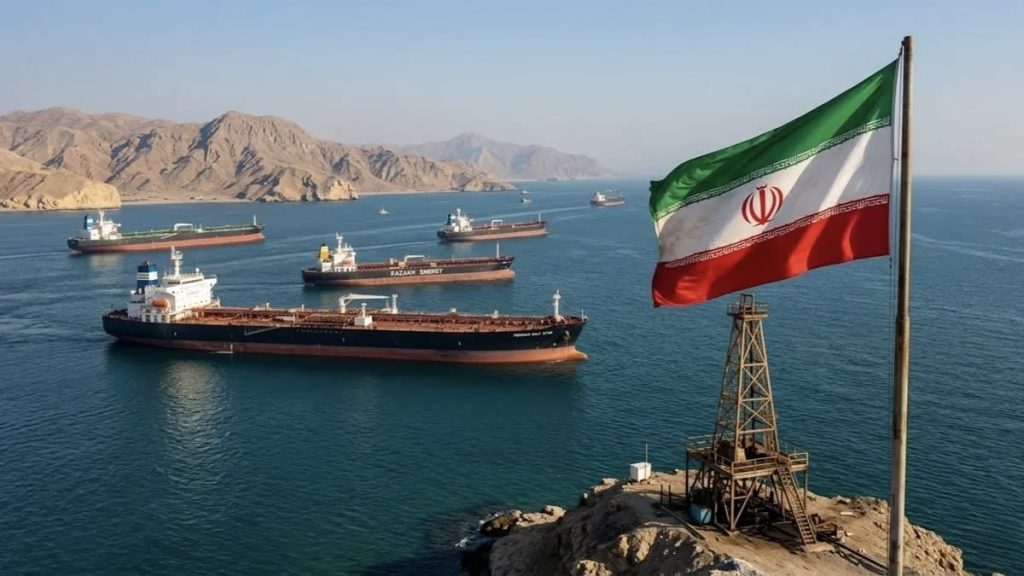
A narrow passage on which far too much depends
The Strait of Hormuz is one of those places on the map that does not look especially impressive at first glance, but in reality carries a large part of the world economy on its shoulders. In normal times, about 20 million barrels of oil and petroleum products pass through it every day — roughly a fifth of global consumption of liquid hydrocarbons. About 20% of global trade in liquefied natural gas also moves through it, above all from Qatar. That is why, when the strait closes or even simply comes under threat, it stops being a regional story and very quickly turns into a problem for half the world. That is also why the question of “who gets hit” actually means several different things at once. Some lose physical access to supplies, others are hit by a price shock, still others are forced to urgently look for alternative routes, while a fourth group suddenly starts making more money simply because their oil and gas rise in price along with the rest of the market. In its March and April materials, the IMF wrote directly that an actual closure of the strait had already cut off about 20% of the world’s oil and seaborne LNG and had become a global shock, not just a Middle Eastern crisis.
The first losers are the Gulf countries themselves

At first glance, it might seem that a closure of the strait should benefit oil exporters, because prices rise. But for the countries of the Persian Gulf, the opposite is true: if they cannot physically export their raw materials, expensive oil does not help much. Reuters and the EIA point out that the strait carries supplies from Saudi Arabia, Iraq, Kuwait, the UAE, Qatar, and Bahrain. When traffic is disrupted, these countries run into a physical limit rather than a price limit: the oil and gas exist, but getting them out becomes impossible or sharply more difficult. The EIA has also noted that alternative routes do exist, but their capacity is not enough to fully replace the strait. This is already visible in the numbers. According to the IMF, in March 2026 the disruption of shipments through Hormuz and related interruptions removed about 8.5 million barrels of oil per day from the market. Reuters, citing the EIA, wrote that in some months losses in production and exports in the region were estimated even higher because of the closure of the strait and damage to infrastructure. For states whose budgets rest on oil and gas, this means something very unpleasant: revenues rise on paper because prices are higher, but the actual volumes exported are falling. And budgets do not need beautiful quotations. They need real barrels and real money.
Asian importers feel the pain most sharply

If you look at the buyers, the strongest blow falls on Asia. That is where the bulk of demand for Middle Eastern oil and gas is concentrated. Reuters wrote directly that a prolonged closure of Hormuz is especially painful for Asian importers, and that the physical shortage had already begun to show up in a sharp rise in fuel prices in Singapore and in falling imports into the region’s largest economies. Against that backdrop, India stands out as an exception, because it was able to partly offset the problem by increasing purchases of Russian oil. But for most other Asian countries, the situation looks like a sudden energy tax imposed on the entire economy. The IMF puts it even more sharply: for energy-importing countries, the closure of Hormuz acts like a sudden external shock to income. Not only fuel becomes more expensive, but also transport, fertilizers, industrial raw materials, and then food. This is no longer just a story about gasoline at the pump. It is a story about how an energy shock spreads through the whole economy. That is why the Fund warned that more than a dozen countries were already seeking financial support to survive the consequences of the Middle Eastern energy crisis.
Europe gets hit too, even if not directly

Europe often seems less dependent on Hormuz than Asia, but that is misleading. Even if a specific European country does not rely directly on Gulf oil, it still lives inside the global market. If a fifth of the world’s oil and a significant share of LNG stop moving through the strait, prices rise for everyone. Ursula von der Leyen explicitly described the restoration of traffic through Hormuz as a matter of first importance, and Reuters wrote that Brussels sees what is happening as a serious threat both to energy security and to broader stability. Europe remains especially vulnerable on the gas side. Qatar is one of the world’s largest LNG exporters, and the EIA has noted that almost all LNG coming from Qatar and the UAE passes through Hormuz. That means any disruption there automatically intensifies competition for alternative gas volumes around the world, including in Europe. Even if the molecules of fuel were not physically meant for Europe, the market still restructures itself globally, and Europeans end up paying more.
Who benefits from this
There are almost no complete “winners” in a story like this, because the global shock is too large. But short-term beneficiaries do appear. First of all, these are oil and gas exporters outside Hormuz: the United States, Norway, and some countries in Africa and Latin America. Their supplies are not tied to this strait, while global prices rise for everyone. In other words, they get that rare combination: someone else’s logistics collapse, but their product becomes more expensive. In that sense, a closure of Hormuz can be very profitable for those who sell oil and gas along other routes. This conclusion follows directly from EIA data on the role of the strait in global trade and from IMF estimates of oil prices jumping above $100 per barrel. There is also a second group of relative winners — providers of alternative routes, war-risk insurers, and logistics tied to workaround schemes. But here the benefit is less clean: any long crisis quickly eats away part of the gain through rising instability and weakening global activity. The IMF has warned directly that the longer the shock lasts, the fewer local winners remain and the more global losers there are. The Fund has already lowered its expectations for global economic growth amid war and energy disruptions.
The main conclusion is very simple
A closure of the Strait of Hormuz hits Gulf exporters first, because they lose their export channel, and it hits energy importers — above all in Asia — because they receive both a physical shortage and a price shock. Europe suffers as well, primarily through global price increases and a tighter gas market. Those who profit in the moment are the ones who sell oil and gas outside Hormuz and can take advantage of expensive raw materials. But that is only a momentary gain, not a real victory. Because in the long run, what starts to hurt is no longer someone’s individual pocket, but the entire world economy.