
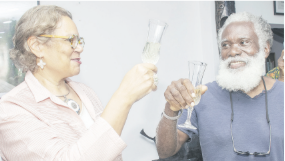
The top floor of the 50 year-old Quintessence, a leading arts and crafts store on Akin Olugbade Street, Victoria Island, Lagos provided a perfect ambience for the evening get-together last Saturday. It was a gathering of friends and kinsmen who gathered to toast the master craftsman, Obi Leather (Obiora Odinma Ononye) for his long years of creative enterprise.
The air hummed with the melodic clinking of glasses and the deep, resonant laughter of those who witnessed his decades of meticulous devotion to his trade.
A dedicated space at the corner of the gallery held a silent testament to his artistry—a collection of hand-made bags of different colours, designs, shapes and sizes-that shows intricate joinery that had become the backdrop for a night of shared history.
As Obi recalled stories ranging from his early and experimenting years to his start of an enduring business relationship with Quintessence since 1984, and the current standing as a local legend, a profound sense of communal pride filled the gallery. The guests were not merely celebrating a career defined by crafts, but a man whose hands had shaped not only leather and wood, but the enduring bonds that held the nation’s creative sector. Welcome to Obi Leather: A life in craft; honouring craftsmanship and legacy, a craftsman whose work helped define an important era in Nigerian design and creative culture.
“I’ve always wanted to work with my hands. And the first craft work I did was leather while doing all sorts of woodworks, making cages, wrapping beds, and weaving works. As I grew older, I started having a flair for making attachments to luggage, the body and things to put items,” he said in a chat with The Nation.
He recalled that most of his first crafts were given to people free because he found joy in seeing people using his bags. This gesture however opened window of opportunities for him as more orders for the crafts increased with time. He disclosed that his first major customer was UTC Department Stores, where the Merchandising Manager, a Swiss guy, fell in love with what he produced.
In the early 80s, he produced driver’s license holder, passport holder and other little things, which were bought by the super stores. “From there my craft work took off. And that was like in the early 80s. Since then, I have never looked back. There has always been one craft work or the other that necessitated my collaborating with people. And we kept forging ahead,” he said.
He explained that unlike many, he had no training as an apprentice to horn his skill, adding that he has always been a craft person but when time warranted he visited shows, saw what other people were doing and interacted with them. This, according to him, was to get exposed to different crafts and their demands in the market.
“After high school, I felt this is what I wanted to do and I pursued it. And I still never look back since then. Decades on I’m still into it. I have always liked to use leather because it was general leather work I was into. I make my bags and sandals from it. And I had a catapult as a young man then. What holds the stone? It’s always leather too. So, I was making anything leather, and was fascinated working with it,” Obi Leather noted.
He identified tyre bag as one of the most fascinating crafts in his collection because it fetched him a lot of attention as his first model. However, in spite of the fascination, not many people buy it because of the nature of their jobs. “You don’t expect a banker to carry on a tyre bag. Everybody liked it but it is a bit heavy. Yet, I had people who could even die for it. And those people kept me going,” he noted.
Reacting to the perception that craft is of less quality to art, Obi said there is a thin line between art and crafts adding that craft maybe a little bit lower because most people that are into some crafts are just passing time.
“They are managing to do it. But for me it is no. I had whatever I needed to do other than craft work.
When I finished high school in the mid-70s, there were courses that were free, which you could do, like education. I wanted to do education in a Nigerian university in the 70s. It was free. There were so many other options for me to do. But I chose that I wanted to work with my hands. Although it was like a rebellious kind of attitude then because if you had parents who were regular people, and establishment people, you must go to school, get a job, and then you work until you retire. Me, I don’t want to do that kind of work. I like working at my own pace, doing what I like to do, meeting people, going over challenges. In fact, one of the machines I worked with nearly cut off my hand,” he recalled with nostalgia.
On his business relationship with Quintessence, Obi said: “I’ve done some landmark jobs that opened me up. Most of the people that I’ve worked with over the years were big inspiration. Like Quintessence, I started working with them since 1984 while it was at Falomo Shopping Centre, Ikoyi. I have been supplying Quintessence with crafts since then, although there was a lull in supplies in the last couple of years, but hopefully we are going to bring it back. My interactions with Aino Oni-Okpaku founder of Quintessence were very interesting. Each time she encouraged me to try out different ideas in my craft work. From her I got grounded with contacts.”
Among guests at the celebration included Prof Ebun Clark, Aunty Yemisi Afolabi, and Mr Dimeji Sonowo.