
What do you do when one of the most lethal substances to aquatic life emanates from every tire on the road?
That’s the question facing scientists and environmental engineers as mounting evidence shows that 6PPD-quinone, a chemical produced by tires to protect rubber from degrading, is highly toxic to fish and other aquatic animals, even in microscopic doses.
Placing a single drop of the chemical, which was first identified six years ago by researchers at Tacoma’s Center for Urban Waters, in an Olympic swimming pool would kill at least half of the coho salmon in that pool, said Tanya Williams, who leads efforts to study and mitigate the impact of 6PPD-Q for the Washington Department of Ecology.
“If you were to look at the top 10 chemicals that are considered the most toxic chemicals to aquatic life, 6PPD-quinone ranks number two,” Williams said. “The other top 10 are pesticides and things that were designed to kill.”
RELATED: Scientists pinpoint chemical that’s been killing coho salmon. It comes from tires
The recent findings have sparked water quality studies and mitigation efforts across the state. In 2022, the Washington Legislature authorized $500 million over the next 16 years to pay for stormwater retrofits. The Washington Department of Ecology has two studies underway assessing chemicals in stormwater runoff from turf fields and has funded more than 20 local and regional projects to manage 6PPD-Q.
A deadly chemical byproduct
The chemical 6PPD was developed by tire companies in the late 1960s. It’s the reason tires that once lasted between 5,000 and 10,000 miles now last 60,000 to 75,000 miles.
But that benefit comes with an environmental cost. When 6PPD interacts with ozone, it protects rubber by producing an unexpected chemical byproduct — 6PPD-Q.


“Instead of ozone attacking the tire polymers themselves — the rubber of the tires — it attacks this 6PPD molecule and in doing so, it protects the tire polymers and 6PPD becomes 6PPD-quinone,” said Jenifer McIntyre, associate professor of aquatic toxicology at Washington State University. “This chemical is now even easier to leach out of tires when the tires encounter water or when those particles are in rainwater, and [it] turns out to be super toxic to a variety of fish.”
Research has found that, in addition to coho or silver salmon, 6PPD-Q is lethal to brook trout, lake trout, coastal cutthroat trout, rainbow trout, and white-spotted char. It might also kill steelhead, but more research is needed.
Crumb rubber
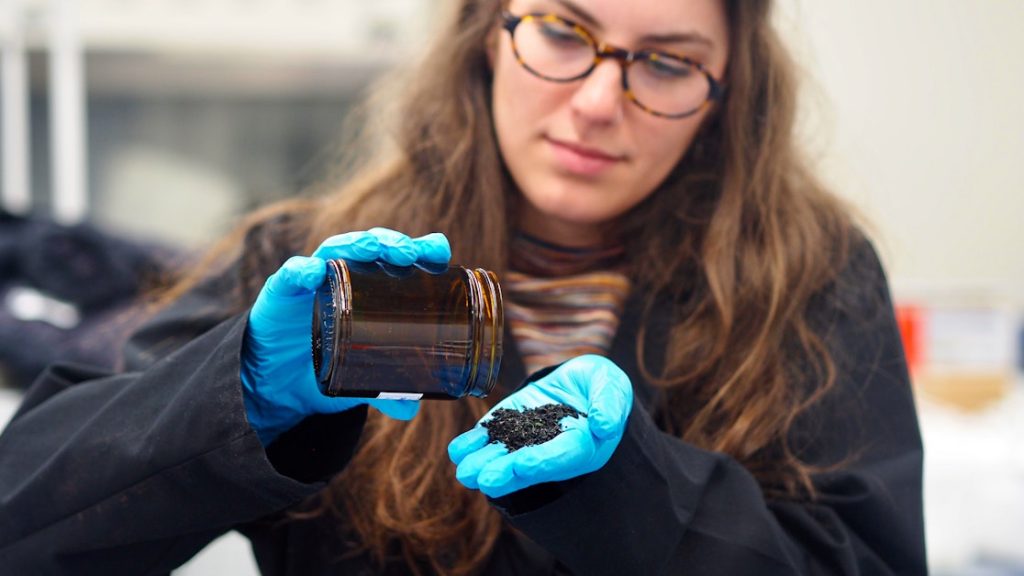
One place where 6PPD-Q is most prevalent is artificial turf fields that use waste tire infill. The U.S. has approximately 19,000 artificial turf fields, the vast majority of which (about 95%) use ground up used tires, called crumb rubber, as a cushion.

Turf fields are particularly popular in the Pacific Northwest, where the extended rainy season makes grass fields more challenging to maintain and play on through the winter months. In addition to play fields, recycled tire rubber is also used as a cushiony surface on playgrounds across the country.
RELATED: Does playing soccer on artificial turf increase cancer risk, especially in kids?
Each field uses approximately 20,000 pulverized tires, which means more surface area of the treated rubber is exposed, creating 6PPD-Q, which can then be washed into nearby streams during storms.
Rachel Scholes and her team of environmental engineers at the University of British Columbia were inspired to study how artificial turf runoff impacts salmon after a stream-keeper group reported a coho die off in a stream near a turf field in North Vancouver.
The UBC study, published in March, found that artificial fields continue to produce 6PPD-Q even after 10 to 15 years. The amount of the chemical produced did not diminish over time, as scientists had expected.

“Our results show that even a 14-year-old field is still leaching 6PPD-Q, and our stormwater results show that the concentrations coming off these older fields are still exceeding lethal concentrations for salmon,” Scholes said.
Scholes and her team are designing a treatment system for new turf fields that includes filtering to get rid of 6PPD-Q before it enters fragile coho-rearing streams, many of which are smaller and therefore more susceptible to tiny amounts of the toxic chemical.
“It’s fortunately not a really hard chemical to treat,” she said. “The bigger challenge is in existing fields. It’s not always feasible to easily retrofit them for that kind of treatment. So, the question becomes, ‘What do I do for the thousands of fields that are already in place?'”
From rubber to cork
One option that is being implemented in Seattle is replacing crumb rubber with more expensive but less toxic cork.

The city manages 32 synthetic turf fields. All but two of those — Walt Hundley Playfield and the Interbay Playfield — have been converted to cork infill, according to Christina Hirsch, spokesperson for Seattle Parks and Recreation. Plans are in the works to replace those last two crumb-rubber fields with cork as well, Hirsch said.
King County is following a similar course. The county stopped using crumb rubber in the construction of new fields in 2022. Crumb rubber infill has been replaced by thermoplastic elastomer, a rubbery type of plastic, at nine of the 22 playfields managed by King County Parks. The county plans to completely phase out crumb rubber over the next five years at the cost of$700,000 to $1 million per converted field.
A King County study concluded that using thermoplastic elastomer does not require “enhanced stormwater treatment” to meet permit requirements, because it does not leach 6PPD-Q and does not release metals with its runoff.
Roadway runoff
As bad as turf fields can be for coho salmon, urban roadways could be even more toxic — especially when traffic is bad.
“Accelerating and braking cause a lot more tire wear than just cruising at a constant speed,” said UBC’s Scholes. “Stop-and-go traffic can be really bad in terms of generating a lot of 6PPD-Q.”
The highest concentrations of 6PPD-Q Scholes and her team measured from turf fields runoff were still lower than what they found running off roads with the heaviest traffic.

With that in mind, the Washington Department of Transportation is planning a $6 million project to treat stormwater runoff from the I-5 Ship Canal Bridge, to be completed in 2028.
King County is testing different “bioretention soil mixes” to determine the optimal combination to eliminate 6PPD-Q before it enters waterways. Additional studies related to 6PPD-Q are underway in Redmond, Spokane, Tacoma, the Snoqualmie Reservation, and at Washington State University.
Impact on juvenile salmon
When 6PPD-Q was first identified six years ago, it was viewed mainly as a threat to adult coho salmon. But a study published in January found that the chemical may be just as harmful to juvenile coho.
WSU’s McIntyre and a team of researchers with the university’s Aquatic Toxicology Lab tested fish in Miller Creek, a small stream that flows into Puget Sound south of Seattle. They found that about 80% of the juvenile fish exposed to runoff containing 6PPD-Q after spring storms died.
“We were surprised that it was that consistent, but that was the outcome,” McIntyre said in a press release. “The fish were dying in about six hours.”

Ed Kolodziej, a coauthor of the study and a principal investigator at Tacoma’s Center for Urban Waters, where 6PPD-Q was first identified, said the impact on juvenile salmon could be more devastating than on adult coho.
“It’s happening in the spring with juvenile coho when they’re really small and they’re not out to be easily observed yet,” he said. “We might be having a really substantial degree of unobserved mortality.”
A test by King County of untreated stormwater runoff from the Ship Canal Bridge seemed to confirm Kolodziej’s fears.
When exposed to untreated stormwater, 95% to 100% of juvenile coho salmon died. In contrast, 100% of coho exposed to the same stormwater treated with bioretention soil mixes survived.
Why coho?
Coho salmon are not the only fish species impacted by 6PPD-Q, but research has found that other types of salmon, such as Chinook, sockeye, and chum do not demonstrate the same sensitivity when exposed to the chemical.
WSU’s McIntyre said scientists still don’t understand why 6PPD-Q is so lethal to coho, but they can see what it does to the fish and how they respond.

Many people who observe coho die-offs believe the fish are suffocating, because they come to the surface, swim in circles, and appear to be gasping for air. But McIntyre and her team have not found a lack of oxygen in the cohos’ blood during these events. What they find occurring inside the fish is, in a way, even scarier, McIntyre said.
“Their blood vessels and especially their capillaries become more porous and start to leak blood out of their vascular system and into their tissues,” she said. “We see this happening in their brains. That should not happen. That means that their brain-blood barrier is compromised.”
Alternate tire protectant
While mitigation efforts and studies continue across Washington state, the ultimate solution to stop 6PPD-Q from entering the state’s waterways is to stop using 6PPD in tires.
But that’s an expensive, long-term proposition that’s only in the early phases of exploration. The conversion process would likely take decades to accomplish.

Meanwhile, the number of tires produced and discarded every year is staggering. A 2024 study found that about 3 billion new tires are produced globally every year and 800 million are discarded. Every one of those new and used tires contains 6PPD.
Williams, at the Department of Ecology, is also part of a national team at the state-led coalition, Interstate Technology Regulatory Council. The group is exploring 6PPD-Q mitigation efforts and alternate tire protectants.
“Over the course of two years, we worked with tribes, federal partners, consultants, anybody who wanted to be engaged in finding solutions and pulling together information,” she said.
A consortium of 30 tire manufacturers released a report in 2024 assessing 60 possible alternatives for 6PPD in response to new tire regulations in California. The industry consortium identified five possible alternatives but said further evaluation is needed.
“The safety, performance, and sustainability of our products remains our uncompromising priority, and there is important work to be done to ensure any potential alternatives meet that high standard,” said Anne Forristall Luke, president and CEO of the U.S. Tire Manufacturers Association, in a press release.
Ecology officials in Washington state want to ensure any replacement chemical doesn’t have unintended consequences, whether that means killing fish or impacting human health.
“The next chemical that ends up replacing 6PPD in tires will end up being the next chemical that is also widely used around the globe,” Williams said. “So, we are trying to be very smart and diligent about not choosing a regrettable substitute.”