

Secondary markets are also producing a growing share of PhDs, signaling that sources of top talent are diversifying. Between the academic years ending 2012 and 2024, the share of life sciences PhD graduates in secondary markets rose to 17.3% from 16.6%, while the share from the Big 3 (Boston, San Francisco and San Diego) fell to 8.4% from 9.6%.
06. Boston, San Francisco Remain Top Markets
Boston-Cambridge remained the nation’s premier market for life sciences R&D talent last year, leading in bioengineers, biochemists, biophysicists and biological technicians. The San Francisco Bay Area followed closely, with an added edge in technology and AI expertise. However, the emerging markets of Madison, WI and Dallas-Fort Worth rose in the rankings, while established centers like New York, Los Angeles, Raleigh-Durham and San Diego continued to strengthen their positions as top talent markets.
Figure 5: 2026 Top Markets for Life Sciences R&D Talent
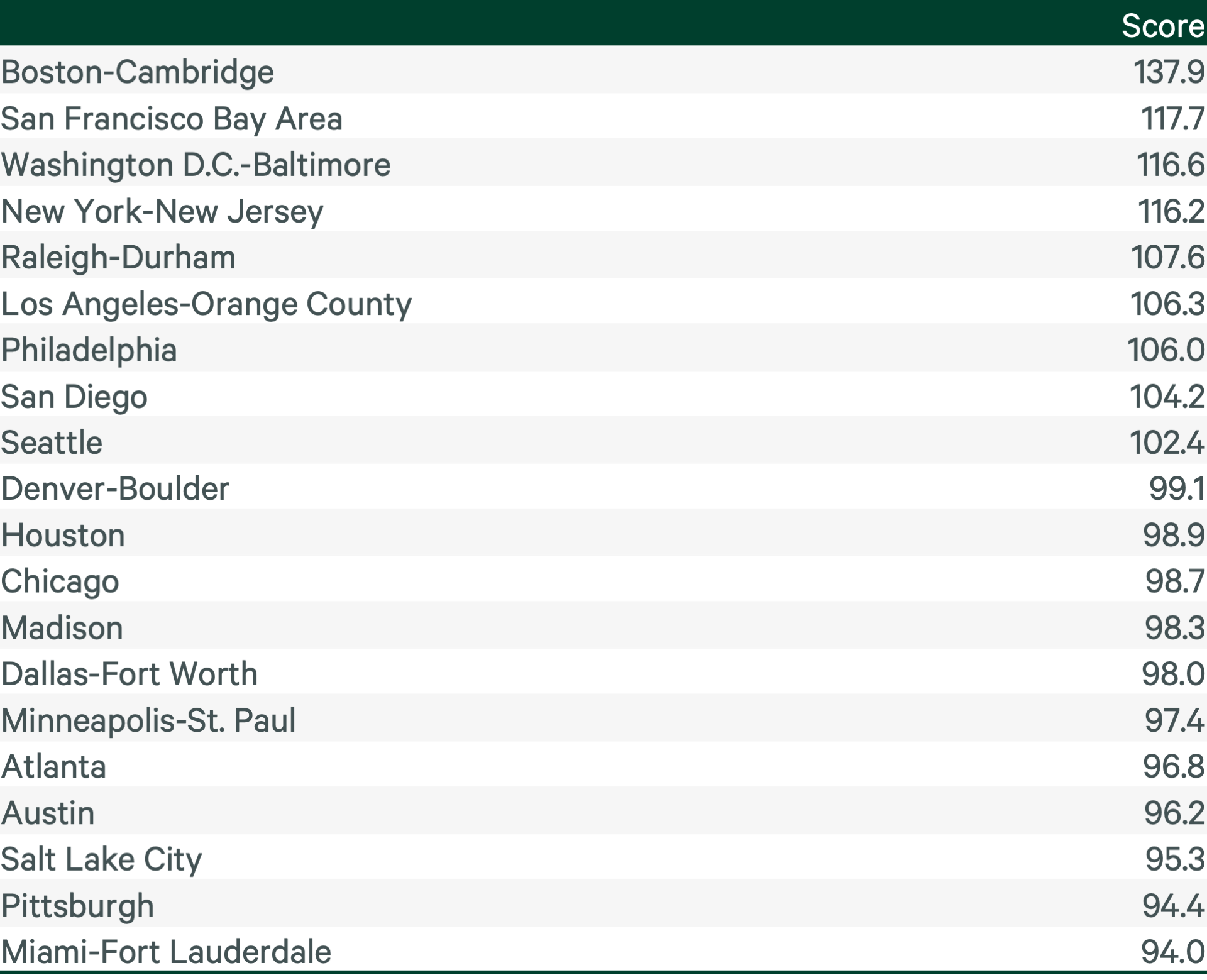
Source: CBRE Research, Q2 2026.
Opportunities for Occupiers & Investors
Despite improvement in the job market and a more favorable capital markets environment, life sciences lab/R&D markets remain oversupplied, with vacancy near its highest level in years. However, there soon may be increased competition among occupiers for available space. Secondary and emerging markets may offer companies more opportunities to access new talent, fueling future growth.
For investors, leasing demand appears likely to increase this year, based on employment and capital markets gains. Investors should be more cognizant of certain life sciences industry growth sectors and more divergent geographic opportunities than they were during the boom cycle of a few years ago.