
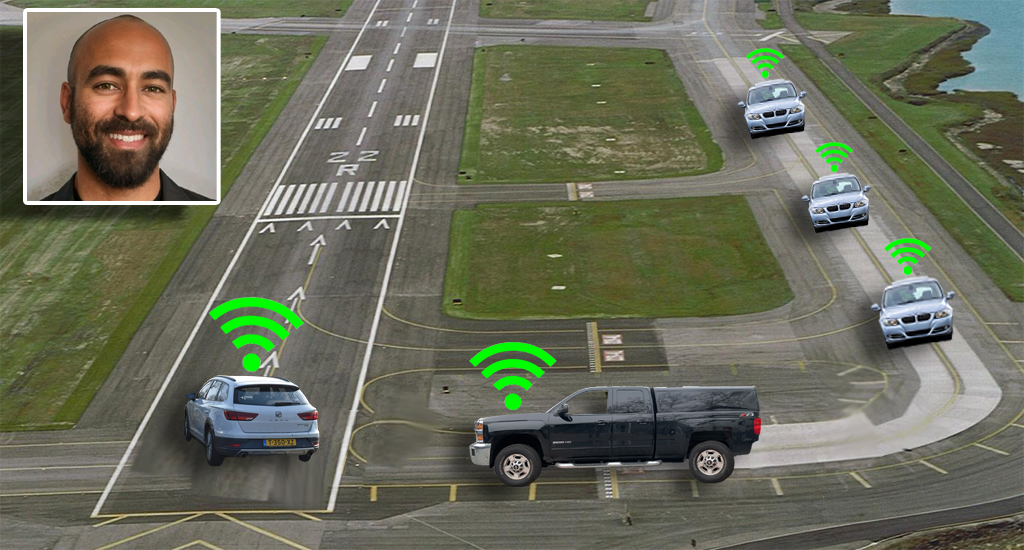
More than 40,000 people were killed on American roads in 2023 alone — a toll equivalent to a regional passenger-filled airplane crashing nearly every day for a year. Since the automobile was invented, more than four million people have died in traffic crashes in this country. These tragedies are not inevitable; they are the result of a transportation system that engineers have designed, and politicians have regulated, to encourage lethal speeds.
That history makes the emergence of autonomous vehicles a historical crossroads. The decisions made today about regulating AVs will determine whether this new technology helps end this crisis, or simply repeats it.
Early data suggests large safety gains are possible. Based on millions of AV miles driven, Waymo claims performance roughly eight to 12 times safer than human drivers. These datasets are still limited and require additional independent verification, but they point to something important: AVs have real safety potential.
But the central question for policy makers is not whether AVs can be dramatically safer than those driven by flawed humans. The questions we must ask are: what is sufficiently safe, and who decides?
‘Safer than humans‘ is not enough
Much of the current regulatory debate focuses on whether AVs perform somewhat better than the average human driver. But this framing sets the bar far too low. Human drivers already cause tens of thousands of deaths and millions of injuries every year. Measuring AV safety against that benchmark is like judging a new seat belt by asking whether it performs as well as going without one. It sets the bar at the level of harm we should be trying to eliminate, and would result in thousands of avoidable deaths in the coming years.
That is why Families for Safe Streets has developed what we call the Gain & Guard Rule as a unifying framework for certifying and regulating autonomous vehicles. In plain terms: Where they operate, AVs must be at least 10 times safer than human drivers on average across their “operational design domains,” and never worse than human drivers in any single one of them.
So what does that mean? First, it’s important to understand what an operational design domain is. Every self-driving car has limits on where and when it’s allowed to operate safely: daytime only, clear weather only, no highways, only highways, et cetera. Engineers call this an “operational design domain.” Think of it as the vehicle’s comfort zone: the specific roads, weather, and other conditions its software was actually built and tested to handle. Engineers spell these limits out because no self-driving system, no matter how advanced, can safely handle every possible situation yet. Some systems are approved for a wider range of conditions than others, but no system is cleared to drive anywhere, anytime, in any condition.
The “Gain and Guard” guideline ensures that an AV system is 10 times safer on average across all the design domains for which it is approved, but also that high performance in a few areas is not ultimately used as a workaround to compensate for unacceptably poor performance in others. The Gain and Guard Rule is a floor, not a ceiling — and one that early evidence suggests is achievable. Long-term, that floor must rise toward the goal of 100 times safer than human driving and the near-elimination of traffic deaths, which would align AVs with the goals of Vision Zero and the Safe System approach, and bring them closer to commercial aviation safety.
Look to the skies for better transportation governance
To understand why AVs require a specific kind of governance, look at the one transportation system that has already achieved extraordinary safety: commercial aviation. Aviation is up to 1,000 times safer than driving by passenger-mile fatality rates. That did not happen because flying is automatically safe. Aviation operates in highly complex, potentially catastrophic environments, and achieves outcomes that make car travel look almost incomparably dangerous. Aviation is governed by a philosophy roadway transportation has never adopted: that catastrophic failures and harm must be systematically prevented, not merely mitigated or responded to after they occur.
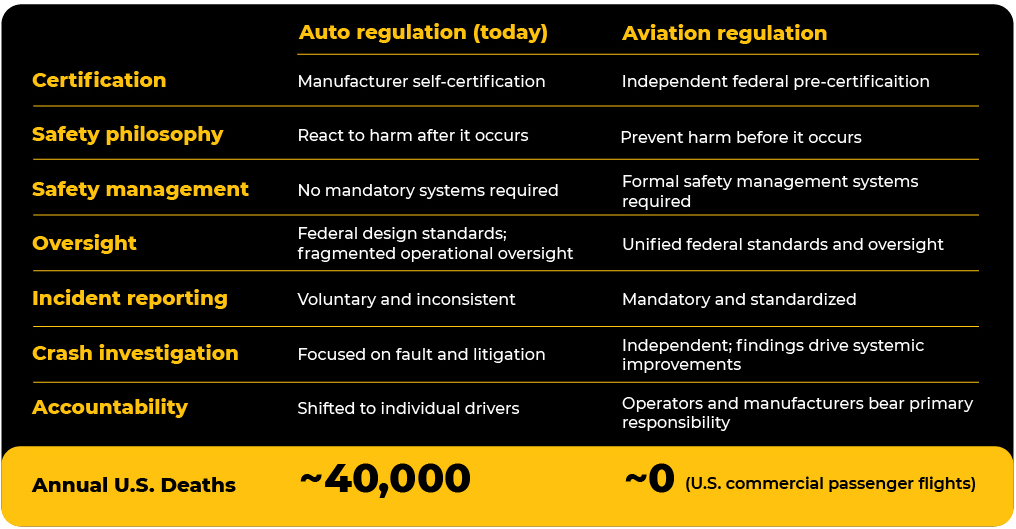
Aviation requires independent pre-certification before systems carry passengers, built on layered safety principles such as redundant engineering systems, multiple independent safety checks, fail-safe design, and backup power and control systems – all of which is in contrast to auto manufacturer self-certification frameworks that routinely lead to large-scale recalls affecting tens of millions of cars annually.
With planes, detailed incident reporting is standardized and mandatory, crash investigations are conducted independently and explicitly used to drive systemic safety improvements at scale, and liability is structured across airline operators and manufacturers when failures and injury occur. The result is nearly zero passenger deaths per year for commercial passenger aviation in the U.S. The contrast with 40,000 roadway deaths is not a function of driving being inherently riskier — it is a function of governance and what we as citizens decide is “safe enough.”
Families for Safe Streets proposes an aviation-style governance framework for AVs: a staged, regulator-supervised certification pathway that begins with simulation testing, progresses through controlled real-world operation, and requires demonstrated safety performance at every stage, with full-scale deployment permitted only after meeting the Gain & Guard Rule. It also calls for mandatory standardized data reporting, clear regulatory authority to suspend or revoke deployment when performance thresholds are not met, and independent investigation of serious incidents with findings fed back into system-wide safety improvements.
Families for Safe Streets also calls for a tiered traffic law compliance framework that escalates regulatory intervention, up to suspension or revocation of operating authorization, when AVs accumulate persistent violations based on defined thresholds (with similar intervention for specific serious and major incidents). This would apply to violations such as passing stopped school buses or blocking crosswalks, even if they do not immediately cause measurable harm.
Operators and manufacturers are responsible for harm
When harm does occur, AV liability must build on aviation’s strict liability structure. Crash victims should not spend years navigating disputes among auto manufacturers, software providers, AV camera providers, and fleet operators before receiving compensation. AVs will only compound the complex and routinely inadequate structure of today’s car-based liability system.
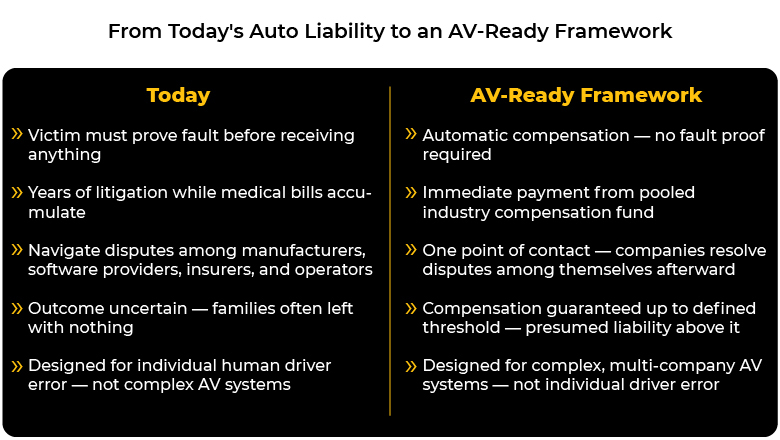
Families for Safe Streets supports an aviation-inspired framework: automatic compensation up to a defined threshold without requiring proof of fault by victims, through a pooled industry compensation fund capitalized by the full vertical and horizontal range of AV industry participants: auto and parts manufacturers, fleet operators, software providers, and ride-hailing platforms – relative to each company’s market share. Compensation beyond that threshold would remain available for victims, but could be disputed by the AV companies. Cost allocation would be resolved among responsible parties after initial victim compensation.
People harmed by autonomous vehicles should not face higher barriers to compensation and care than airline passengers.
Safety first, always: AVs must work for people
These frameworks would push AV companies to continuously improve safety performance and enable autonomous vehicles to operate on public streets in a way that fosters predictability and public confidence.
Autonomous vehicles may eventually transform transportation. But they do not change our responsibility to protect human life. The policies established today will determine whether this new technology helps end our traffic safety crisis — or simply repeats the policy failures that have made it a persistent crisis for more than a century.
The standard must not be “as safe as human drivers.” It must be to set us on a trajectory toward eliminating traffic deaths. That is what commercial aviation has largely achieved. It is what we must require of AVs.
Families for Safe Streets will host a free public webinar on June 24 to mark the release of the position paper “Safety First, Always: An FSS Framework for Autonomous Vehicles.” Register now via Zoom and download the full paper after June 24 at familiesforsafestreets.org/autonomous-vehicles.