
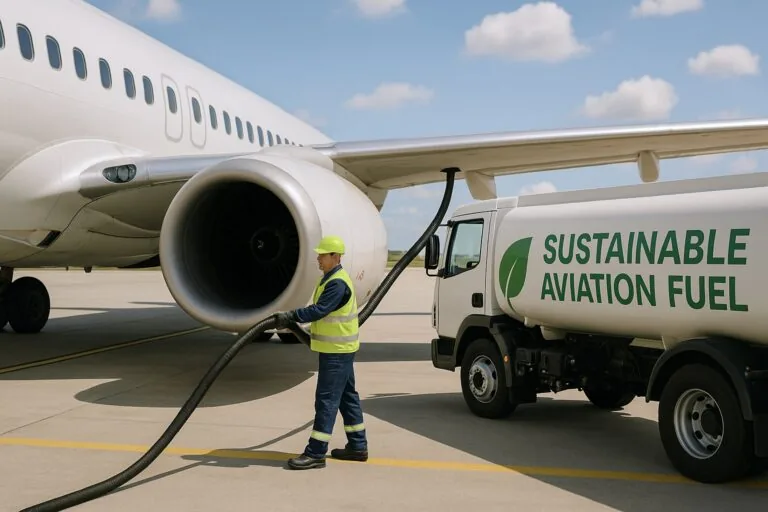
Sameh Elhefny, Minister of Civil Aviation, inaugurated a workshop to draft a feasibility study for the domestic production and utilization of Sustainable Aviation Fuel (SAF), a cleaner alternative to jet fuel made from renewable or waste-based sources. The two-day event was organized in cooperation with the International Civil Aviation Organization (ICAO) under the ACT-SAF program, with support from the European Union (EU), according to the cabinet.
ICAO is a specialized UN agency which sets standards and regulations necessary for aviation safety, security, efficiency, and regularity, as well as for aviation environmental protection.
The workshop comes in line with Egypt’s plan to strengthen the path of sustainable development, accelerating the transition to a green economy, and implementing the targets of Egypt’s Vision 2030, and in light of the Ministry of Civil Aviation’s strategy to develop the air transport system, enhance its operational and environmental efficiency, and boost its competitiveness in accordance with international best practices
Elhefny said the implementation of this project, in cooperation with the ICAO and with support from the EU, represents an advanced model of international partnerships based on the exchange of knowledge and technical expertise, and on accelerating the execution of projects for the transition toward sustainable aviation.
He explained that the study will lay the scientific and economic groundwork for a national roadmap aligned with CORSIA — the only globally recognized market‑based system for meeting international aviation emissions requirements. This comes within the framework of the international community’s commitment to ICAO’s environmental plan for the production and use of SAF.
The study will assess national capabilities, identify investment opportunities, and formulate an integrated framework that supports private‑sector participation and strengthens cooperation with financing institutions and industry partners, thereby enabling Egypt to integrate into the global value chains of this future industry.
The minister affirmed his confidence that the outcomes of the workshop will contribute to preparing a national roadmap and an actionable plan for the production and use of SAF.
It is worth noting that Egypt is accelerating its shift toward low-carbon aviation fuels as part of its broader climate and energy transition strategy. In this regard, the government established the Sustainable Aviation Fuel (ESAF) in 2024 to lead the country’s transition toward cleaner aviation fuels and support national climate goals.
Prime Minister Mostafa Madbouly recently met with Karim Badawi, Minister of Petroleum and Mineral Resources, and Sameh Elhefny to track joint ministerial cooperation on securing jet fuel and launching Egypt’s domestic Sustainable Aviation Fuel (SAF) production.