
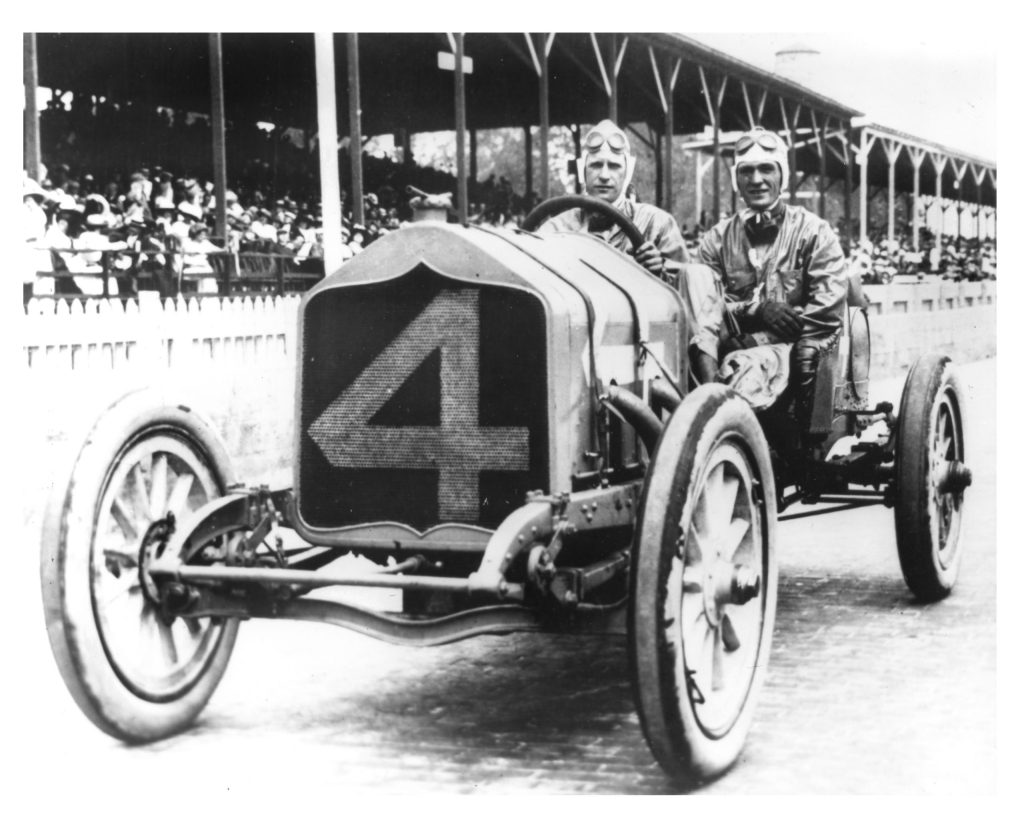

AUTO RACING WAS a dangerous proposition when the Indianapolis Motor Speedway opened for race cars in August 1909. Most racers were stripped-down passenger cars with drivers and riding mechanics seated high on a bare chassis with an unprotected fuel tank right behind them and a blazing engine just ahead. Safety equipment? Not back then. Adding to this peril was a track surface of crushed stone and tar, hardly smooth pavement.
The automobile was regarded as a newfangled piece of machinery that needed to prove its worth to the public. The rigors of racing could do that, but the associated dangers were not for the faint of heart. Those who dared persevered by accepting and challenging enormous risks for the glory of it all.
Johnny Aitken was one of those men. He fit perfectly into the scene at the dawn of the automobile and the Speedway. Remarkably, Aitken scored 15 victories at the IMS between 1909 and 1916 that will forever stand unchallenged, but none of them were in the 500-Mile Race. Rather, Aitken’s wins were earned during events with distances between two and 80 laps, most of them in the pre-500 days of 1909–10. His significance at the Speedway, however, went beyond winning races.
Back then, automobile factory teams were the main participants of top-level racing events. Aitken worked as an engineer and driver for the National Motor Vehicle Company of Indianapolis, whose president, Arthur Newby, was one of the co-founders of the IMS—a business associate of Carl Fisher, the primary visionary behind the track.
The first event on the new track was a planned two-day motorcycle meet in mid-August of 1909. Unfortunately, it got off to a literal rocky start thanks to the track’s unstable surface. The second day was canceled after the final event of the first day due to safety concerns.
A week later, a three-day event with 18 races marked the first spectacle involving automobiles. The track was groomed to a condition the organizers believed could stand the onslaught of the heavier and more powerful vehicles.
Many of the top drivers of the day attended, including Aitken representing National. The first day’s final event brought tragedy when a likely mechanical failure caused William Bourque’s Knox to flip violently after sliding and being launched into the air by a trackside ditch. Bourque and riding mechanic Harry Holcomb died in the accident.
There was no other incident that day, but the track had broken up in numerous places. In response, officials of the American Automobile Association sanctioning body considered canceling the next two days of racing, but track co-founder Carl Fisher promised to have workers toil through the night to repair the track.
The next day’s four-lap 10-mile sprint was highly competitive, with a different driver leading each lap. Aitken became the fourth lap’s leader after the two cars ahead of him dropped out, taking the checkered flag at 66.6 mph for his first Speedway victory.
A field of 14 lined up for the sixth race, a two-lap handicap. In a dead-heat finish between Aitken and National teammate Charlie Merz, officials finally declared Aitken the winner by a hundredth of a second. He also broke Ralph DePalma’s world record for the distance by one second, recording a time of 4:25:00 (at 75 mph) for his second triumph.
The penultimate event was the 300-mile run for the towering Tiffany-made Wheeler-Schebler Trophy. Aitken’s National led 18 others into the first turn, setting a world record of 65 mph in the first 100 miles before dropping out with engine failure. Then Merz’s car blew a tire, sending it into the first turn’s wooden fencing and killing two spectators. Merz’s riding mechanic, who originally rode with Aitken, died in the accident. The race was finally stopped short at 235 miles.
The five deaths at the new Speedway during its first automobile racing event raised substantial concerns. The track’s founders weighed cement and bricks as options to upgrade the track surface, choosing bricks even though they cost twice as much as concrete.
To be sure of the brick option, a section was laid on the main straightaway. Up went Aitken, was enlisted to perform traction tests on a section of bricks laid on the main straightaway, spinning the wheels of his car, coming to a screeching stop, and flooring the gas while tethered so that the car swayed side to side. The bricks held up, and the new track was paved with 3.2 million bricks, ready for trial runs on two frigid December days that proved the new surface much superior to the old.

Aitken’s third and fourth wins at the IMS came in 10-mile events on the first two days of racing in May 1910; on the second day, Aitken finished ahead of Ray Harroun’s Marmon, setting an American class record of 73.5 mph. These first two days in 1910 with the new surface helped established Indianapolis as the best track in the country.
He secured a total of nine wins by July of that year, including two retroactively earned when Marquette-Buick cars, which had outclassed most of the competition and scored the most wins, were disqualified by the AAA because they didn’t fit its definition of stock automobiles.
In a two-lap affair on the first Saturday in September, Aitken nipped Joe Dawson’s Marmon by less than two seconds for his 10th victory.
The final day of racing, Labor Day, saw one of the Speedway’s closest finishes, with four cars competing for victory in a 5-mile sprint. Aitken won by about 3/10 of a second over Dawson, bringing his total to 11.
The weekend’s events were capped by a 12-car, 200-mile contest, another battle between National and Marmon. Aitken took the lead on Lap 27 and held it to the end as Harroun’s car failed. That victory gave Aitken a dozen.
The sheer number of races in 1910 meant that spectators waned in attendance over the season. Fisher and partners decided that a single annual event on Memorial Day stood a better chance for success, deciding on a distance of 500 miles. This would allow people to attend the race starting at 10 a.m. and be home in time for dinner after “seven hours of speed and thrills.”

On Tuesday, May 30, 1911, Memorial Day, 40 cars lined up in rows of five for the inaugural Indianapolis 500. Aitken and his National started on the outside of the front row, from which he swept down to the inside of the track into Turn 1 to take the lead for the first four laps. He led another four before leaving the race with a broken connecting rod at 125 laps, placing him 27th.
Aitken married in 1912, leading Newby to take him out of competition, as he believed racing was too risky for married men. Aitken stayed on at National as team manager, overseeing Joe Dawson, who had was racing for National on loan from Marmon, in the 1912 Indy 500. Late in the race, Dawson trailed six laps behind leader DePalma in his Mercedes. That is, until the German car’s engine broke a connecting rod. Dawson led the final two laps, picking up the victory.
A year later, Aitken managed French Peugeot team, helping driver Jules Goux secure an overwhelming victory by more than 13 minutes, a record that still stands.
By 1915, Aitken had begun working for Stutz Motor Car Company and was free to return to driving. He served as a relief driver for the company before joining the Indianapolis Speedway Team Company, founded by Fisher and another IMS co-founder, James Allison, as lead driver in a Peugeot. He took a pole position in the Indy 500 that year but dropped out after 69 laps.
Despite his loss at the 500, 1916 was a significant year for Aitken—and his last as a driver. That year, he secured first-place victories in the 300-mile First International Sweepstakes Race, the 250-mile Astor Cup Race, the 100-mile Harkness Trophy Race, and the American Grand Prize race (as co-driver after taking over from Howdy Wilcox).
He then went on to dominate the one-day, multi-race Harvest Auto Racing Classic at the IMS on September 9, winning the 20- and 50-mile races with less than a second to spare and coming out on top after a fierce duel in the third and final 100-mile race. This single day brought his number of wins at the IMS to 15, making him the most winningest driver in the history of the track—a record still not broken. He finished second overall in the 1916 season despite being deemed ineligible for points.
Aitken retired in 1917 and became a vice president of Allison Experimental Company. He died on October 15, 1918, at age 33, a victim of the Spanish flu pandemic.