
KAIA Holds On-site Meeting on the Transition of the Automotive Ecosystem
“Investment Burden Increases Amid Chinese EV Surge and Market Uncertainty”
The Korea Automobile and Mobility Industry Association (KAIA) held an on-site meeting to review the status of the auto parts industry’s transition to future vehicles and discuss policy support measures. Participants unanimously agreed on the need to introduce a “tax incentive for domestic electric vehicle production” to maintain the domestic production base and strengthen the competitiveness of the parts industry during the transition to electric vehicles.
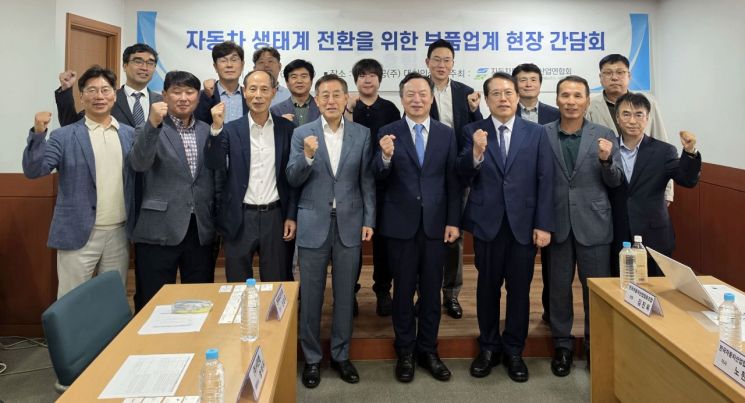
On the 22nd, KAIA announced that it had held the “On-site Meeting with the Auto Parts Industry for the Transition of the Automobile Ecosystem” at the Hyolim Precision headquarters in Pyeongtaek, Gyeonggi Province.

Participants are taking a commemorative photo at the “On-Site Meeting of the Parts Industry for the Transformation of the Automotive Ecosystem” held on the 22nd at Hyorim Precision in Pyeongtaek, Gyeonggi-do. KAIA
The meeting was attended by KAIA Chairman Jeong Daejin, Korea Automobile Manufacturers Association Chairman Lee Taeseong, and Korea Automotive Technology Institute Vice President Lim Gwanghoon. From the parts industry, key representatives participated, including KG Mobility Partners Chairman Park Kyungbae, as well as TaeSang, Daousan, Eugene SMRC, Hyolim Precision, Yungjin Enterprise, Seojin Cam, Kongsberg Automotive, Hankook Fookoku, and Schaeffler Ansan.
The auto parts industry explained that the transition to electrification is directly impacting not only automakers but also the overall production structure and investment capacity of partner parts companies. They noted that, especially amid slowing electric vehicle market growth and the rapid rise of Chinese EV makers, market uncertainty has increased, placing a greater burden on investment needed for the transition to future vehicles.
Accordingly, the industry proposed establishing a consortium-based support system involving automakers, parts suppliers, and materials companies. They emphasized the need for comprehensive, lifecycle support such as providing technical roadmaps, supporting access to market and patent information, and expanding testing and certification infrastructure.
They also asserted that fiscal and tax support should be expanded to alleviate investment uncertainty related to future vehicles, and that domestic parts usage should be reflected in EV support policies to encourage local production and reinvestment.
In addition, it was suggested that the government should pursue more proactive industrial policies and reasonably improve regulations, taking reference from China’s policies fostering its electric vehicle industry. The need to address labor shortages by expanding R&D and production workforce development, increasing the utilization of foreign workers, and introducing flexibility in working hour systems was also highlighted.
KAIA Chairman Jeong Daejin stated, “The swift introduction of a tax incentive for domestic electric vehicle production is necessary to maintain and expand the domestic production base, support the electrification transition of the parts industry, secure work, and enhance investment capacity for future vehicles.”
He added, “As requirements for carbon emission information in production processes and supply chain due diligence are increasing, particularly in the European Union, the burden on the parts industry is growing. It is also necessary to support the establishment of a data platform that can be jointly utilized by the automotive industry.”
Lee Taeseong, Chairman of the Korea Automobile Manufacturers Association, said, “The automotive industry can maintain its competitiveness only when both automakers and the parts industry grow together. Even during the transition to electric vehicles, it is important that domestic production and investment are sustained to ensure a stable auto parts industry ecosystem.”
Lim Gwanghoon, Vice President of the Korea Automotive Technology Institute, emphasized, “Strengthening the competitiveness of the parts ecosystem, which is the core foundation for the transition to future vehicles, is essential for ensuring sustainable competitiveness in the auto industry. It is necessary to expand R&D investment in AI, autonomous driving, and electrification, and to establish a connected system for technological development, demonstration, and commercialization.”
Park Kyungbae, Chairman of KG Mobility Partners, said, “Parts companies must continuously invest in R&D and facilities to transition to future vehicles, but market uncertainty and declining profitability have increased the investment burden. In particular, small and medium-sized parts companies are struggling to secure the necessary funds for this transition investment.”
Chairman Park expressed hope, saying, “If production-linked support policies such as a tax incentive for domestic electric vehicle production are implemented, companies will be able to establish more stable investment plans and actively engage in the transition to future vehicles.”
Hot Picks Today

“Loans? We Pay All Cash”: 60% of Buyers Show Massive Financial Power in Japan’s Penthouse Market
KAIA plans to continue identifying policy tasks to support the transition to future vehicles, including the introduction of a tax incentive for domestic electric vehicle production, based on the opinions raised at this meeting. The association will also strengthen cooperation with the government and related organizations.
This content was produced with the assistance of AI translation services.
© The Asia Business Daily(www.asiae.co.kr). All rights reserved.