
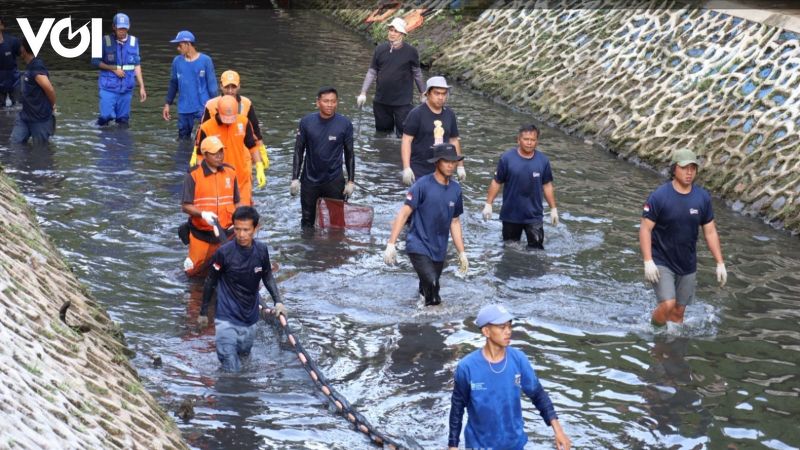
JAKARTA – DKI Jakarta Governor Pramono Anung has instructed his staff to expand the operation of sweeping fishing to all areas. This step follows the fishing activities previously carried out in the Cideng River, specifically in front of Plaza Indonesia, Central Jakarta.
Pramono assessed that the capture of sapu-sapu fish needed to be carried out sustainably because the population could not be controlled in a short time. Even so, he said the initial efforts that had been made had a positive impact.
“So yesterday there were quite a lot, but it was impossible to finish immediately. But this, in my opinion, is something that is beneficial and makes a positive contribution,” said Pramono in East Jakarta, Sunday, April 12.
Pramono explained that the presence of sapu-sapu fish has a negative impact on the aquatic environment. In addition to damaging the embankment, the fish also prey on food sources for other fish, thus disrupting the balance of the ecosystem.
He reminded that if it is not immediately controlled, the population of mopeds has the potential to exacerbate damage to the ecosystem in Jakarta waters.
“If the arrest is not carried out immediately and the number of these sweepers is also reduced, this will definitely affect our ecosystem,” explained Pramono.
Therefore, Pramono asked his staff not only to focus on Central Jakarta, but also to target other areas with high populations of sapu-sapu fish. Similar operations will be carried out gradually by making activities in the Plaza Indonesia area as a starting point.
“So I will ask not only in Central Jakarta, in all areas where there are many fish, for us to carry out operations. So we started at Plaza Indonesia yesterday as a start,” he said.
Joint officers from the Central Jakarta Administration City Government and the DKI Jakarta Food, Maritime, and Agriculture Resilience Service (KPKP) held a volunteer fishing activity in Cideng River, specifically in front of Plaza Indonesia, Friday, April 10.
The Mayor of Central Jakarta Arifin said that during the arrest process, the fish were hiding in the tar structure.
“Earlier, many of the fish that wanted to be caught were in the mud and damaged the mud because the fish were quite large. The mudfish also stores its eggs in the mud,” said Arifin in his statement, Friday, April 10.
From the results of the volunteer work, the officers managed to catch about 40 sapu-sapu fish. The fish were then killed and will be buried to prevent further impacts.
“This fish is very dangerous because it eats all the poisons in the river. I appeal to the public not to consume the fish,” he said.
The head of the DKI Jakarta KPKP Office, Hasudungan Sidabalok, explained that the problem of sapu-sapu fish was not new. Similar handling was also carried out earlier in the Ciliwung River.
“When cleaning the fish with a broom in the Ciliwung river, we have taken samples of fish and water, it turns out that the threshold of contamination exceeds the fish containing Salmoella and E.Coli also heavy metal residues,” said Hasudungan.
He said that the condition in Kali Cideng was relatively easier to handle because the length of the flow was not along the Ciliwung, so that the control of fish populations could be more optimal.
After being arrested, the mop fish will be taken to a government-owned processing facility before being destroyed. This ban is part of efforts to maintain the quality of the aquatic environment while preventing damage to the river infrastructure due to the invasive fish’s activities.
The English, Chinese, Japanese, Arabic, and French versions are automatically generated by the AI. So there may still be inaccuracies in translating, please always see Indonesian as our main language.
(system supported by DigitalSiber.id)