
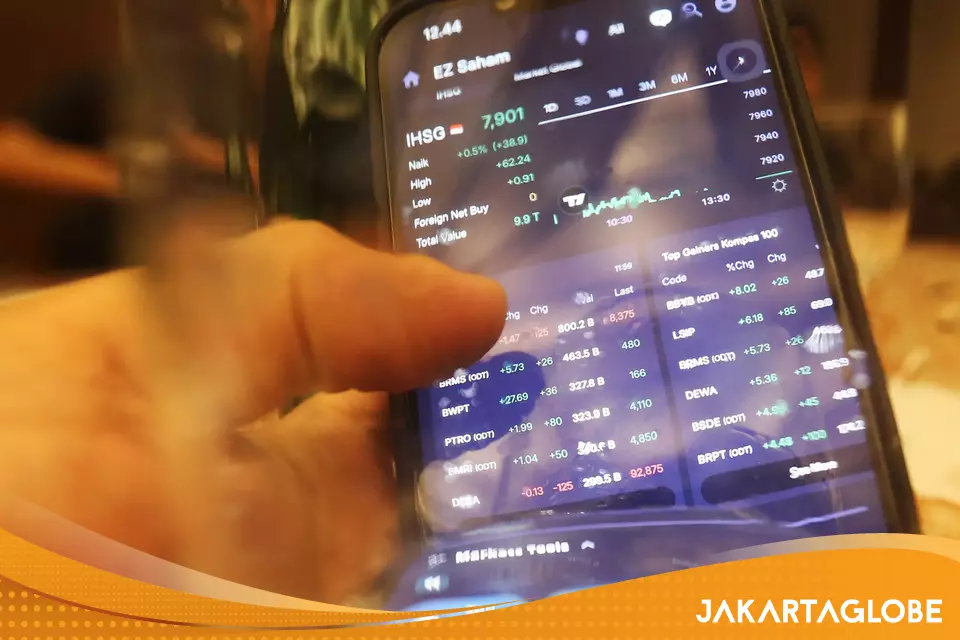
Jakarta. Jakarta Composite Index (JCI) fell deeper into correction territory on Friday morning as investors reacted to mounting concerns over the government’s new export control policies, prolonged Middle East tensions, and renewed pressure on state-owned banks following Fitch Ratings’ warning on sovereign support risks.
JCI dropped 27 points, or 0.44%, to 6,065 in early trading after moving between 5,966 and 6,074.
RTI data showed trading volume reached 3.7 billion shares with turnover of Rp 1.7 trillion ($96 million) across more than 189,000 transactions. Losers heavily outnumbered gainers, with 437 stocks declining, 123 advancing, and 148 unchanged.
Phintraco Sekuritas said external sentiment remained weak due to the prolonged conflict in the Middle East and concerns over a potential closure of the Strait of Hormuz, which could keep crude oil prices elevated longer than expected.
ADVERTISEMENT
At the same time, the brokerage said several newly introduced government policies were viewed negatively by investors as they could hurt the investment climate in the short term.
“On the other hand, these new policies are likely intended to boost state revenue in order to help cover the fiscal deficit,” Phintraco Sekuritas said in its research note.
The brokerage added that the upcoming FTSE and MSCI rebalancing could continue to weigh on the Indonesian market.
Banking stocks were also expected to remain under pressure after Fitch Ratings said the long-term ratings of state-owned Himbara banks were heavily dependent on government support.
Fitch said that the banks’ ratings remain aligned with Indonesia’s sovereign rating of BBB/Negative, reflecting the possibility that the government’s capacity to support the banking sector could weaken if fiscal pressures intensify.
Meanwhile, S&P Global Ratings warned that Indonesia’s plan to centralize commodity export management could potentially hurt exports, weigh on state revenue, and affect the country’s balance of payments.
“As a result, we continue to monitor state-owned mining stocks and remain cautious about further downside risks for non-state-owned mining shares,” Phintraco Sekuritas said.
Separately, Kiwoom Sekuritas Indonesia said the government, Bank Indonesia, and the Financial Services Authority (OJK) were strengthening the implementation of the natural resource export proceeds (DHE SDA) policy to increase foreign exchange reserves, deepen the domestic forex market, and maintain rupiah stability.
Bank Indonesia has expanded DHE SDA placement instruments to include Chinese yuan in addition to US dollars, in line with growing Indonesia-China local currency settlement transactions, which have exceeded $25 billion annually.
The central bank also extended the DHE SDA placement tenor to as long as 12 months. Funds can now be parked in term deposits, BI foreign exchange securities, BI foreign exchange sukuk, as well as foreign currency-denominated government bonds and sharia securities.
Global sentiment was mixed overnight. Wall Street closed slightly higher on Thursday, with the S&P 500 rising 0.2% and edging closer to its record high. The Dow Jones Industrial Average gained 276 points, or 0.6%, while the Nasdaq Composite added 0.1%.
As of 8:59 a.m. Jakarta time, Japan’s Nikkei 225 jumped 2.04%, South Korea’s Kospi rose 0.43%, Hong Kong’s Hang Seng gained 0.57%, and China’s Shanghai Composite edged up 0.06%.
Tags:
Keywords: