
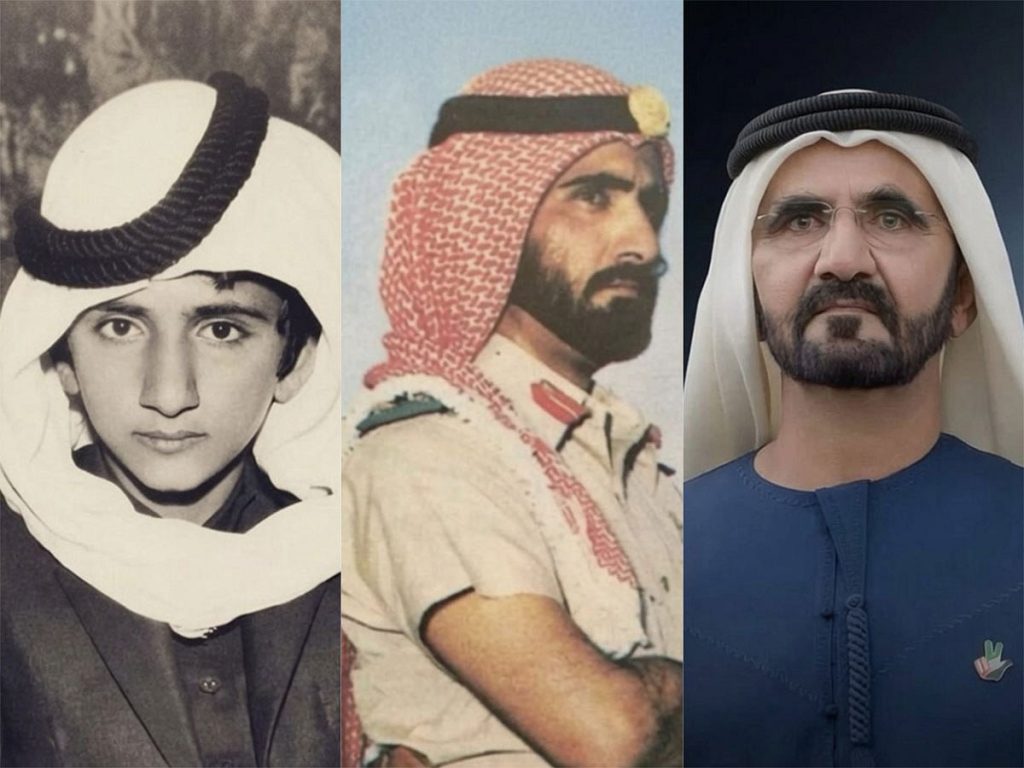
Few modern leaders have left such a profound mark on the place they call home. Sheikh Mohammed’s journey is one of vision, perseverance and an enduring belief that the future belongs to those willing to build it.
The formative years
Sheikh Mohammed bin Rashid bin Saeed bin Maktoum bin Hasher bin Maktoum Al Maktoum Al Falasi was born in Dubai on July 15, 1949, into the distinguished Al Maktoum family.
His grandfather, Sheikh Saeed bin Maktoum bin Hasher Al Maktoum, was the Ruler of Dubai at the time of his birth. The family home in the historic Al Shindagha neighborhood would become the cradle of his formative years, surrounded by the wisdom of elders and the warmth of family.
His father, the late Sheikh Rashid bin Saeed Al Maktoum, assumed leadership of Dubai in 1958 when young Mohammed was just ten years old.
As the third son among four brothers, Sheikh Maktoum, Sheikh Hamdan, and Sheikh Ahmed, Mohammed grew up in an environment where leadership was not merely discussed but lived and breathed daily.
The influence of his mother, Sheikha Latifa bint Hamdan bin Zayed Al Nahyan, on his character cannot be overstated.
The depth of their bond was so profound that decades after her passing in 1983, he would write in his book “My Story”: “When they leave, something extinguishes in our lives and in our homes… When they leave, the features of roads, homes, and faces change, even food tastes different… Who is like my mother? Who is like Latifa?”
He famously described her as “the closest to me. I have never seen love like her love, nor a heart like her heart, nor closeness like her closeness.”
His grandfather, Sheikh Saeed, provided another key influence, allowing young Mohammed to sit beside him at the daily majlis (council) in Al Shindagha.
There, surrounded by tribal elders and community leaders, the boy absorbed lessons in governance, wisdom, patience, and the importance of serving God, nation, and people. The majlis became his first classroom in the art of leadership.
Early education and military training
Sheikh Mohammed’s formal education began at age four under his father’s supervision, learning Arabic language fundamentals and Islamic teachings. In 1955, he enrolled at Al Ahmedia School in Deira, later transferring to Al Shaab School, and finally Dubai Secondary School, where he completed his secondary education in 1964-1965.
His father, recognizing that his son possessed the qualities necessary for managing growing security demands both locally and internationally, made the pivotal decision to send him to Britain for military education.
In the summer of 1966, Sheikh Mohammed traveled to London to attend Bell School of Languages in Cambridge, a institution that exposed him to diverse cultures through students from across the globe.
From there, he enrolled at Mons Officer Cadet School in Aldershot, which later became part of the Royal Military Academy Sandhurst. There, he underwent intensive military training and was promoted to the rank of second lieutenant on probation. His exceptional performance earned him the “Sword of Honor” for achieving the highest distinction in his specialization.
The Dawn of leadership: A young man’s responsibilities
Upon graduating from Mons Officer Cadet School in October 1968, Sheikh Rashid appointed his son as Chief of Dubai Police and Public Security, effective November 1, 1968.
At just 19 years old, Sheikh Mohammed assumed responsibility for maintaining law and order in an emirate that was rapidly transforming into a commercial and tourist hub.
This appointment came at a critical moment. Just months earlier, on February 18, 1968, Sheikh Mohammed had witnessed a historic meeting at Al Sedeira between his father and Sheikh Zayed bin Sultan Al Nahyan of Abu Dhabi.
The two leaders agreed to establish a federation of emirates and invited others to join them. Sheikh Mohammed vividly recalls that moment: “I was there and saw the meeting of good intentions with high ambitions in a tent without carpets… I heard Rashid say to Zayed, ‘You are the president.’
Thus, Zayed became the president, father, founder, and eternal leader of this state. Zayed did not ask for the presidency; rather, history summoned him to build a nation and a state.”
The birth of a nation and a minister
On December 2, 1971, the United Arab Emirates was officially established, and Sheikh Mohammed, at just 22 years old, was appointed Minister of Defense, making him the youngest defense minister in the world and one of the longest-serving in history.
He held this position for over 50 years until 2024, when he appointed his son, Sheikh Hamdan bin Mohammed bin Rashid Al Maktoum, Crown Prince of Dubai, as Deputy Prime Minister and Minister of Defense.
His responsibilities, however, extended far beyond defense. In the summer of 1977, Sheikh Rashid entrusted him with chairing a committee to manage Dubai Airport. From that moment, Sheikh Mohammed’s vision began shaping Dubai’s trajectory as a global aviation hub.
He pioneered the Open Skies policy and laid the foundations for a tourism sector that would flourish in subsequent decades. Simultaneously, he managed Dubai’s sensitive oil portfolio and, in 1985, assumed responsibility for the Jebel Ali Free Zone, an industrial area enhanced by the Jebel Ali Port.
Through all the regional turbulence that surrounded the Arab world, the Arab-Israeli conflict, the Iran-Iraq War, the invasion and liberation of Kuwait, Sheikh Mohammed never wavered. He continued driving progress in Dubai and the UAE while steadfastly maintaining historic humanitarian positions alongside brotherly and friendly nations.
The Crown Prince: Unleashing Dubai’s potential
When Sheikh Maktoum bin Rashid assumed leadership following their father’s passing in October 1990, a somber period followed for Sheikh Mohammed and his brothers. But in January 1995, Sheikh Maktoum signed a decree appointing Sheikh Mohammed as Crown Prince of Dubai. This appointment would prove transformative for the emirate.
With boundless energy and vision, Sheikh Mohammed launched a cascade of initiatives and megaprojects that would alter Dubai’s destiny. Among these were the Dubai Shopping Festival, Dubai eGovernment, Dubai Internet City, and Dubai Media City.
He personally supervised the implementation of massive tourism and construction ventures, including the expansion of Dubai Airport, the Palm Islands projects, the Burj Al Arab hotel, Dubai Marina, the Business Bay, and the Burj Khalifa, the world’s tallest building. Each of these landmarks has become synonymous with Dubai’s ascent to global prominence.
Today, Sheikh Mohammed’s fingerprints can be seen everywhere in Dubai, from e-services and transportation networks to the Dubai International Financial Centre and global corporations like Emirates Airline and DP World.
The Ruler: Defining a new era
On January 4, 2006, Sheikh Mohammed succeeded his late brother Sheikh Maktoum as the Ruler of Dubai, becoming the tenth ruler of the emirate since 1833. Simultaneously, he became a member of the Supreme Council of the Union.
The late Sheikh Khalifa bin Zayed Al Nahyan, then President of the UAE, proposed appointing Sheikh Mohammed as Vice President and Prime Minister, tasking him with forming a new government, which was announced in February 2006.
Just as he had transformed Dubai, Sheikh Mohammed accelerated progress at the federal level. Through successive governments, he propelled the UAE into the future with smart government services, a diversified and resilient economy, and the implementation of major strategies, most notably “UAE Vision 2021.” Under his leadership, the UAE government became a global model for development and modernization.
A Leader’s profile: The man behind the title
Sheikh Mohammed’s leadership style is characterized by exceptional competence, strategic vision, a love for achievement and excellence, humility, humanity, profound patriotism, and a remarkable combination of high culture and logical dialogue.
He is known for his practical approach, following up on projects personally, encouraging the dedicated, and inspiring positivity and leadership both locally and globally.
His day begins early with the dawn prayer, followed by breakfast and a whirlwind of activities. Despite holding multiple positions, he prioritizes time with his family, whom he considers “the most precious thing in existence.”
He sits with his children, offering wisdom from his life experiences and instilling love for God, the Prophet, the UAE, Sheikh Zayed, and his grandfather Sheikh Rashid. He nurtures in them a love for authentic Emirati heritage, traditions, and cultural pursuits.
Sheikh Mohammed has 16 children, 7 sons and 9 daughters. His marriage to Sheikha Hind bint Maktoum bin Juma Al Maktoum in 1979 was a grand celebration spanning seven days, attended by the founding fathers of the UAE, the late Sheikh Zayed and Sheikh Rashid, along with over 20,000 participants at Dubai Stadium.
The Sheikh poet: A voice of his people
Beyond governance, Sheikh Mohammed is a celebrated Nabati poet. He began composing poetry while still a student, drawing inspiration primarily from his father, Sheikh Rashid, and Sheikh Zayed.
In his early days, he published poems under pseudonyms like “Nidawi” and “Sulait” to ensure they were accepted by readers on their merit rather than his lineage.
His poetry blends Nabati and classical rhyming styles, encompassing romantic themes, patriotic verses, and commentary on current events.
His works have been set to music and performed by renowned Arab singers including Kadim Al Sahir, Latifa Al Tunisi, Asala Nasri, and Abdul Majeed Abdullah, making his words resonate far beyond political circles.
The Horseman: A passion for equine excellence
Sheikh Mohammed is known globally as “Faris Al Arab” (The Arab Knight) for his extraordinary achievements in equestrian sports. His love for horses developed early under his father’s encouragement, and he became the most passionate among his brothers about horsemanship, even composing poetry about these noble animals.
His first appearance at international horse racing was in England in 1967 during his studies there. Ten years later, he achieved his first global victory with the mare “Hatta” at Brighton racecourse in England on June 20, 1977. This passion grew into the creation of Godolphin, the world’s most successful horse racing team, where Sheikh Mohammed applied his vision and philosophy to the sport.
In 1996, he launched the Dubai World Cup, the world’s richest horse race, which attracted the legendary American horse Cigar to win the inaugural competition. The race continues to draw participants from across the globe, cementing Dubai’s place on the international sporting calendar. Sheikh Mohammed personally leads the national team in endurance racing, and UAE riders are considered among the best in the world in this discipline.
Legacy and continuing impact
Under Sheikh Mohammed’s leadership, the UAE has become a global model for development and modernization. The country ranks among the top in the region for attracting investment and ease of doing business. Government services have been revolutionized, with the UAE consistently ranking among the world’s most competitive nations.
Sheikh Mohammed’s vision has always prioritized citizens’ needs in vital sectors including education, health, social affairs, and the economy. He has repeatedly emphasized that “building the nation and humanity is the greatest and most noble goal in life,” and that “the citizen comes first, second, and third.”
His exceptional leadership has brought about a qualitative transformation in citizens’ lives and living standards, as well as in government operations at both federal and local levels. He has established a leadership school whose foundational principle is building people and creating future leaders. His approach has become a guiding compass for leaders worldwide across various fields.