
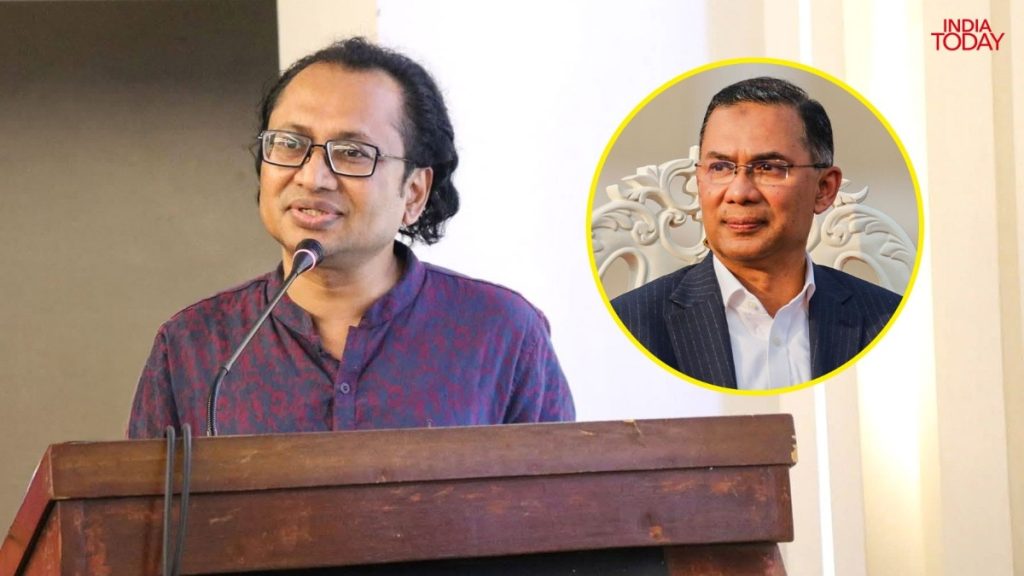
India briefly stopped the entry of Bangladesh Prime Minister’s Adviser on Policy and Strategy, Zahed Ur Rahman, at New Delhi’s IGI Airport before clearing his entry into the country. However, the aide to Bangladesh PM Tarique Rahman chose to return to Dhaka via Colombo, according to reports by Bangladeshi media outlets. This is the first such incident concerning an official related to the Bangladesh Nationalist Party (BNP) government, which came to power just months ago.
Zahed Ur Rahman, a close aide of Tarique Rahman, was reportedly held for around two-and-a-half hours by Indian immigration authorities after arriving in New Delhi on Sunday evening to attend a meeting of the Indian Ocean Rim Association (IORA), Bangladesh-based news outlet Prothom Alo reported quoting diplomatic sources in Dhaka and New Delhi. Although clearance was later granted following intervention from higher authorities, the adviser chose to return to Dhaka via Colombo instead of entering India, according to reports in the Prothom Alo and The Daily Star.
The adviser had travelled to India to attend the 28th Meeting of the Committee of Senior Officials of the IORA, scheduled to be hosted by India’s Ministry of External Affairs (MEA) on June 15 and 16.
Bangladesh’s High Commission in New Delhi had formally informed India’s MEA through a diplomatic note on Friday regarding Zahed’s participation in the meeting, according to Prothom Alo. The newspaper further reported that Bangladesh High Commissioner M Riaz Hamidullah had also spoken to Indian officials concerned ahead of the visit.
Despite the advance communication, Zahed was reportedly stopped during immigration checks and kept waiting for over two hours “without a clear explanation being conveyed immediately”, the reports said.
The Daily Star, meanwhile, cited an Indian news channel as saying that Zahed’s name had reportedly appeared on a “security-related watchlist” during verification procedures. The report added that the Bangladeshi adviser was travelling on a regular green passport carrying a SAARC sticker rather than a diplomatic passport.
Indian authorities have not publicly commented on the development so far.
The incident comes even as New Delhi and Dhaka are navigating a new political phase in bilateral ties after ties hit a low under the interim government led by Muhammad Yunus.
Referring to the temporary denial of entry to PM Tarique Rahman’s information adviser, political commentator Pratim Ranjan Bose described the recent developments as signs of New Delhi adopting a firmer approach towards the BNP-led government in Bangladesh. He said in a post on X, “This is the first time since BNP came to power in Feb that India upped the ante.”
He also alleged that Islamist elements had gained influence within the Bangladeshi administration and claimed Dhaka was increasingly creating space for forces hostile to India.
WHO IS ZAHED UR RAHMAN WHO LEFT FOR DHAKA FROM DELHI?
The episode has nevertheless gained attention because Zahed Ur Rahman is among the more visible figures in the new Bangladesh administration led by Prime Minister Tarique Rahman, who assumed office in February after the BNP’s electoral victory in the elections held in mid-February. That was the first general election held after the fall of the Sheikh Hasina regime in protests in August 2024.
A physician, columnist and political commentator, Zahed previously served on the election reform commission formed during the interim administration led by Muhammad Yunus. He has also been known in Bangladesh for his commentary on democracy, elections, governance and human rights through columns and digital platforms.
The development also comes at a diplomatically significant moment for Dhaka’s foreign outreach.
Reports had emerged recently that Tarique Rahman’s first foreign visit after assuming office would begin with Malaysia rather than India or China. The move was viewed by observers in Bangladesh as part of an effort to maintain strategic balance in the region while the new administration settles into office.
According to Prothom Alo, Bangladeshi government sources had said the BNP administration exercised caution while selecting the destination for Rahman’s first overseas trip due to regional geopolitical considerations and the strategic competition involving India and China.
PM NARENDRA MODI INVITED TARIQUE RAHMAN TO INDIA
New Delhi had earlier made an outreach to the new Bangladeshi government soon after its formation. Prime Minister Narendra Modi had deputed Lok Sabha Speaker Om Birla to attend Tarique Rahman’s swearing-in ceremony in February, where an invitation was conveyed for the Bangladeshi prime minister to visit India.
That outreach was seen as an indication of India’s intent to engage early with the new dispensation in Dhaka after a politically turbulent phase in Bangladesh over the past two years.
Against this backdrop, the Delhi airport episode has naturally drawn interest among diplomatic observers tracking the trajectory of India-Bangladesh relations under the BNP-led administration.
At the same time, there is nothing yet to indicate that the incident has altered the broader diplomatic engagement between the two countries. The fact that clearance was eventually granted to Zahed might also suggest that the issue was resolved at the official level, even though the adviser ultimately chose not to proceed with the visit.
Still, the optics surrounding the incident are likely to be closely watched in both capitals, particularly as Bangladesh shapes its foreign policy priorities under the new government.
India has been helping Bangladesh with diesel supplies despite a global energy crisis due to the Iran war.
For India, Bangladesh remains one of its most strategically important neighbours in South Asia, with cooperation spanning connectivity, trade, security and regional maritime engagement. As a result, developments involving senior officials on either side tend to attract wider diplomatic attention, especially during the current period of foreign policy recalibration in Dhaka.
– Ends