
On Tuesday, US President
Donald Trump said that he believed
China persuaded Iran to negotiate and agree to a fragile two-week ceasefire in a war that has crippled West Asia. The declaration reflected Beijing’s silent role in the pursuit of peace between the two nations, while Pakistan struggled to bring both sides to the negotiation table.
“I hear yes,” Trump said when asked if Beijing was involved in getting key ally Tehran to negotiate on a truce. It is pertinent to note that the US President is
due to travel to Beijing in mid-May to meet his Chinese counterpart, Xi Jinping, in a crucial summit between the two superpowers.
Trump’s trip was originally scheduled to take place in early April, but the American leader postponed it, saying he had to stay in Washington to oversee the
Iran War. It becomes instrumental to point out that China is also a close ally of Iran and the main buyer of the Iranian oil, most of which passes through the Strait of Hormuz, which has been facing a blockade since the start of the conflict.
With both sides admitting China’s role in mediation, the major question that emerges is whether Beijing sit at the negotiation table with
Islamabad to broker peace between Iran and the United States, or will it remain a silent mediator throughout the ordeal.
How China convinced Iran
Iran rejected Pakistan’s proposal
Earlier this week, Iran rejected Pakistan’s proposal of reopening the
Strait of Hormuz for a ’temporary ceasefire’. The news came shortly after it was reported that Islamabad had sent the proposal to both the US and Iran.
The news was first reported by Axios, which stated on Sunday that the US, Iran and regional mediators were discussing a potential 45-day ceasefire as part of a two-phase deal that could lead to a permanent end to the war, citing US, Israeli and regional sources.
Under the proposal, a ceasefire would take effect immediately, reopening the Strait of Hormuz, with 15–20 days to finalise a broader settlement. The matter remained at a stalemate until China came into the picture.
China presses Iran
Three Iranian officials later told The New York Times that China used its influence to press Iran to accept the ceasefire with the United States. Tehran’s decision to accept the two-week ceasefire proposal brokered by Pakistan came after diplomatic efforts by Pakistan and a last-minute push by China, the unnamed Iranian officials told NYT. China asked Iran to show flexibility and defuse tensions, they said.
China’s foreign ministry lauded the ceasefire, with spokeswoman
Mao Ning saying Beijing “welcomes relevant parties announcing the reaching of a ceasefire agreement” — careful, measured language that nonetheless signals Beijing is claiming its share of the diplomatic credit.
Meanwhile, Trump’s latest remarks were the first explicit US acknowledgement that Beijing’s role went beyond the symbolic, marking a significant shift from the administration’s earlier framing of the
China-Pakistan Five-Point Initiative as a sideshow.
The leverage China has
China’s ability to influence Tehran — rooted in its 25-year strategic cooperation agreement with Iran, its role as Iran’s largest oil customer, and its
CPEC connectivity with Pakistan — gave it leverage that the US, despite its military superiority, could not exercise directly.
The latest intervention from China reflects not only Beijing’s influence over Tehran but also its own stake in preventing a protracted war that could disrupt energy supplies or set off a global recession. The war is also hurting Persian Gulf nations, with which China has close relations.
It is important to note that Pakistan and Iran both heavily depend on China. Loans from Beijing have become vital to keeping the heavily indebted Pakistani economy afloat. Meanwhile, China has also played a central role over the last several years in supporting the Iranian economy by buying almost all of its oil exports at a time when many other countries avoided doing business with the
West Asian nations. Hence, China will be looking at stability in both nations.
Some analysts have described China’s West Asia initiative as a calculated headline-grabber, reinforcing Beijing’s image as a responsible power amid US stumbles — rather than a substantive contribution to ending the conflict.
China has no military footprint in the West Asia region, unlike the US, and has not built the institutional trust among Gulf powers that effective mediation typically requires, limiting its ability to translate diplomatic positioning into concrete outcomes.
Why China is keeping its involvement under wraps
China’s move in recent days reflects the delicate balance Beijing is trying to maintain in this situation. On Tuesday, Beijing backed Iran at the
United Nations by joining Moscow in vetoing a Security Council resolution that could have paved the way for military action to open the Strait of Hormuz.
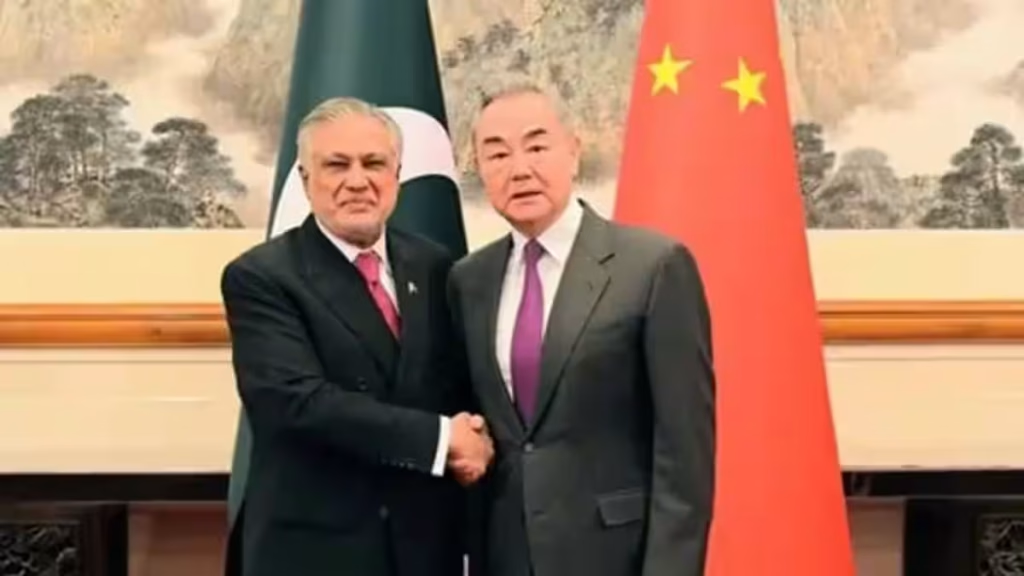
However, behind the scenes, Iranian officials noted that China has often urged Tehran to pull back from escalation. China’s Foreign Minister
Wang Yi made a flurry of calls to his counterparts in the region, emphasising the need for a cease-fire and for countries not to resort to force to reopen the Strait.
Last week, he met with Pakistani officials, who came to the Chinese capital after hosting a meeting in Islamabad with officials from Turkey, Saudi Arabia and Egypt to discuss a possible resolution of the conflict. Meanwhile, in one of his calls to the Iranian counterpart Abbas Araghchi, Wang urged Tehran to “pay attention to the legitimate concerns of its neighbours,” meaning the Gulf nations.
The situation begs the question whether China will formally be part of the Islamabad talks or continue as a behind-the-scenes guarantor. There can be three reasons why China has kept its involvement hidden in the matter.
1) The upcoming Trump visit – Trump had to postpone his visit to Beijing from April to May due to the looming war. While Pakistan has been a US ally in the past and seems to have won over US President Trump to mediate this conflict, Beijing, however, is entering the fray as a rival to Washington.
During the summit, Beijing has been aiming to stabilise the bilateral economic relationship with the US, secure a reduction in US technology control regarding semiconductors and AI and prevent further sanctions on Chinese firms. All these considerations are preventing China from boasting about its involvement.
- An ally of Pakistan – China, has been a strong ally of Pakistan to the extent that the latter’s economy depends on the former. Hence, this gives Beijing a major sway in how Pakistan even conducts the mediation process. For the longest time, Pakistan has been struggling to convince the US and Iran to agree to a ceasefire. Hence, if China reveals that it was the one calling the shots, it might turn out to be a diplomatic embarrassment for Pakistan.
- Fear of failing – West Asia continues to remain an active volcano with conflict spurring from anywhere across the region. While China has helped broker a surprise rapprochement between Saudi Arabia and Iran in 2023, it has emerged as a strong mediator on the world stage. It has seen considerable failures as well.
For instance, Beijing set forth a 12-point peace plan for Russia’s war in Ukraine, and a three-part proposal for a two-state solution between Israel and Palestine, both of which were vague and saw little apparent follow-up. Hence, China will be careful with what battles it would like to put its name on.
End of Article