
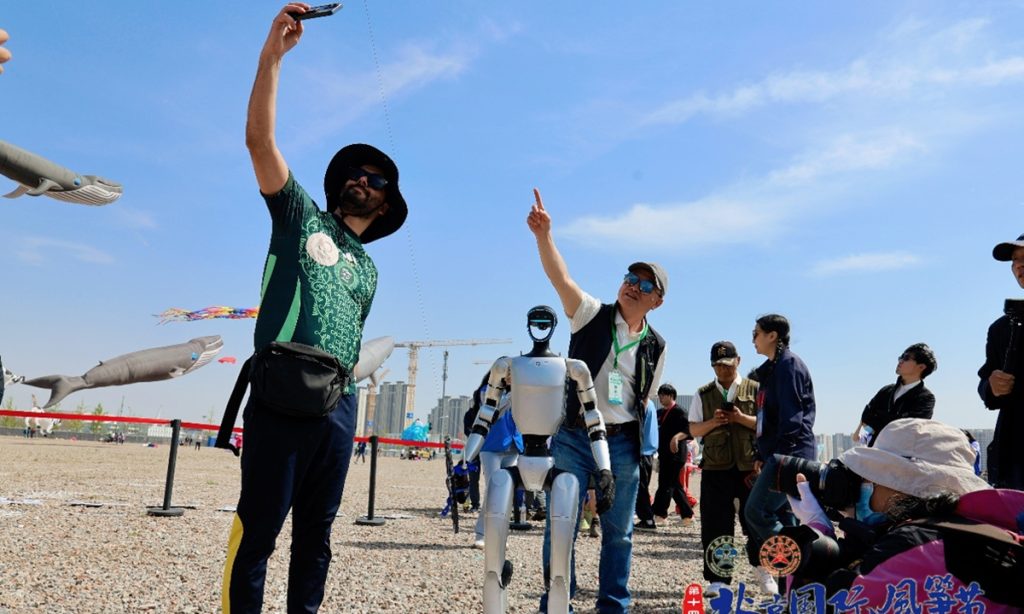
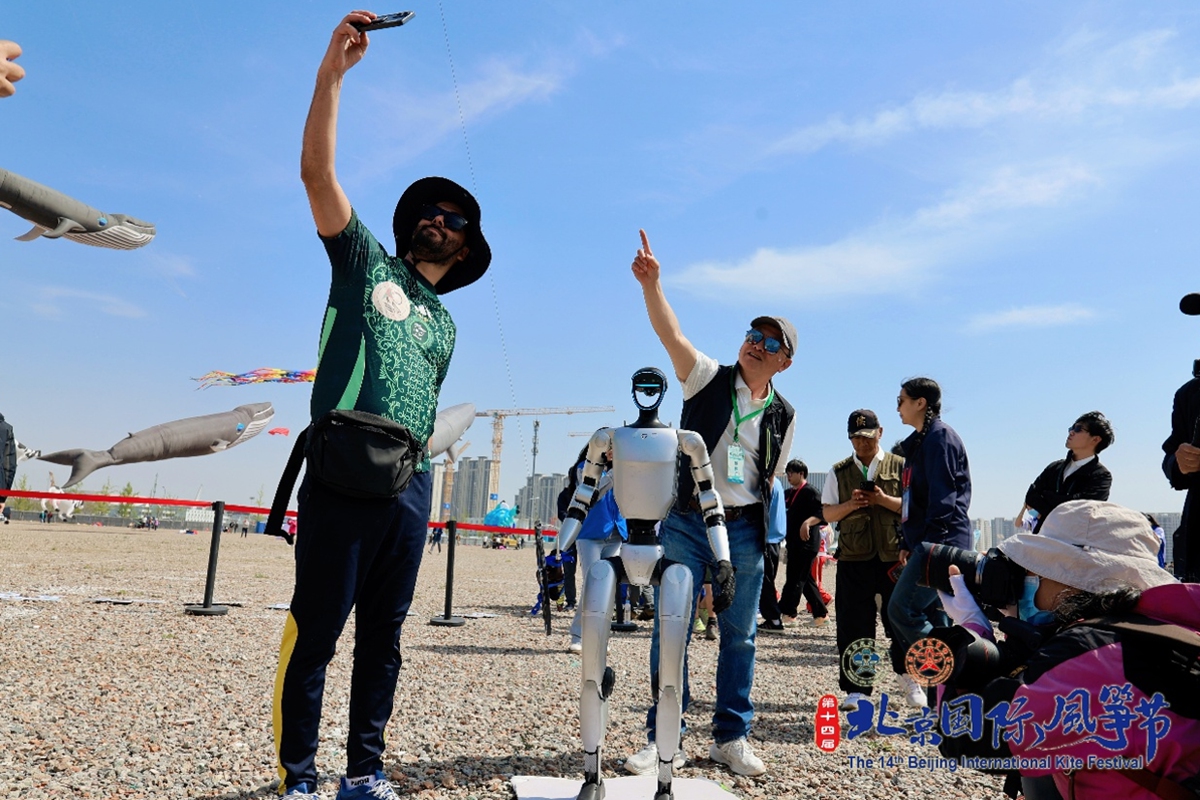
A foreign competitor poses for a photo with a robot at the 14th Beijing International Kite Festival in Beijing on April 11, 2026. Photo: Courtesy of Beijing Sports Federation
A robot flying a kite became the unlikely star of the 14th Beijing International Kite Festival on Saturday, offering a glimpse of how organizers are injecting technology into one of China’s oldest folk pastimes, the Beijing Sports Federation (BSF), one of the event’s organizers, told the Global Times on Sunday.
The two-day event at Beijing Garden Expo Park brought together 15 teams from home and abroad competing across eight categories, including dragon-shaped and hard-winged serial kites. Soft and sport kite performances featured participants from the US, Russia, France, Tunisia and other countries, according to BSF.
The appeal of the festival lies in its unique integration of an “aerial art spectacle,” the preservation of intangible cultural heritage, and international folk exchanges, Zuo Liubiao, secretary general of the Beijing Kite Association, told the Global Times.
Kite-making has long been a traditional folk handicraft in North China. Tianjin Kite Wei was listed as a national intangible cultural heritage in 2008. In 2006, Weifang kite-making from East China’s Shandong Province was inscribed on the national intangible cultural heritage list.
This year, one of the highlights of the Beijing International Kite Festival was a robot that held a kite string and performed simple up-and-down movements after the kite had been launched by a professional coach.
The display, which lasted about 20 minutes as part of the opening ceremony, drew crowds of spectators and competitors who jostled each other to take photos.
“Integrating technology into events has become a trend. We wanted to bring this into traditional kite flying and explore new forms of cultural and sports activities,” Wang Bo, a deputy director of the Fengtai district’s sports bureau, told the Global Times.
However, according to Wang, the robot did not walk or run as originally envisioned. Gravel surfaces at the venue and uneven ground made it difficult for the machine to move without tipping over, while unstable winds added to the risk. In the end, organizers settled for a stationary demonstration.
“We adapted the robot’s movements using a mobile app, and it took only about 10 minutes to program the simple string-pulling actions,” Wang said, adding that the robot was not custom-built for the event but was adapted with technical support.
Wang acknowledged that the trial was a preliminary exploration, constrained by short preparation time and limited budget.
“If conditions permit in the future, we will plan earlier and try bionic flight, smart remote control, and other forms that combine technology with traditional sports,” Wang said.
Despite its limitations, the robot proved to be a crowd-pleaser. Teams from both home and abroad were among those who lingered to watch the machine in action.
“This is a worthwhile trial,” Wang said of the robot experiment. “Even though it did not fully achieve the ideal of an autonomous kite-flying machine, it succeeded in drawing public attention and creating an initial collision between traditional folklore and modern technology.”
In addition to the competition and robot demonstration, the festival offered a variety of interactive experiences, including kite-making and flying workshops, family kite-making classes, calligraphy demonstrations and DIY kite workshops for college students.
Chinese and foreign students, teenagers and families joined in to experience the joy of making and flying kites, feeling the beauty of traditional folk customs, youth exchanges and family interaction in spring.
Chagraoui Serine, a Tunisian student studying at Beijing International Studies University, told the Global Times she has loved kite flying since childhood. She said this event felt very distinctive, and that she had met many friends with the same interests there, adding that the Beijing International Kite Festival had the largest and highest number of kites she had ever seen.
According to BSF, the festival supports Beijing’s goal of transitioning from a “Double Olympic City” to an international sports event hub. It also serves as a bridge for cultural exchange between China and other countries and a test bed for new consumer scenarios in sports.