
By: Khanh Vu Duc
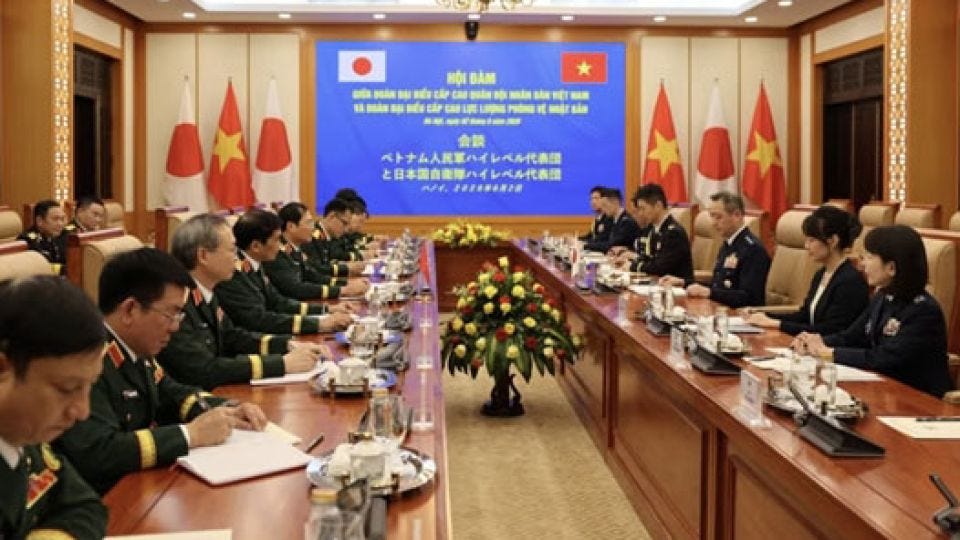
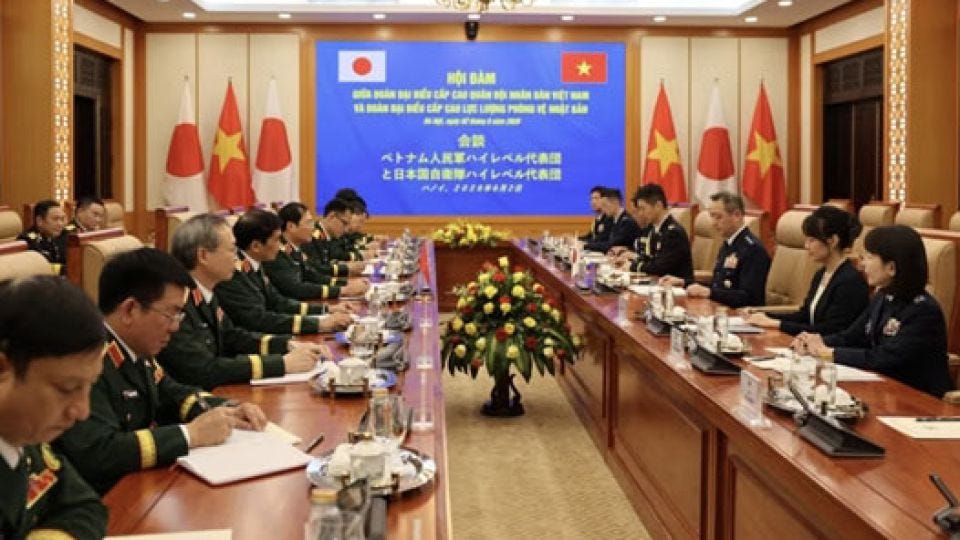
In early June, General Uchikura Hiroaki, Japan’s joint staff chief, met in Hanoi with Deputy Prime Minister and Minister of National Defense Phan Van Giang and General Staff Chief Nguyen Tan Cuong to strengthen bilateral defense and security ties, the latest of continuing high-level exchanges between political leaders, prime ministers, foreign ministers, and defense officials of Vietnam and Japan.
These meetings have become regular, predictable, and largely free of the historical tensions or territorial disputes that complicate many relationships in East Asia. Driven partly by supply-chain diversification and “China Plus One” strategies, Japanese investment has expanded into advanced manufacturing, semiconductors, digital technology, renewable energy, and critical minerals with an objective not of balancing China through military alignment, but of raising the costs of coercion by strengthening Vietnam’s own capabilities and improving regional resilience. This approach remains fully consistent with Vietnam’s long-standing policy of strategic autonomy and its “Four No’s” defense doctrine.
In addition, Vietnam has become an increasingly important production base for Japanese companies seeking resilience in an uncertain geopolitical environment and rising hostility to Japanese interests in China. Japan’s average annual FDI in Vietnam hovers around US$6.5 to US$7 billion, with cumulative investments nearing US$78.6 billion. In contrast, Japan’s FDI in China, while still commanding a much larger historical cumulative base and seeing occasional yearly spikes, has cooled on average due to supply-chain diversification and geopolitical tensions.
Economic cooperation now extends beyond trade and investment to economic security, technological innovation, and supply-chain resilience. Both countries increasingly view economic competitiveness as an integral component of national security.
Developing Trust
Japan has earned Hanoi’s confidence by consistently respecting Vietnam’s independent foreign policy while providing long-term political and economic support without demanding strategic alignment. The two countries also cooperate closely through ASEAN, the East Asia Summit, ADMM-Plus, APEC, CPTPP, and the United Nations. Both consistently affirm the importance of international law—particularly the United Nations Convention on the Law of the Sea—as the foundation for maintaining peace, stability, and freedom of navigation in the South China Sea.
While Tokyo openly advances its vision of a Free and Open Indo-Pacific, Hanoi continues to pursue strategic autonomy through diversified partnerships. These approaches are not contradictory. Rather, they are complementary, allowing both countries to deepen cooperation without forcing Vietnam into bloc politics.
The exchanges are an example of how the Indo-Pacific region is increasingly shaped not by rigid military blocs but by flexible partnerships among states seeking greater security without sacrificing strategic autonomy. In an era of intensifying great-power competition, middle powers are finding new ways to strengthen resilience while avoiding the constraints of formal alliances. Few relationships illustrate this better than the growing partnership between Vietnam and Japan.
Over the past five decades of diplomatic relations, Hanoi and Tokyo have transformed a once-cautious post-war relationship into one of Asia’s most stable and consequential strategic partnerships. What began as economic engagement following Vietnam’s Đổi Mới reforms in 1986 has evolved into a Comprehensive Strategic Partnership encompassing diplomacy, trade, infrastructure, technology, and defense. Yet neither country seeks a military alliance. Instead, both have deliberately chosen a model of deep cooperation that preserves policy independence while advancing shared strategic interests. That balance explains both the durability and the growing importance of the relationship.
Political Trust as Strategic Capital
Trust has become the partnership’s most valuable asset, with economic ties remaining the partnership’s strongest pillar. For decades, Japan has been Vietnam’s leading provider of official development assistance, financing ports, highways, power generation, urban transport, and industrial infrastructure that supported Vietnam’s modernization. Today, the relationship has moved well beyond the traditional donor-recipient framework.
The most significant transformation has been in security cooperation, with military dialogues, cybersecurity cooperation, maritime domain awareness, coast guard coordination, humanitarian assistance, disaster relief, and peacekeeping becoming regular components of the bilateral agenda. Through its Official Security Assistance program, Japan has strengthened Vietnam’s maritime capabilities by supporting surveillance, training, and transfers of non-lethal equipment.
Yet strategic autonomy requires more than diplomatic flexibility. It also depends on the institutional strength, transparency, public trust, and a clearly articulated set of principles and shared values that allow a country to sustain independent decision-making over the long term. For Vietnam, the challenge is not merely maintaining balanced relations among major powers, but ensuring that its strategic autonomy is supported by stronger institutions, greater societal trust, and clearer principles guiding its international engagement. In the 21st century, countries do not choose sides only through alliances; they also choose the principles and norms that shape their place in the international order.
Tokyo understands Vietnam’s strategic constraints. Hanoi, in turn, values Japan’s technological capabilities, institutional reliability, and long-term commitment. The result is a partnership that deepens steadily without transforming into an exclusive security coalition.
Different Paths, Shared Goals
A comparison with Japan’s relationship with the Philippines highlights the flexibility of Tokyo’s regional strategy. The Philippines, backed by its alliance with the United States, has pursued deeper military interoperability with Japan through reciprocal access arrangements, logistics agreements, expanded joint exercises, and major defense equipment transfers. Vietnam has chosen a different path—one centered on capacity-building, institutional cooperation, and greater self-reliance rather than alliance integration.
Neither model is inherently superior. Each reflects different historical experiences, domestic political choices, and strategic circumstances. Japan’s success lies not in exporting a single security model but in adapting its partnerships to the priorities of each country.
The Vietnam-Japan relationship demonstrates that strategic trust does not require a formal alliance. As great-power competition intensifies, middle powers are becoming increasingly important in shaping the regional order. By combining economic interdependence, technological cooperation, and measured security engagement, Vietnam and Japan have built a partnership that strengthens resilience while preserving sovereign decision-making.
In that evolving landscape, the Vietnam-Japan partnership offers a practical model for the Indo-Pacific: stable, adaptable, and rooted in mutual respect. It demonstrates that strategic autonomy does not require strategic ambiguity, and that middle powers can shape the regional order not through alliances alone, but through partnerships built on trust, resilience, and shared principles.
Khanh Vu Duc is a frequent contributor to Asia Sentinel. He is a lawyer and part-time law professor at the University of Ottawa who researches on Vietnamese politics, international relations, and international law.